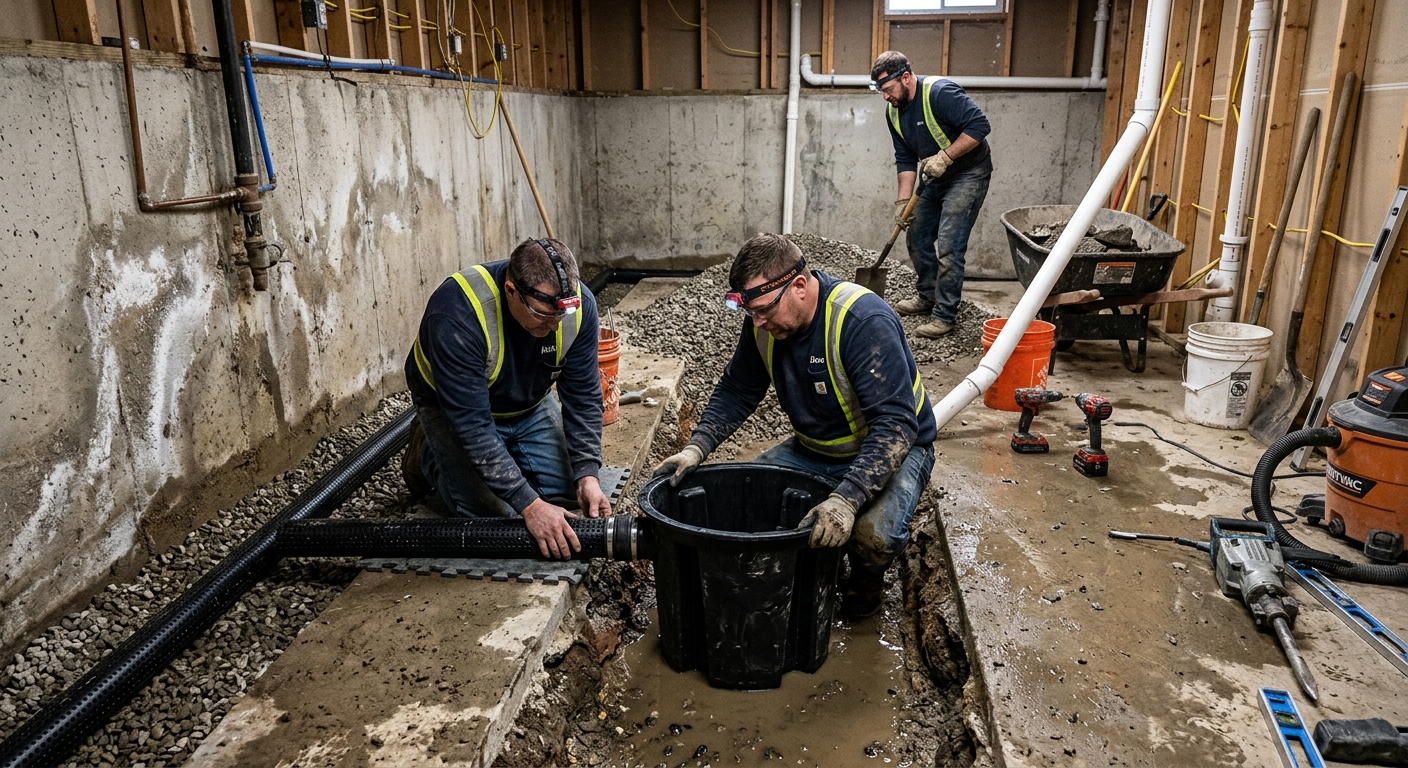
Basement waterproofing options and costs in Strathcona
In Strathcona, homeowners typically choose basement waterproofing based on where the water is entering and how hard it is to relieve pressure against the foundation. With a population of 12,585 (Statistics Canada, 2021 Census), neighbourhoods throughout the community see a steady mix of older houses and mid-century builds—exactly the stock where original tar-and-paper style waterproofing and early drainage systems are most often failing. When perimeter weeping tile is undersized, broken, or simply past its service life, water finds the easiest path into poured concrete or block foundations through cracks, mortar joints, and footing lines.
In the Lower Mainland–Southwest, pricing is shaped less by extreme soil expansion and more by persistent saturation, high groundwater pressures, and drainage that can’t keep up during prolonged coastal rainfall. Wet, mild winters and frequent freeze-thaw cycles also widen existing cracks and joints, so repairs that look “fine” in dry weather can reappear after a heavy week. Labour rates, tight urban lot access, and occasional rocky sections that require mechanical breaking during excavation can push exterior work toward the top end of the market.
Trade demand tends to spike in areas like Strathcona Village and the older blocks closer to the downtown/rail corridor, where mature landscaping and established driveways make exterior excavation more disruptive—and where interior retrofits are common while homeowners plan longer-term exterior repairs. Use the comparison below to understand how different systems address the water problem, and what range you can realistically expect in Strathcona.
| Method |
What It Addresses |
Disruption Level |
Durability |
Price Range |
| Exterior excavation + new membrane + drainage tile |
Primary source water entry by stopping hydrostatic pressure and rebuilding perimeter drainage |
High (excavation around foundation, landscaping/driveway impacts, backfill and restoration) |
High (often the most comprehensive long-term fix when properly detailed) |
$15,000–$30,000 |
| Interior perimeter drain channel + sump pit |
Water once it enters by collecting it at the interior perimeter and pumping it away |
Medium (minor floor/finish cuts, sump placement) |
Medium-High (depends on ongoing drainage capacity and pump maintenance) |
$8,000–$18,000 |
| Foundation crack injection (epoxy or polyurethane) |
Crack sealing: epoxy for non-moving cracks; polyurethane for active leaks and moisture paths |
Low (access drilling at crack line; localized patching) |
Medium (good results when crack type and movement are correctly matched) |
$500–$2,000 |
| Sump pump installation (primary + battery backup) |
Manages collected groundwater and reduces flood risk during heavy rain or power interruptions |
Low-Medium (pit excavation/installation and discharge line routing) |
Medium-High (backup improves reliability in storm events) |
$1,000–$5,000 |
| Window well drain installation |
Surface water entry near egress windows (grading, seepage, and splashback control) |
Low-Medium (localized excavation and rework around window well) |
Medium (depends on correct grading and downspout management) |
$800–$2,500 |
| Lot re-grading / downspout extension |
Redirects water away from foundation, reducing volume that reaches weeping tile and wall interfaces |
Low-Medium (surface work; may require minor landscaping restoration) |
Low-Medium (best as part of a system, not a stand-alone cure for hydrostatic pressure) |
$2,000–$8,000 |
Prices are estimates only and vary by project scope, site access and material selection.
What affects the price of waterproofing in Strathcona
In the Lower Mainland–Southwest, two quotes for what sounds like the “same” waterproofing job can differ by 30–50% because contractors price the site reality, not the brochure. In British Columbia, the three biggest separation points from the national average are soil/water behaviour, water table pressure, and freeze-thaw stress. Where clay-heavy soils can create dramatic seasonal swelling in other parts of Canada, Lower Mainland soil issues more often show up as prolonged saturation and drainage that struggles to keep up. That said, local saturation still increases hydrostatic pressure against foundation walls—so the need for drainage upgrades or interior pumping becomes more frequent.
Freeze-thaw matters too: wet winters followed by cooler snaps expand and contract cracks and joints, turning small defects into active leaks over time. And in coastal BC, intense, prolonged rainfall saturates backfill quickly when original drainage fails, which can raise the amount of labour needed to excavate, expose, and rebuild a perimeter system. In older Strathcona homes (often with mature landscaping), you also see more failed original weeping tile (sometimes decades-old), plus deteriorated discharge routes that limit sump capacity.
Concrete examples: if your foundation is on a tight lot with a deck or driveway right against the wall, exterior excavation can require mechanical breaking and additional restoration—pushing exterior projects toward the $15,000–$30,000 band. If the leak is mainly through a few known crack lines and you can access them cleanly, crack injection may keep you closer to the $500–$2,000 repair range. Conversely, a basement that’s periodically wet after storms often needs both a perimeter drain and sump, bringing the project into the $8,000–$18,000 interior system band.
| Price Factor |
Why It Matters |
Cost Impact |
| Interior vs. exterior approach |
Interior work manages water after it enters; exterior work addresses entry and hydrostatic pressure at the source |
Interior often 40–60% less disruptive; exterior can increase costs substantially due to excavation and restoration |
| Foundation type |
Poured concrete, block, stone, and ICF respond differently to pressure, crack movement, and sealing details |
Poured concrete crack injection may be efficient; block/stone often needs additional interior drainage measures |
| Soil type |
Soil behaviour affects lateral pressure and how quickly drainage systems can draw water down |
Clay/silty backfills tend to hold water longer than sands, increasing pump run time and drainage scope |
| Crack type and length |
Hairline non-moving cracks seal differently than structural horizontal or step cracks |
Structural or widespread cracking can require more injection, wider prep, or engineering review |
| Sump pump backup system |
Power reliability matters during storm periods and spring flooding |
Battery backup adds cost but reduces risk during outages; can move the job within the $1,000–$5,000 range |
| Access |
Landscaping, decks, patios, and driveways can require removal to excavate and waterproof effectively |
Limited access increases labour and restoration, especially for full exterior systems |
| Weeping tile age |
Original tile (60+ years in many older homes) is often corroded, collapsed, or disconnected |
If replacement is needed, costs climb toward full interior/exterior drainage system pricing |
| Mould or efflorescence remediation required before sealing |
Active moisture causes salt deposits and microbial growth; sealing over contaminated surfaces can fail |
Often adds prep time and remediation steps before any waterproofing membrane or coating |
Permits & regulations in British Columbia
In British Columbia, foundation excavation, structural crack repair, and changes to lot drainage typically require a building permit. If a sump pump discharge is connected in a way that affects storm or sanitary service (for example, tying into municipal systems), municipal approval is commonly required. For structural crack repair—especially horizontal cracks in block walls or major step cracks—a structural engineer’s assessment is often needed to confirm whether underpinning or other structural work is required before waterproofing can proceed.
Step-by-step, here’s how a homeowner in Strathcona should verify a contractor’s credentials and compliance. First, ask the contractor for their written permit plan (or who will pull permits, if applicable) and confirm what work they will not start before approvals are in place. Second, check the contractor’s licensing/registration status using the appropriate online registry for BC (the contractor should provide their business number and license details on request). Third, request a certificate of insurance showing general liability coverage with an expiry date and confirm the homeowners are listed as additional insured where offered.
Fourth, confirm WSIB/WCB coverage (workers’ compensation) and ask for proof—don’t rely on verbal confirmation. Finally, if structural repairs are proposed, confirm they can coordinate engineering support and that their scope differentiates “waterproofing” from “structural repair.”
Interior vs exterior waterproofing — what does Strathcona need?
Exterior waterproofing is the “source control” option. It involves full excavation around the foundation, installing a proper waterproofing membrane, restoring or replacing perimeter drainage (weeping tile), and then backfilling and re-grading so surface water can’t overwhelm the system. In Strathcona and the wider Lower Mainland–Southwest, this approach is most effective when the basement is repeatedly wet during coastal rainfall events, when original drainage has failed, or when you’re dealing with hydrostatic pressure that keeps finding weak points along the footing line.
Interior waterproofing focuses on what’s happening after water enters. It typically includes an interior perimeter drain channel, sump pit, and sump pump (often with battery backup). This is less invasive and can be a practical fit when excavation is constrained by decks, landscaping, or hardscapes. However, it does not stop hydrostatic pressure against the wall itself—so it relies on a properly sized drain and a reliable pump system to prevent accumulation.
How to decide in Strathcona: poured concrete foundations often respond well to targeted crack injection as part of a broader plan, while block foundations commonly benefit from interior drainage as a complement because water can travel through voids, joints, and wall interfaces. For spring storm risk and the likelihood of power interruptions, battery backup can be worth the added cost—particularly when you’ve had basement flooding during heavy rain.
Example: if your main issue is active leaking through a few accessible cracks, crack injection may land closer to the $500–$2,000 band, and an interior perimeter drain could keep you in the $8,000–$18,000 range. If the exterior drainage is fully failed and the wall is under persistent pressure, spending in the $15,000–$30,000 exterior band is often justified because it addresses the entry mechanism rather than continuously pumping water.
| Method |
Best For |
Addresses Source? |
Disruption |
Lifespan |
Price Band |
| Full exterior excavation + membrane |
Recurring wet basements, confirmed failed exterior drainage, heavy hydrostatic conditions |
Yes |
High |
Long (when drainage outlets and membrane detailing are correct) |
$15,000–$30,000 |
| Interior French drain + sump system |
Leaking basements where exterior access is limited or immediate mitigation is needed |
No (manages water after entry) |
Medium |
Medium-Long with proper pump sizing and maintenance |
$8,000–$18,000 |
| Crack injection — epoxy (structural) |
Non-moving cracks with good access and no ongoing active seepage |
Partial (seals the crack path but not the overall pressure mechanism) |
Low |
Medium-Long if the crack is truly non-moving |
$500–$2,000 |
| Crack injection — polyurethane (active leak) |
Active seepage, damp cracks, and areas where water is still moving |
Partial (targets the leak path while the drainage/pump handles pressure) |
Low |
Medium (often best paired with interior drainage) |
$800–$2,400 |
| Interior drain channel only (no sump) |
Light dampness, manageable seepage, or temporary stabilization before a larger project |
No |
Medium |
Short-Medium if water volumes rise in heavy storms |
$4,000–$10,000 |
| Re-grading + downspout extensions |
Surface water management where water is clearly redirectable |
Partially (reduces inflow volume) |
Low-Medium |
Medium (depends on continued maintenance and drainage capacity) |
$2,000–$8,000 |
How to choose a waterproofing contractor in Strathcona
Choosing the right contractor in Strathcona starts with proving they can legally and safely do the work in British Columbia—and that they design solutions, not just install parts. First, verify licensing/registration for the type of construction work being performed. Ask for their certificate of general liability insurance and confirm coverage amounts, expiry date, and whether your address is covered as a certificate holder. Next, confirm WSIB/WCB coverage (workers’ compensation) with proof; a waterproofing crew working without it is a risk you don’t want on your property.
Then request 2–3 itemised written quotes. You want line-by-line breakdowns for labour and materials (membrane, drainage components, sump/piping, disposal, patching/restoration), not a single lump sum. Read the scope carefully: is permit pulling included (or explicitly not included)? Is soil disposal included or is it an added charge? Are pump discharge routes described, and does the proposal address battery backup for storm resiliency? Also ask what exclusions apply—common ones are damage to existing services, landscaping restoration limits, and unforeseen soft spots during excavation.
Warranty matters. Ask for the workmanship warranty length, product/manufacturer warranty details, and whether warranties are transferable to future owners. Keep payment practical: never pay more than about 10–15% upfront, and use a holdback until you’ve confirmed performance and completion details. Finally, insist on a written start date and an estimated completion timeline tied to weather and excavation/restoration sequencing.
- Ask what waterproofing system is recommended after a site assessment, not after a phone call.
- Request itemised labour/materials and confirm disposal and restoration inclusions.
- Confirm whether they will pull permits and who is responsible for inspections.
- Require proof of general liability insurance (certificate of insurance) and confirm policy expiry.
- Provide WSIB/WCB coverage proof for the crew.
- Ensure product details are specific (membrane type, drainage board, pipe sizes, filter fabric).
- Verify crack injection method matches crack behaviour (epoxy vs polyurethane) and why.
- Confirm sump system design: pit size, pump capacity, discharge line route, and anti-backflow.
- Ask about battery backup or other redundancy given spring storm risk.
- Get the warranty in writing, including workmanship and product coverage, and whether it transfers.
- Agree on a payment schedule with limited upfront payment and holdback at milestones.
- Get start date and completion estimate in writing, plus how weather delays are handled.
Red flags in Strathcona: a contractor who refuses to document their scope and exclusions; vague pricing that doesn’t separate exterior excavation vs. restoration; promises of a “one-size-fits-all” membrane without diagnosing drainage failures; no proof of WSIB/WCB or insurance; and a proposal that recommends a sump “only” without discussing whether exterior drainage and grading reductions are also needed.
Frequently asked questions — waterproofing in Strathcona
How much does basement waterproofing cost in Strathcona?
In Strathcona and the Lower Mainland–Southwest, waterproofing cost depends mainly on whether you’re addressing water at the source (exterior) or managing it after it enters (interior). For many homes, interior waterproofing and new weeping tile systems typically fall around $8,000–$18,000 when a perimeter drain, sump pit, and pumping are included. If the exterior perimeter excavation is required—especially when original drainage has failed—budget toward $15,000–$30,000. Smaller repairs like foundation crack work may start much lower, often within $500–$2,000, but only when crack type and movement are correctly matched. (Statistics Canada, 2021 Census) also helps frame why older housing stock in the area can drive repeat repair demand during wet seasons.
Interior vs exterior waterproofing — which is better?
Neither is automatically “better” in British Columbia; the right choice is the one that fits the water-entry mechanism. Exterior waterproofing is best when you’re seeing persistent wetness after prolonged rainfall, when perimeter drainage is failing, or when hydrostatic pressure is repeatedly overwhelming the foundation. Interior waterproofing is often the practical choice when excavation access is limited or when you need faster mitigation without major landscaping disruption. In Strathcona, poured-concrete basements may seal well with crack injection as part of the plan, while block foundations often benefit from interior drainage as a complement. If you’re mainly experiencing dampness around cracks, an interior plan may keep you closer to the $8,000–$18,000 range; if the exterior system is truly broken, spending within $15,000–$30,000 can be justified because it tackles the source rather than continuously managing water after entry.
Why is my basement leaking in Strathcona?
Basement leaks in Strathcona are commonly tied to how water behaves around the foundation—especially during long coastal rainfall stretches. When original weeping tile is undersized, disconnected, corroded, or simply beyond its service life, groundwater and surface water build up and find weak points through cracks, mortar joints, and footing interfaces. The Lower Mainland–Southwest also has wet, mild winters with frequent freeze-thaw cycles, which can widen existing cracks and joints and restart seepage after it temporarily subsides. In older neighbourhoods with mature landscaping, downspouts and grading may also direct runoff toward the foundation instead of away. Another common cause is sump capacity being insufficient or nonexistent, so water enters and isn’t effectively removed. A site inspection typically identifies whether you need crack injection alone, an interior perimeter drain with sump, or exterior drainage upgrades.
How do I know if a foundation crack is serious?
Not every crack is structural, but in Strathcona you should treat certain crack patterns more seriously—especially when they align with active moisture. A hairline crack that stays dry and doesn’t change is often less concerning, and in some cases it’s suitable for epoxy injection. Serious signs include horizontal cracks, step cracks in block walls, cracks that coincide with visible dampness or efflorescence (white salt staining), and cracks that widen after storms or during freeze-thaw. If the crack is actively leaking, polyurethane injection is usually considered because it can handle water movement. The key is matching repair method to crack behaviour. For major or suspected structural movement, a structural engineer review is commonly part of the process in British Columbia before waterproofing proceeds.
How much does foundation crack repair cost in Strathcona?
Foundation crack repair cost in Strathcona depends on crack length, access, whether the crack is active or moving, and how much prep is required. Many homeowners find pricing starts in the $500–$2,000 range for localized injection work when the number of ports and the crack extent are limited and access is straightforward. If there’s broader cracking or multiple crack lines, cost can rise above that range—particularly when you need both appropriate injection material selection and additional remediation for moisture-caused surface issues like efflorescence or mould. Active seepage typically requires polyurethane (often priced higher than epoxy-only repairs), and structural indications can require engineering assessment before the correct repair strategy is finalized.
Do I need a sump pump in Strathcona?
A sump pump isn’t always required, but in Strathcona it’s frequently recommended when water volumes during wet seasons are high or when interior drainage systems are installed to collect groundwater. The Lower Mainland–Southwest climate can keep soils saturated for long periods, and that can mean intermittent or recurring hydrostatic pressure. If an interior perimeter drain is collecting water, the sump is what keeps the collected water from backing up and flooding the basement. Because British Columbia can see power interruptions during heavy spring rain and storm events, many homeowners choose primary pumping plus battery backup for reliability. Pricing for sump pump installations commonly sits in the $1,000–$5,000 range depending on discharge configuration and whether backup is included. The best way to decide is an inspection that confirms whether you’re dealing with active seepage, how the drain system will be sized, and where the discharge can safely go.