Basement waterproofing options and costs in Logan Lake
Logan Lake homeowners usually start waterproofing planning once they notice dampness along the slab edge, a musty smell, or water staining after spring melt. In Logan Lake, this is especially common because 58.2% of homes were built before 1981—older waterproofing assemblies are more likely to have failing original systems (and deteriorated weeping tile), so problems that look “minor” can become active seepage after freeze-thaw seasons. With 2,255 people in town (Statistics Canada, 2021 Census), local trades are responsive, but scheduling can still be tight when multiple contractors are booked for spring work across the Thompson–Okanagan.
The Thompson–Okanagan’s semi-arid valleys and variable soils mean site conditions drive cost more than brochures. In some lots, clay pockets or dense silts hold water longer against foundation walls, increasing hydrostatic pressure and requiring more comprehensive drainage and sealing. In other areas with more freely draining material, exterior excavation and drainage can “fix the source” more efficiently. Where foundation depth is deeper or landscaping and concrete are in the way, excavation and reinstatement also raise labour and disposal costs.
Neighbourhood demand is typically highest in older residential areas with lots that have mature landscaping and older drainage patterns—many of these homes show recurring dampness near cold joints and slab edges. Once you know whether you need to address the source outside, manage water inside, or repair the wall itself, you can compare the methods in the table below.
| Method |
What It Addresses |
Disruption Level |
Durability |
Price Range |
| Exterior excavation + new membrane + drainage tile |
Source water entry; replaces failed membrane and re-establishes drainage path and weeping tile |
High (excavation, removal, backfill, reinstatement) |
Long-term when drainage is correctly sized to site soils and weeping tile routing |
$18,000–$40,000 |
| Interior perimeter drain channel + sump pit |
Water that enters through slab edge and cracks; captures and routes to sump pump |
Medium (floor/edge cuts, chipping, mechanical install) |
Very good for symptom control; best paired with exterior drainage when pressure is high |
$9,000–$22,000 |
| Foundation crack injection (epoxy or polyurethane) |
Cracks in poured concrete or block; epoxy for dry/structurally bonded cracks, polyurethane for active leaks |
Low to medium (small access points; minimal demolition) |
Can be excellent on the right crack type and preparation; not a substitute if drainage fails |
$800–$3,500 |
| Sump pump installation (primary + battery backup) |
Reduces risk during power interruptions; moves collected water away from foundation |
Low to medium (pit excavation, plumbing/electrical work) |
Reliable when combined with a properly sized interior or exterior drainage plan |
$2,500–$5,500 |
| Window well drain installation |
Rain/snowmelt water around basement windows; stops wet window wells and seepage |
Low to medium (excavation around wells; rework landscaping as needed) |
Good for localized sources; depends on correct discharge route and grading |
$1,800–$4,200 |
| Lot re-grading / downspout extension |
Reduces surface runoff against foundation; lowers water load before it becomes seepage |
Low (minor landscaping/grading; careful reinstatement) |
Moderate; helps a lot, but won’t fix a failed below-grade drainage system alone |
$1,000–$3,000 |
Prices are estimates only and vary by project scope, site access and material selection.
What affects the price of waterproofing in Logan Lake
In Logan Lake and the wider Thompson–Okanagan, two homeowners can receive quotes for “the same” basement waterproofing and still see a 30–50% difference once the contractor factors in the site. That spread is common across British Columbia because labour rates, disposal costs, excavation constraints, and the ability to properly daylight drainage systems vary from lot to lot—and because freeze-thaw conditions punish repairs that don’t remove hydrostatic pressure.
The three biggest cost drivers that separate regional pricing from the national average are soil type, water table and freeze-thaw. Clay-heavy or silt-prone pockets can hold water against foundation walls longer, increasing lateral pressure and enlarging cracks over successive seasons. In parts of Thompson–Okanagan, local water management after spring snowmelt can require more drainage capacity and more pipe routing than a “standard” design. Freeze-thaw cycles also widen hairline gaps and joints; that turns a slow dampness problem into active seepage, which then demands additional crack preparation and sealing.
Here are a few concrete Logan Lake examples that move the price up or down. If your home has older weeping tile (often original from the build era—especially in houses built before 1981), the contractor may find sections crushed or clogged and will price more excavation and daylighting. If your foundation is a full basement with deeper excavation, the work can land near the $18,000–$40,000 exterior range; if access is tight and only an interior solution is feasible, many projects sit closer to $9,000–$22,000. If mould or heavy efflorescence is present, remediation steps add time before membranes or sealants can be applied reliably.
| Price Factor |
Why It Matters |
Cost Impact |
| Interior vs. exterior approach — interior is less disruptive but addresses symptoms |
Exterior targets the source; interior manages water after entry |
Interior often 30–55% less disruptive, but may cost more long-term if pressure continues |
| Foundation type — poured concrete vs. block vs. stone vs. ICF |
Different wall materials crack and seal differently; repairs require different methods |
Concrete may respond well to injection; block often needs interior drainage support |
| Soil type — clay expands more than sand, adding pressure |
Clay pockets hold moisture and exert greater lateral pressure during freeze-thaw |
Higher probability of larger cracks and greater drainage scope |
| Crack type and length — hairline vs. structural horizontal cracks |
Structural movement changes what’s repairable by sealant injection alone |
Horizontal/structural cracks may trigger engineering and underpinning costs |
| Sump pump backup system — battery or water-powered backup needed |
Backup reduces freeze-summer risk during power interruptions |
Adds cost but protects the investment; commonly recommended in spring |
| Access — landscaping, decks, or driveways must be removed for exterior |
Excavation on tight lots can require shoring and more restoration |
Can swing exterior projects upward significantly |
| Weeping tile age — original tile (60+ years) may be completely failed |
Failed tile shifts water pathways and increases seepage volume |
May turn a “targeted” job into full perimeter drainage replacement |
| Mould or efflorescence remediation required before sealing |
Active salts and contamination can prevent proper adhesion of sealants |
Adds labour and drying/verification time before waterproofing proceeds |
Permits & regulations in British Columbia
In British Columbia, foundation-related work often falls under the “municipal building and safety” umbrella, meaning you should expect permits for key waterproofing activities—especially where you are altering structural components or changing drainage connections. In practice, foundation excavation, structural crack repair, and changes to lot drainage (for example, work that affects how runoff is redirected) typically require a permit. If your plan includes connecting a sump discharge to storm or sanitary services, you generally need municipal approval before any tie-in.
For structural crack repair—particularly horizontal cracks in block walls or major step cracks—homeowners should plan on a structural engineer’s assessment to confirm whether underpinning or other structural remedies are needed. That matters because waterproofing products won’t “fix” movement; they only address water.
To verify a contractor in Logan Lake, start by checking the correct licence status through the provincial licensing registry for the trade(s) they perform. Then request a certificate of liability insurance naming you as the interested party (or showing appropriate coverage limits). Ask for proof of WSIB/WCB coverage. For clearance, you should be able to receive a clearance letter or equivalent documentation from the contractor’s insurance/workplace account. Finally, if structural repairs are contemplated, confirm they have documented engineering support (either in-house or via a partner engineer).
Interior vs exterior waterproofing — what does Logan Lake need?
Interior and exterior waterproofing are designed for different realities. Exterior waterproofing means full excavation along the foundation, installation of a new membrane, new drainage tile/weeping tile, proper backfill, and reinstatement. It addresses the source of water entry and reduces hydrostatic pressure, but it’s significantly more expensive and disruptive because you’re removing landscaping and sometimes concrete to access the foundation.
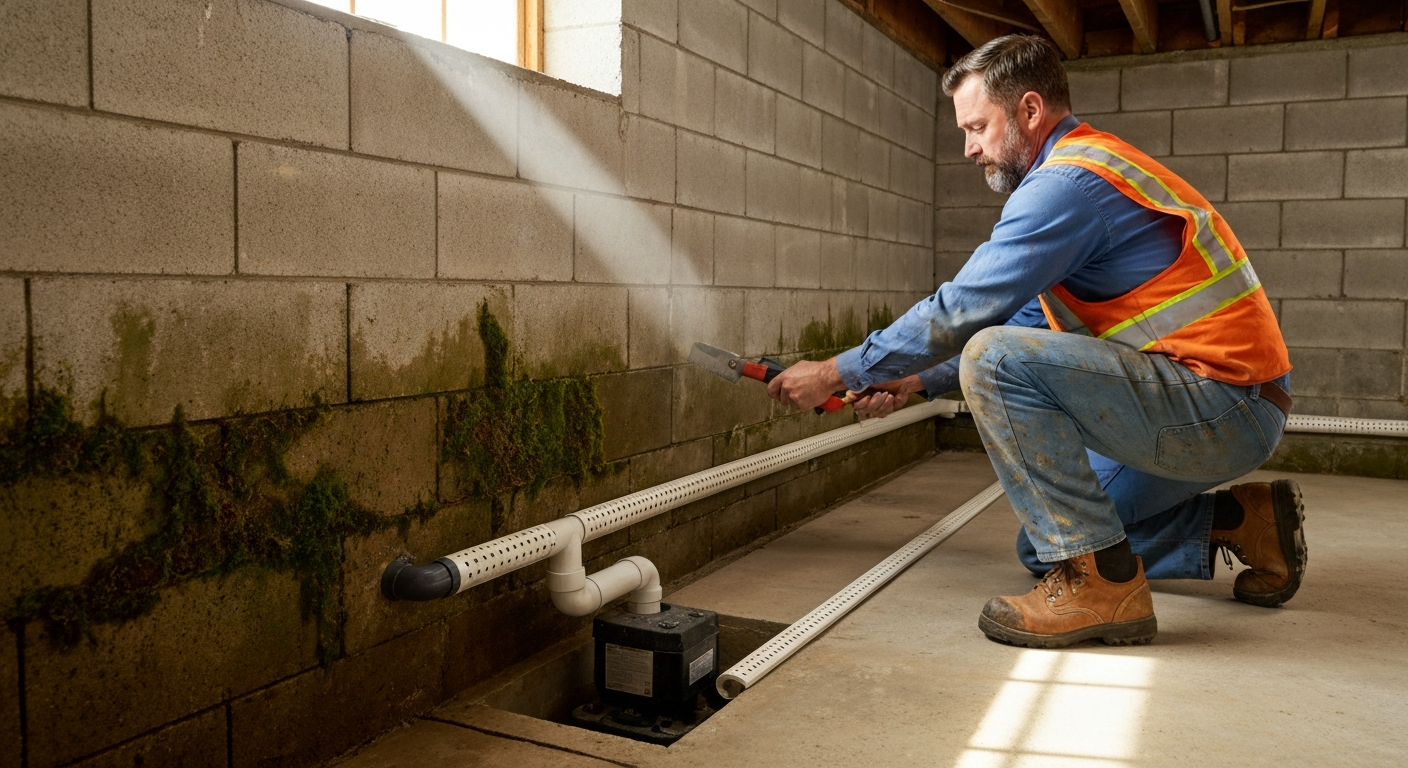
Interior waterproofing—typically a perimeter drain channel, sump pit, and sump pump—captures water after it has entered and routes it away from your foundation. It’s less invasive and often the practical choice when excavation access is difficult. However, interior systems do not stop water pressure from building against the wall itself. In Thompson–Okanagan conditions, that matters because freeze-thaw can widen existing cracks, turning small seepage into recurring wet seasons.
For Logan Lake, the right choice depends on foundation type and how the site holds water. Poured concrete walls often respond well to crack injection when the crack type is suitable (dry/structurally bonded cracks for epoxy; active leaks for polyurethane) and when drainage is managed. Block foundations frequently benefit from interior drainage as a complement, since block joints and mortar bedding can be harder to fully seal from the outside depending on excavation access. Because spring in British Columbia can bring power interruptions during high-usage periods, sump pump projects often justify a backup system (battery or water-powered) so the system can keep running if the power goes out.
A typical justification example: an exterior project can sit in the $18,000–$40,000 range, while a well-installed interior perimeter drain and sump often falls in $9,000–$22,000. If your soil holds water (clay pockets/silt) and the weeping tile is failing, the exterior approach may prevent repeated crack “re-sealing” and protect the long-term condition of the walls—making the higher price worth it.
| Method |
Best For |
Addresses Source? |
Disruption |
Lifespan |
Price Band |
| Full exterior excavation + membrane |
When you have failing below-grade drainage, recurring seepage, and you can excavate safely |
Yes—directly reduces water entry by restoring the barrier and drainage |
High |
Long-term (often the most durable outcome when drainage is correctly designed) |
$18,000–$40,000 |
| Interior French drain + sump system |
When exterior access is limited or you want to manage water entry without full excavation |
No—manages water after it enters |
Medium |
Very good with proper pump sizing and reliable discharge |
$9,000–$22,000 |
| Crack injection — epoxy (structural) |
Dry or stabilized cracks in poured concrete where the crack is not actively moving |
Partial—stops water through the crack if it’s not under ongoing pressure issues |
Low to medium |
Good when prep, crack type, and dryness criteria are met |
$800–$3,500 |
| Crack injection — polyurethane (active leak) |
Active seepage cracks where water is still pushing through |
Partial—stops the leak path but should be paired with drainage if needed |
Low to medium |
Good to very good when correctly matched to active water conditions |
$900–$3,800 |
| Interior drain channel only (no sump) |
Light seepage where water can be safely handled without a sump |
No—redirects water internally but depends on conditions |
Medium |
Variable; risk increases during heavy melt events |
$6,500–$14,000 |
| Re-grading + downspout extensions |
Surface runoff issues and wet window well corners after rain/snowmelt |
No—addresses surface water before it becomes a seepage problem |
Low |
Moderate; effectiveness depends on maintaining grading and drains |
$1,000–$3,000 |
How to choose a waterproofing contractor in Logan Lake
Choosing the right contractor in Logan Lake comes down to verification and scope clarity. First, confirm the contractor is properly licensed in British Columbia for the work they perform, and request their certificate of liability insurance so you know you’re covered if there’s damage to your home during excavation or concrete work. Next, ask for proof of WSIB/WCB coverage. You can verify by checking the contractor’s online standing (where available), and by requesting documentation directly—then match the dates and coverage details to the project period.
Get 2–3 itemised written quotes rather than a lump-sum: you want a labour and materials breakdown showing what’s included (excavation length, membrane type, drainage pipe size, pumping components, disposal, and reinstatement). Read the exclusions carefully—many disputes come from not understanding whether permit pulling, saw-cutting, concrete removal, or backfill compaction testing are included.
For warranty, ask for two parts: the workmanship warranty length (and whether it’s transferable if you sell) and the product/manufacturer warranty for membranes, drainage components, and sealants. Ask how issues are handled if there’s a repeat leak after a spring freeze-thaw cycle.
On payment, keep it conservative: never pay more than 10–15% upfront, and hold back a portion until the job is complete and cleaned up. Finally, insist on a start date and completion estimate in writing so seasonal scheduling in the Thompson–Okanagan doesn’t turn into months of uncertainty.
- Ask what site investigation they do first (moisture mapping, inspection of old weeping tile, crack profiling).
- Confirm the discharge location for sump water (clear daylight route or approved connection).
- Get confirmation on whether they include engineering support when cracks suggest movement.
- Require an itemised scope: excavation length/height, membrane system, pipe size, slope, and discharge details.
- Ask what they do about mould/efflorescence before sealing.
- Check that disposal and backfill compaction are included (not “allowance only”).
- Clarify reinstatement: topsoil, sod, gravel, concrete/asphalt patches, and window well framing.
- Request the exact warranty terms in writing (workmanship vs product).
- Confirm pump specs if included (horsepower/flow rate) and the backup plan (battery or water-powered).
- Verify permit responsibility: who pulls the permit and what’s the lead time?
- Use a payment schedule you can live with: small deposit, holdback, no large milestone payments.
- Ask for a moisture plan after completion (drying time, monitoring, and documentation).
Red flags in Logan Lake: a quote that’s only a “seal everything” pitch with no crack type assessment; no mention of backup power when recommending sump pumps; vague wording like “as required” without allowances for excavation/reinstatement; refusing to provide insurance/clearance or not showing WSIB/WCB; and warranties that don’t clearly separate workmanship from product coverage.
Frequently asked questions — waterproofing in Logan Lake
Do I need a permit for foundation work in British Columbia?
In British Columbia, you should expect permits for most foundation excavation and structural-affecting work. Typically, foundation excavation, structural crack repair, and changes to lot drainage require a permit, and any connection of sump discharge to municipal services usually needs municipal approval. For Logan Lake homeowners, the practical takeaway is to ask your contractor to confirm what they will pull (and who is responsible) before any excavation begins. If the cracks look structural—such as major step cracking or horizontal cracking—an engineer’s assessment is commonly required to determine whether underpinning is needed, which also impacts permit scope. Always ask for the permit number and inspection milestones in writing.
How long does waterproofing last?
How long waterproofing lasts in Logan Lake depends on whether the job addresses the source of water entry, not just the symptoms. Exterior systems that restore membrane and drainage typically provide the longest protection, especially on older homes where weeping tile and drainage paths fail over time. Interior systems can last many years too, but they manage water after it enters; if hydrostatic pressure remains high, cracks may keep opening and require follow-up crack sealing. With the Thompson–Okanagan freeze-thaw cycle, even small gaps can worsen if drainage isn’t correct. Homeowners often choose exterior work when the soil holds moisture, where pricing commonly sits around $18,000–$40,000. Interior perimeter drainage projects often fall in $9,000–$22,000 and can perform very well when designed and maintained appropriately.
Can I waterproof my basement from the inside only?
Yes, in many Logan Lake cases you can waterproof from the inside only—especially when exterior excavation isn’t feasible due to tight access, mature landscaping, or when the goal is to control water intrusion. Interior perimeter drains, a sump pit, and a sump pump system can capture seepage along slab edges and redirect it away from your foundation. However, interior work generally doesn’t stop hydrostatic pressure against the wall itself. In Thompson–Okanagan sites with clay pockets or dense silt, water pressure can keep driving seepage through joints and cracks, meaning you may still need crack injection and possibly exterior drainage later. If you’re comparing approaches, interior solutions commonly land around $9,000–$22,000, while exterior excavation typically sits higher (often $18,000–$40,000) because it targets the source.
What causes foundation cracks in Logan Lake?
In Logan Lake and the broader Thompson–Okanagan, common causes include freeze-thaw movement and soil expansion, plus aging foundations and drainage problems. Repeated freeze-thaw can widen existing hairline cracks and joints, and where backfill or the surrounding soil retains moisture (for example, clay pockets), lateral pressure can increase against foundation walls. Older housing stock is also a factor: many homes built before 1981 are more likely to have dated waterproofing assemblies and drainage patterns, which can allow more water to contact and stress the foundation over time. Poor lot grading and failing downspouts or weeping tile can also increase the amount of water entering around the foundation perimeter, which worsens movement. If cracks are horizontal or show signs of structural movement, you should request engineering input before relying on injection alone.
How do I compare waterproofing quotes?
To compare quotes in Logan Lake, don’t look only at the bottom-line total—compare the itemised scope and included tasks. Ask for an explanation of the investigation (where the leak is coming from), the method matching the crack type (epoxy vs polyurethane), and the drainage design (pipe routing, slope, and discharge). Confirm whether disposal, backfill compaction, reinstatement (sod/concrete/asphalt patches), and any permit pulling are included. A quote that only says “install membrane” without specifying drainage tile size and discharge plan is hard to compare. Also verify the warranty terms for workmanship and product components separately. As a pricing anchor, exterior excavation projects commonly start around $18,000–$40,000, while interior perimeter drain systems often fall in $9,000–$22,000. If two quotes are far apart, ensure the higher price isn’t just covering more accurate drainage and prep work.
How long does basement waterproofing take in Logan Lake?
Timelines vary by scope, foundation type, access, and whether exterior excavation is required. In general, small interior crack injection jobs can be completed relatively quickly (often within days, depending on preparation and number of ports), while interior perimeter drainage and sump installations usually take longer due to saw-cutting, installing drains, plumbing/electrical, and drying time. Exterior waterproofing can take weeks because excavation, membrane installation, drainage tile placement, backfill compaction, and full reinstatement (landscaping, concrete/asphalt repairs) are all sequential steps. In British Columbia’s Thompson–Okanagan climate, scheduling also matters because spring melt and heavy rain can slow progress and affect backfill and curing. A good contractor will provide a start date and completion estimate in writing and explain what weather conditions could change the schedule.