Basement waterproofing options and costs in Kitimat
Kitimat homeowners usually face waterproofing choices shaped by the North Coast’s wet climate and older housing stock. With 77.9% of homes in the area built before 1981, many basements still rely on aging tar-and-paper style damp-proofing or undersized/failed weeping tile. That matters because when joints open from freeze–thaw, or when perimeter drainage can’t keep up, water finds the path into block and poured concrete foundations—often as seepage, efflorescence, and recurring basement humidity.
In Kitimat, costs tend to land toward the higher end of the spectrum because excavation is deeper to reach footing-grade drainage, wet spoil disposal is harder, and crews often need additional pumping capacity during removal and backfill. Demand is especially strong around the Hazelton/Range area and older pockets near downtown Kitimat, where many properties have mature landscaping and original drainage systems that are now failing after decades of storm-driven saturation. Contractors in these zones also price for redundancy: a perimeter system is only as reliable as the sump pump and discharge routing.
Because of these realities, many basements are best solved with a combination—exterior to stop the source where possible, plus interior drainage where exterior excavation is limited by access, bedrock, or established yards. Use the comparison below to align what you need with what you’ll likely pay in Kitimat’s North Coast market.
| Method |
What It Addresses |
Disruption Level |
Durability |
Price Range |
| Exterior excavation + new membrane + drainage tile |
Stops hydrostatic water entry by replacing exterior waterproofing and upgrading perimeter drainage |
High (excavation, regrading, landscape restoration) |
High (typically longest-lasting when footing-grade drainage is built correctly) |
$9,000–$22,000 |
| Interior perimeter drain channel + sump pit |
Collects seepage after it enters and relieves pressure at the basement floor perimeter |
Medium (interior floor work; minimal landscaping impact) |
High (well-designed systems with discharge redundancy) |
$5,000–$15,000 |
| Foundation crack injection (epoxy or polyurethane) |
Seals cracks based on movement: structural sealing vs active leak control |
Low (drilling/patching, small surface restoration) |
Medium to high (depends on crack type and whether water is continuing) |
$600–$1,800 |
| Sump pump installation (primary + battery backup) |
Keeps water levels under control and maintains function during power interruptions |
Medium (sump pit/grates; limited interior finishing) |
Medium to high (best with backup system and proper discharge) |
$900–$2,500 |
| Window well drain installation |
Prevents water ingress at below-grade window areas (common with storm runoff) |
Low to medium (small excavation around windows) |
Medium (high performance when tied into a working perimeter discharge plan) |
$1,200–$3,000 |
| Lot re-grading / downspout extension |
Redirects surface water away from foundation to reduce loading on drainage systems |
Low (outside work only) |
Medium (supports the waterproofing system; not a full replacement) |
$1,000–$4,000 |
Prices are estimates only and vary by project scope, site access and material selection.
What affects the price of waterproofing in Kitimat
In Kitimat and the broader North Coast, two homes can get meaningfully different quotes for what sounds like the same fix. It’s not unusual to see a 30–50% swing across the North Coast and other parts of British Columbia because waterproofing is a “site-engineered” job: soil, water behaviour, access constraints, and foundation condition dictate labour hours and material quantities.
Three local drivers separate North Coast costs from the national average. First, soil type: clay-heavy soils expand during freeze–thaw and can widen wall cracks over time, while sandier conditions often let water move more predictably. Second, water table: higher or seasonally saturated ground increases hydrostatic pressure, which means stronger drainage and higher pump-duty cycles. Third, freeze–thaw: repeated cycles stress joints and cracks, especially in older foundations where damp-proofing has already degraded. Coastal BC rainfall then saturates backfill quickly when original drainage fails—pushing work toward exterior excavation and/or upgraded interior drainage.
Concrete examples from Kitimat pricing: (1) a basement with failing original weeping tile often shifts costs upward because crews must remove compromised backfill and rebuild perimeter drainage, which can push projects into the $9,000–$22,000 exterior range; (2) an older home that only shows localized seepage at the perimeter may be addressed within the $5,000–$15,000 interior drain/sump band; (3) if landscaping must be removed along the foundation line, restoration labour can add several thousand dollars even when the waterproofing scope is otherwise straightforward. With 64.9% of dwellings being single-detached in the region profile, many lots are accessible enough for exterior work—but excavation depth and wet spoil still keep unit costs higher than drier markets.
| Price Factor |
Why It Matters |
Cost Impact |
| Interior vs. exterior approach — interior is less disruptive but addresses symptoms |
Exterior targets water entry; interior manages water that already gets in |
Interior typically saves on excavation/restoration but can cost more long-term if hydrostatic conditions are not fully relieved |
| Foundation type — poured concrete vs. block vs. stone vs. ICF |
Crack patterns, leak pathways, and how well surfaces accept sealing vary by type |
Poured concrete often pairs better with crack injection; block walls frequently benefit from interior drainage complements |
| Soil type — clay expands more than sand, adding pressure |
Expansion during freeze–thaw can widen cracks and increase lateral stress |
Clay/saturated mixed soils increase drainage scope and pump duty |
| Crack type and length — hairline vs. structural horizontal cracks |
Active leaks and structural movement require different treatments |
Structural cracks can require engineering review and more complex repairs |
| Sump pump backup system — battery or water-powered backup needed |
Reduces failure risk during power interruptions |
Backup adds cost but prevents expensive dry-out/recovery cycles |
| Access — landscaping, decks, or driveways must be removed for exterior |
Exterior work depends on how much must be removed and replaced |
Can increase excavation/restoration labour and disposal requirements |
| Weeping tile age — original tile (60+ years) may be completely failed |
Failed perimeter drainage forces higher hydrostatic pressure |
Often pushes projects toward exterior excavation or major interior drainage upgrades |
| Mould or efflorescence remediation required before sealing |
Sealing over contamination can reduce adhesion and prolong odour/humidity issues |
Cleaning/drying can add time and materials before waterproofing proceeds |
Permits & regulations in British Columbia
In British Columbia, foundation excavation, structural crack repair, and changes to lot drainage typically require a building permit. If your plan includes altering surface grading to redirect runoff, or if the work affects how water is managed around a foundation, a permit is commonly required. Sump pump installations are often treated differently depending on where the discharge goes; connecting into storm or sanitary infrastructure generally needs municipal approval.
For structural crack repair—particularly horizontal cracks in block walls, significant step cracking, or any signs the foundation has shifted—homeowners should expect an engineering assessment to confirm whether underpinning or structural remedial work is needed. As a contractor, I recommend verifying the installer has engineering support available for structural scopes, along with appropriate liability insurance and worker coverage (WSIB/WCB where applicable) before you sign.
How to verify a Kitimat contractor in a practical way:
- Request the company’s licence details and confirm they match the type of work being proposed (especially for structural and excavation-related scopes).
- Ask for a current certificate of insurance and check that liability coverage is active and includes the job location.
- Confirm WSIB/WCB clearance documentation is current (or applicable proof of coverage).
- For any structural repair, ask whether they engage an engineer and provide that letter/report to you.
- Get clarification in writing on permits: who pulls them, and what is included in the quoted scope.
Interior vs exterior waterproofing — what does Kitimat need?
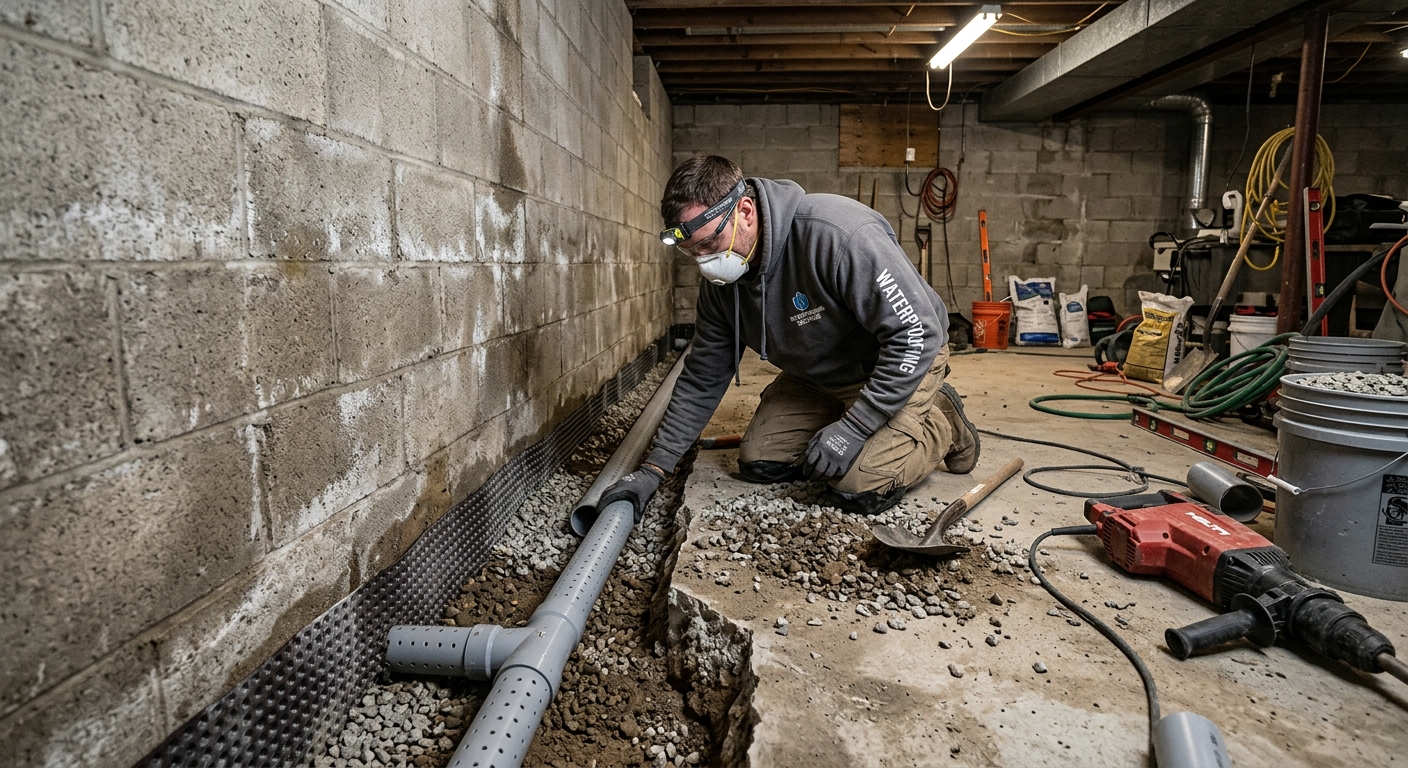
In Kitimat, the key difference is whether you address the source of water entry or you manage water after it gets in. Exterior waterproofing involves full excavation along the foundation, new waterproofing membranes, upgraded perimeter drainage tile, and backfill. Done correctly, it permanently reduces hydrostatic pressure at the wall. The trade-off is cost and disruption—excavation, access constraints, and regrading/restoration. Interior waterproofing—typically a perimeter drain channel, sump pit, and sump pump—captures seepage and relieves pressure at the basement floor perimeter. It’s less invasive, but it doesn’t stop the wall from being loaded by water, which is why many homes need a hybrid plan in a wet, freeze–thaw coastal climate.
Because North Coast foundations often deal with saturated mixed soils and storm-driven water loading, poured concrete walls sometimes seal better with crack injection (especially when cracks are stable). However, block foundations frequently perform better when interior drainage is used as a practical complement—especially when exterior excavation is limited by landscaping or when drainage tile has failed for years. For British Columbia’s seasonal rain patterns and the reality of power interruptions during spring flooding, sump pump backup systems matter: a battery backup or equivalent redundancy can prevent basement flooding when the grid is stressed.
A simple way to decide: if you’re seeing active seepage and hydrostatic pressure symptoms along multiple walls, exterior plus drainage is often justified—especially when interior-only fixes would require repeated pump duty. If the issue is localized, you may be able to stay closer to the $5,000–$15,000 interior band instead of the $9,000–$22,000 exterior excavation range. In Kitimat, that decision should be based on how the water behaves, not just where stains appear.
| Method |
Best For |
Addresses Source? |
Disruption |
Lifespan |
Price Band |
| Full exterior excavation + membrane |
Multi-wall seepage, chronically saturated backfill, failing original perimeter drainage |
Yes (reduces water entry and hydrostatic pressure) |
High (excavation and restoration) |
Long (when drainage is at footing-grade and backfill is managed correctly) |
$9,000–$22,000 |
| Interior French drain + sump system |
Homes where exterior access is limited or where water is entering but exterior is not feasible |
Partially (manages water after entry) |
Medium (floor work; limited landscaping impact) |
Long (if sump capacity and discharge are reliable) |
$5,000–$15,000 |
| Crack injection — epoxy (structural) |
Stable, non-moving structural cracks where moisture is present but movement is minimal |
Partially (seals pathways; doesn’t replace drainage) |
Low (drilling and surface patching) |
Medium to long (best with correct crack selection) |
$600–$1,800 |
| Crack injection — polyurethane (active leak) |
Active water seepage through cracks, especially when water flow is ongoing |
Partially (controls the active leak pathway) |
Low (localized surface work) |
Medium (often paired with drainage/pumping for best results) |
$700–$2,000 |
| Interior drain channel only (no sump) |
Light seepage conditions or as a supplement when pump capacity is already present |
No (water is still collected indoors) |
Low to medium (depends on floor work) |
Medium (performance depends on whether there’s a sump/pumping plan) |
$3,500–$8,000 |
| Re-grading + downspout extensions |
Surface water problems (roof runoff directed toward foundation) and minor wetting |
No (doesn’t control wall/pressure entry) |
Low (outside work) |
Short to medium (works best as a supporting measure) |
$1,000–$4,000 |
How to choose a waterproofing contractor in Kitimat
Start by confirming the contractor can legally and safely perform the specific scope you need in British Columbia. In practice, that means verifying: (1) their licence/authority for the type of construction work they’re proposing, (2) liability insurance with coverage limits appropriate for excavation and interior demolition, and (3) WSIB/WCB clearance for worker coverage. Ask for documentation before site work begins—don’t rely on verbal assurances. For structural crack work, confirm whether they have engineering support available and whether permits are handled for excavation/drainage changes.
Next, request 2–3 itemised written quotes. You want line-by-line detail for labour and materials: membrane type, drainage tile specs, filter fabric, sump pump model (and discharge plan), concrete cutting/breakout quantities, and disposal/restoration inclusions. Scope clarity is where waterproofing quotes win or fail—so read what’s excluded (for example, mould remediation, electrical work, landscaping restoration, or permit fees). If a permit is required, ask who pulls it and whether that cost is included.
Warranty and payment terms protect you in a high-moisture climate. Look for a workmanship warranty (with a clear start point and what’s covered), plus product/manufacturer warranty details—especially whether warranties are transferable to future owners. Keep payment structure sensible: never pay more than 10–15% upfront; hold back until the job is complete and functioning. Finally, get a written start date and completion estimate, and ensure the contractor explains how they’ll manage rain during the excavation/backfill phase in Kitimat.
- Provide licence/registration details that match the scope.
- Show current certificate of insurance and confirm the worksite address is covered.
- Confirm WSIB/WCB clearance documentation is active.
- For structural cracks, include engineer assessment and recommendations where required.
- Quote includes permit responsibilities (who pulls it, and what’s covered).
- Itemised labour and materials (not one lump-sum line).
- Crack injection method matches crack type (structural vs active leak).
- Exterior scope specifies membrane system, drainage tile location, and backfill handling.
- Sump plan includes pump capacity, discharge routing, and backup system if recommended.
- Includes mould/efflorescence remediation steps if present before sealing.
- Disposal of wet spoil and excavation waste is explicitly included for exterior work.
- Warranty length and product warranty terms are written and understandable.
Red flags we commonly see around Kitimat: (1) quotes that promise “one-time sealing” without addressing drainage or hydrostatic pressure; (2) no mention of sump pump redundancy where there’s ongoing seepage; (3) vague scope language like “replace waterproofing as needed” with no quantities or materials; (4) payment requests that front-load most costs before any verification/testing; and (5) refusal to provide proof of insurance/WSIB/WCB or to clarify permit ownership.
Frequently asked questions — waterproofing in Kitimat
What causes foundation cracks in Kitimat?
In Kitimat, foundation cracks are commonly driven by a combination of freeze–thaw movement and water pressure. As coastal ground repeatedly saturates and then freezes, pressure increases at joints and along perimeter interfaces. Older homes—many built before 1981—often have had decades for original damp-proofing and weeping tile to fail, which allows moisture to load the foundation longer. Soil behaviour also matters: saturated mixed soils can shift subtly, and if drainage is poor, the wall experiences more lateral stress. If you have seepage that worsens during heavy rain, that’s a sign the crack pathway is being fed by groundwater, not just settlement. In these cases, crack injection alone may not solve it unless drainage and pumping are corrected.
How do I compare waterproofing quotes?
Compare waterproofing quotes by scope, not by total number. Ask each contractor for an itemised breakdown: what they will remove, what membrane/drainage materials they will install (and where), whether they tie drainage into a working sump plan, and how they handle disposal and restoration. In Kitimat, excavation and wet spoil disposal can be major cost drivers, so make sure exterior quotes include restoration and confirm access limitations are addressed. For interior solutions, check sump pump specs and whether backup is included—especially because British Columbia power reliability can become a concern during spring storm periods. If one quote lands in the $5,000–$15,000 interior band and another is $9,000–$22,000, verify that they’re solving the same problem (source entry vs collected seepage) and using comparable pump capacities and drainage design.
How long does basement waterproofing take in Kitimat?
Timing depends on whether the job is exterior or interior and how wet the site is. For interior perimeter drains and sump installations, many projects can take roughly several days to a couple of weeks depending on floor removal, curing times for patches, and pump testing. Exterior excavation can take longer because crews must schedule around rainfall, excavate to footing-grade, install drainage tile and membrane systems, manage backfill, and then restore landscaping and grade. In Kitimat’s North Coast climate, heavy storm windows can slow backfill and membrane protection, especially if the ground can’t be kept stable. If permits are required, lead time for paperwork can also affect start dates. A reputable contractor will give a written schedule and explain how they protect partially completed work from incoming rain.
What is a weeping tile and does my Kitimat home have one?
Weeping tile (perimeter drainage tile) is a buried collection system around the foundation designed to move groundwater away from the basement walls and floor perimeter. Older homes often have an original tile system, but over decades it can clog, crack, collapse, or become disconnected—so it may no longer relieve hydrostatic pressure. In Kitimat, many properties built in the earlier housing stock period (with 77.9% built before 1981) are more likely to have older, failing drainage. You can’t always confirm it visually, but clues include previous basement drain lines, a known sump pit history, or evidence of old discharge routing. A camera inspection or dye testing (where feasible and safe) can help verify whether the weeping tile exists and whether it’s functioning.
Can I waterproof my basement in winter in Kitimat?
It can be possible, but it depends on ground conditions and what work you’re planning. In winter, exterior excavation is often more difficult because soil can freeze deeper and moisture becomes harder to manage safely. That can slow membrane installation, backfill compaction, and final drainage performance. Interior waterproofing is sometimes more practical during colder months because it avoids deep exterior excavation; interior perimeter drains, sump pit construction, and crack injection may still be feasible if the area can be worked on and temperatures can support curing and finishing. However, you should be cautious: sealing over active moisture or without proper drying can lead to adhesion problems. For Kitimat’s wet coastal cycles, the best contractors plan around weather and will explain whether the site can be dried and whether the drainage system can be tested before finalizing.
What is the difference between waterproofing and damp-proofing?
In Canadian residential practice, “damp-proofing” usually refers to treatments meant to reduce moisture penetration for light seepage, often used historically on basements to address minor dampness rather than sustained water pressure. True “waterproofing” systems are designed to manage or stop hydrostatic pressure and active seepage pathways through proper exterior membrane/drainage design and/or interior drainage and sump pumping. In Kitimat, where rainy North Coast conditions can saturate backfill and increase water loads, damp-proofing alone often isn’t enough once weeping tile fails or cracks widen from freeze–thaw. That’s why active leak scenarios may require interior drainage and sump capacity, sometimes paired with crack injection. If you’re offered only surface sealant, ask whether it matches the real water pathway and whether the solution fits the typical Kitimat moisture conditions.