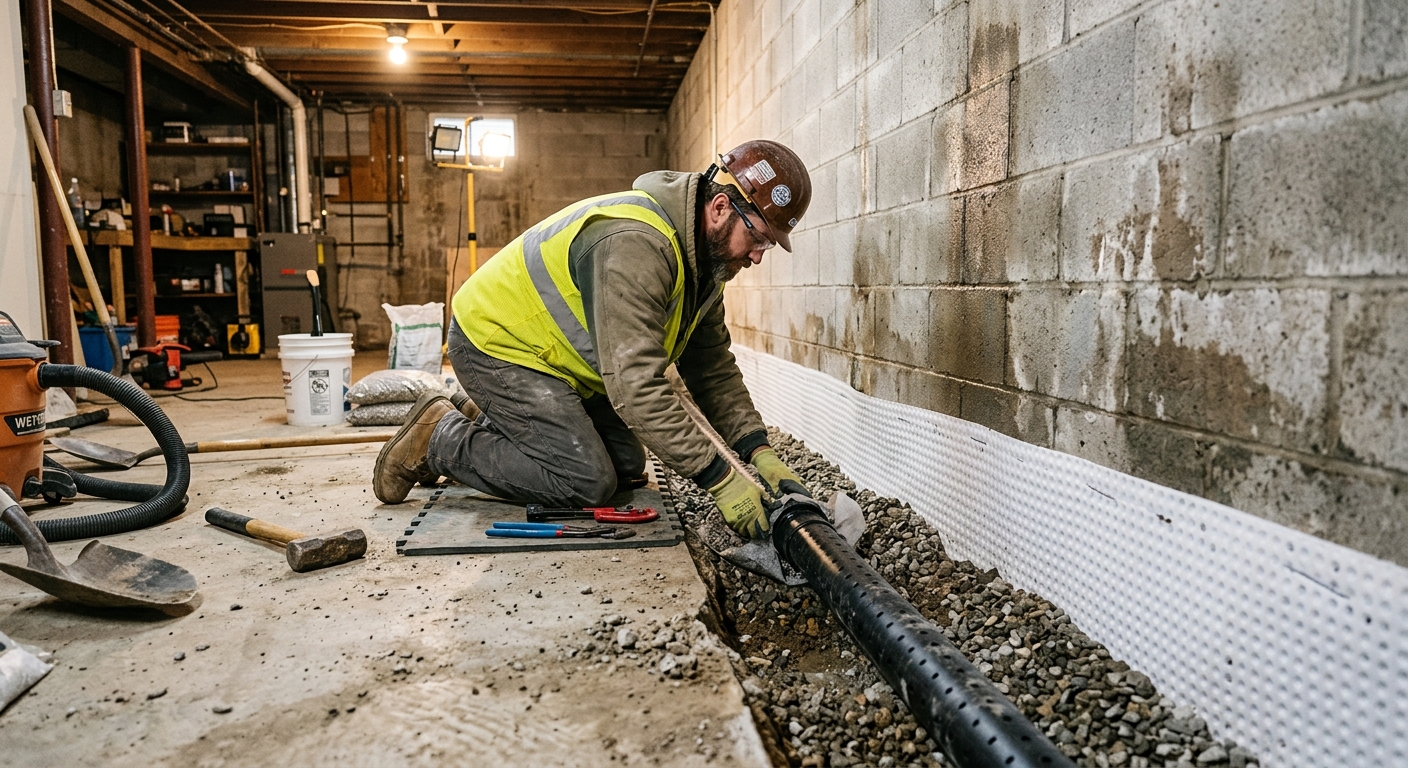
Basement waterproofing options and costs in Courtenay
In Courtenay, basement waterproofing is usually about stopping water from getting into the foundation and managing what already enters. With 30.2% of homes built before 1981 (Statistics Canada, 2021 Census), many properties in town still have original drainage details that didn’t last as long as today’s systems—especially around older weeping tile and early membrane approaches. That age profile matters because as perimeter drains fail, hydrostatic pressure builds behind walls, turning small damp patches into active seepage paths, often at cracks.
On Vancouver Island and the Coast, costs commonly trend higher because rainfall is intense, backfill saturates quickly, and exterior drainage repairs require excavation, membrane work, and careful reinstallation. Contractor availability can also affect scheduling: when multiple homes in the same neighbourhood need work after a wet season, crews get booked further out, which can change quote timing and mobilization costs. In areas like the North Island College/Valley Corridor area—where older residential lots and mature landscaping are common—exterior work is especially in demand because digging is harder and access is tighter.
The result is that “same basement, same symptom” can mean very different scopes. The table below compares the main waterproofing options and the typical Courtenay cost bands so you can match the solution to what’s causing the moisture.
| Method |
What It Addresses |
Disruption Level |
Durability |
Price Range |
| Exterior excavation + new membrane + drainage tile |
Source water entry by replacing perimeter drainage and waterproofing at the foundation |
High (excavation, landscaping impacts) |
Long-term when installed to manufacturer specifications |
$7,000 – $18,000 |
| Interior perimeter drain channel + sump pit |
Collects seepage once water reaches the interior side of the foundation |
Medium (minor floor/wall cutting) |
High for controlling moisture; doesn’t remove wall hydrostatic pressure |
$3,000 – $10,000 |
| Foundation crack injection (epoxy or polyurethane) |
Seals cracks; polyurethane is selected for active leaks, epoxy for non-moving cracks |
Low to Medium (drilling/patching) |
Good to excellent when crack type is correctly matched |
$250 – $800 |
| Sump pump installation (primary + battery backup) |
Moves collected water out of the basement; backup protects during outages |
Low to Medium (pit and discharge line) |
High when paired with proper drainage and pump sizing |
$800 – $2,500 |
| Window well drain installation |
Stops water pooling and seepage at egress windows |
Low to Medium |
Good (site-dependent) |
$800 – $2,500 |
| Lot re-grading / downspout extension |
Improves surface runoff away from foundation; reduces saturation of backfill |
Low to Medium |
Moderate (best as part of a complete plan) |
$1,000 – $3,500 |
Prices are estimates only and vary by project scope, site access and material selection.
What affects the price of waterproofing in Courtenay
In Courtenay, two contractors can quote the “same” basement problem and land 30–50% apart because waterproofing pricing is driven by what’s actually happening at the foundation, how far water has travelled, and how much excavation is required. Even on Vancouver Island, labour and disposal costs can swing depending on access (driveways, patios, retaining walls) and the amount of membrane/drainage detail a crew must restore to work standards.
The three biggest regional cost drivers that often separate Vancouver Island and Coast pricing from the national average are soil type, water table conditions, and freeze-thaw. Clay-heavy soils (common in parts of Canada) hold water and can increase lateral pressure on foundation walls; when freeze-thaw cycles trap moisture, small cracks can widen and start leaking again. On many coastal BC sites, higher effective water tables mean sump pumps run more often, and drainage lines require extra sizing and confirmation of discharge routing. Heavy seasonal rainfall saturates backfill quickly when original drainage has failed, so exterior excavation and perimeter drainage work tends to cost more here than interior-only symptom control.
In Courtenay, older housing stock is also a cost multiplier: if weeping tile is original (often decades old) or if there are repeated damp patches, the scope typically expands from “drying the basement” to actually correcting the perimeter water path. For example, replacing failing exterior drainage and membrane can land in the $7,000–$18,000 band, while interior perimeter drains and sump systems usually fall closer to the $3,000–$10,000 range. Costs can drop if the issue is limited to an isolated crack or a downspout/grade problem, but they rise quickly when exterior excavation is needed because landscaping and disposal add real labour hours.
| Price Factor |
Why It Matters |
Cost Impact |
| Interior vs. exterior approach — interior is less disruptive but addresses symptoms |
Interior systems manage collected water; exterior addresses entry points |
Exterior often adds $3,000–$8,000+ versus interior for comparable lots |
| Foundation type — poured concrete vs. block vs. stone vs. ICF |
Crack behaviour and how water moves through materials affects scope |
Block and stone often require more detailed drainage; poured concrete may respond better to targeted sealing |
| Soil type — clay expands more than sand, adding pressure |
Water retention and lateral pressure can worsen cracking over time |
Clay-heavy sites can push you toward exterior corrections and/or stronger drainage |
| Crack type and length — hairline vs. structural horizontal cracks |
Only the right product and prep will stop active leakage paths |
Structural or longer cracks increase labour and may require engineering review |
| Sump pump backup system — battery or water-powered backup needed |
Protects against outage during heavy spring rain events |
Typically adds $800–$2,500 depending on system choice and installation complexity |
| Access — landscaping, decks, or driveways must be removed for exterior |
Excavation in tight lots increases hours and restoration work |
Can increase exterior scope by thousands |
| Weeping tile age — original tile (60+ years) may be completely failed |
Failed tile means water can bypass the interior collection design |
Often moves the project from “interior fix” to “perimeter reconstruction” |
| Mould or efflorescence remediation required before sealing |
Contaminants and salts must be controlled so coatings and sealants bond properly |
Additional labour and materials before waterproofing can add $1,000+ depending on severity |
Permits & regulations in British Columbia
In British Columbia, foundation excavation, structural crack repair, and changes to lot drainage typically require a building permit. If a basement waterproofing project involves cutting, altering support conditions, or addressing cracks that may indicate movement, a permit is commonly required. Also, sump pump installations that discharge to the storm system or sanitary system generally need municipal approval before the connection is made—because routing impacts drainage capacity and compliance.
For structural crack repair—especially horizontal cracks in block walls or major step cracking—an assessment by a structural engineer is often required to determine whether underpinning, reinforcement, or other structural work is needed. A reputable Courtenay contractor should confirm whether engineering involvement is necessary for your foundation condition and provide documentation supporting their approach.
Here’s a homeowner-friendly step-by-step to verify credentials in BC:
- Ask for the contractor’s licence details and business information, then confirm the listing through the appropriate online provincial registry.
- Request a current certificate of insurance showing liability coverage; verify the effective dates.
- Confirm WSIB/WCB coverage (or equivalent clearance documentation if applicable) before work starts.
- For structural repairs, ask whether they have engineering support available and whether the plan will be sealed by the engineer if required.
- Get the permit responsibility confirmed in writing (who pulls the permit, who pays fees, and what inspections are expected).
Interior vs exterior waterproofing — what does Courtenay need?
The fundamental difference is simple: exterior waterproofing (full excavation, new membrane, new drainage tile, and proper backfill details) permanently addresses the source of water entry, but it costs significantly more and disrupts landscaping. Interior waterproofing (perimeter drain channel, sump pit, sump pump) manages water after it enters and is typically less invasive; however, it does not stop hydrostatic pressure on the wall itself. In Courtenay, the better choice depends on whether water is entering through a failing perimeter system, through a crack that acts as a leak path, or through surface water mismanagement.
On Vancouver Island and the Coast, exterior systems often perform better when the lot is chronically wet, because excavation lets crews restore drainage correctly around the foundation—especially where original weeping tile and backfill details have failed. That matters in homes with older foundations, where 30.2% of dwellings were built before 1981 (Statistics Canada, 2021 Census) and where the original drainage approach may be long past its service life. Poured concrete walls often respond well to crack injection when the crack is not actively moving, while block foundations frequently benefit from interior drainage as a practical complement—especially when outside excavation is constrained by existing decks, gardens, or finished grades.
Battery backup sump pumps are also a smart consideration in BC where outage events can occur during extreme weather. A battery system can keep water moving long enough to prevent overflow if the power is interrupted during heavy rainfall.
Dollar reality check: if your issue is broad seepage driven by saturated backfill and failed exterior drainage, an exterior approach may land around $7,000–$18,000, but it can be the only way to remove the root cause. If you’re dealing with localized interior moisture and a sump can quickly control it, the interior route often falls in the $3,000–$10,000 band—though it should be paired with correcting downspouts and grade to reduce recurring load.
| Method |
Best For |
Addresses Source? |
Disruption |
Lifespan |
Price Band |
| Full exterior excavation + membrane |
Widespread seepage, failed perimeter drainage, chronic wet basements |
Yes |
High (excavation and landscape restoration) |
Long-term with proper installation and drainage |
$7,000 – $18,000 |
| Interior French drain + sump system |
Interior seepage control where exterior access is limited |
No (controls water after entry) |
Medium (floor cutting and sump pit) |
High when paired with good pumping capacity |
$3,000 – $10,000 |
| Crack injection — epoxy (structural) |
Non-moving cracks in poured concrete or stable sections |
Partially (seals a crack pathway) |
Low (drill/patch) |
Good when the crack is not actively leaking |
$250 – $800 |
| Crack injection — polyurethane (active leak) |
Active seepage through cracks where water is still moving |
Partially (seals active leak path) |
Low to Medium |
Very good when correct product matches leak conditions |
$250 – $800 |
| Interior drain channel only (no sump) |
Light dampness with limited water volume |
No |
Medium |
Moderate to good (site and season dependent) |
$1,500 – $6,000 |
| Re-grading + downspout extensions |
Surface water issues causing wet foundation perimeter |
Yes for surface-driven problems |
Low to Medium |
Moderate (can need follow-up) |
$1,000 – $3,500 |
How to choose a waterproofing contractor in Courtenay
Start by verifying BC licensing and coverage the same day you request a quote. Ask for their contractor licence details (and confirm the business listing through the provincial online registry), then request a certificate of liability insurance showing coverage limits and effective dates. Next, confirm WSIB/WCB coverage so you know the crew is properly insured while working on your property. If the scope includes structural crack work, ask whether they coordinate engineering support when required, and whether they will provide documentation for permitting or inspection needs.
Then get 2–3 itemised written quotes, not a single lump sum. A good quote breaks down labour and materials (excavation/grading, membrane system components, drain tile, pump and backup, piping/discharge, and restoration). Read the exclusions carefully: confirm whether disposal of excavated material is included, whether permit fees are the homeowner’s responsibility, and what’s covered for landscape reinstatement. For warranty, ask for both workmanship warranty length and product/manufacturer warranty details, and whether the warranty is transferable to future owners.
For payment schedule, don’t allow a large deposit—aim for no more than 10–15% upfront, with a holdback until the job is complete and tested. Require a written timeline with a start date and completion estimate, and insist on a site review that identifies where water is entering (cracks, perimeter drains, window wells, or surface runoff).
- Request the full written scope before signing, including materials and system components.
- Confirm whether they’ll test/camera-check drainage lines if there’s evidence of failure.
- Ask how they will address active leaks versus stable, dry cracks.
- Verify they’ll match sealant/product to crack type (epoxy for stable cracks; polyurethane for active leakage).
- Confirm discharge routing for sump discharge and what approvals are needed.
- Ensure permit pulling responsibility is stated clearly in the contract.
- Check that excavation and membrane work include proper protection board and backfill compaction methods.
- Confirm pump sizing (not just “a pump”), including discharge line diameter and check valve selection.
- Ask about battery backup option and whether it’s included in your scope.
- Make sure restoration is listed (topsoil, sod, deck/step reinstallation, or patching).
- Ask for a clear warranty statement covering workmanship and product conditions.
- Confirm who handles cleaning, dust control, and debris removal at the end of each day.
Red flags in Courtenay: they won’t identify the water entry path, they only recommend a sump without addressing perimeter drainage or grade, they quote “epoxy injection” for active leaks, they refuse to provide insurance/WSIB/WCB documentation, or they avoid discussing permit requirements where lot drainage changes are proposed.
Frequently asked questions — waterproofing in Courtenay
Will basement waterproofing affect my property value in Courtenay?
It usually helps, especially in Courtenay where older homes can experience recurring dampness after wet seasons. Buyers pay attention to visible moisture, musty odours, and past leak history—so a properly scoped repair (with documentation and warranty) is a strong selling point. If your home has 30.2% of housing stock from before 1981 (Statistics Canada, 2021 Census), many buyers will expect due diligence on perimeter drainage and wall conditions. That said, value impact depends on the quality of the fix: exterior waterproofing that corrects the source is typically viewed more positively than interior-only “band-aids” when the leak is driven by saturated backfill. If your contractor uses a clear scope, permits where needed, and a tested pumping plan (including backup where appropriate), it’s easier to demonstrate the improvement.
What drainage issues are most common in Courtenay homes?
In Courtenay and across the Vancouver Island and Coast area, the most common triggers are perimeter drain failures and surface water being directed toward the foundation. When weeping tile or its connections are clogged or completely failed, water finds its path to cracks and along block/poured-concrete joints, leading to repeated dampness. Older housing stock increases the frequency of these failures; many homes were built before 1981 (Statistics Canada, 2021 Census), so original drainage details may no longer perform as intended. We also see problems around window wells where pooling water infiltrates, and downspouts that discharge too close to the foundation. During heavy rainfall, saturated backfill raises hydrostatic pressure; if small cracks are present, they can become active leak routes even if they looked “fine” in drier months.
How do I choose a waterproofing contractor in Courtenay?
Choose a contractor by verifying coverage and insisting on a detailed, itemised scope. In Courtenay, start with their BC licence details (confirm through the provincial online registry), then request a current certificate of liability insurance and proof of WSIB/WCB clearance. Next, ask for 2–3 written quotes showing labour and materials separately—especially for excavation/membrane versus interior drains and sump components. Make sure the scope states what’s included: permit pulling (where required), disposal, and restoration. For foundation crack work, ask whether they will match the method to the crack type—polyurethane for active leaks and epoxy for stable cracks. Finally, review the warranty terms: workmanship warranty length, product/manufacturer coverage, and whether it’s transferable if you sell your home. A quote around $7,000–$18,000 for exterior work should look like a complete perimeter system plan, not just “we’ll seal it.”
What is a battery backup sump pump and do I need one in Courtenay?
A battery backup sump pump is a secondary power system that keeps the sump operating if the main electrical power is interrupted. On Vancouver Island and the Coast, heavy rain events can coincide with outages or power fluctuations, and backup can prevent water from rising into your basement during that gap. Whether you “need” one depends on your risk profile: homes with frequent seepage, lower basement floors, or a history of basement wetting during storms benefit most. If the interior system is your primary control method, backup is often the difference between a wet event and a manageable one. For cost context, sump pump work commonly falls in the $800–$2,500 band, and adding backup typically increases that figure. In many cases, backup makes the interior solution more reliable without changing the rest of the waterproofing plan.
How much does basement waterproofing cost in Courtenay?
Costs in Courtenay vary mainly because exterior work is labour-intensive and targeted by water movement around the foundation. Typical ranges for local projects are: exterior waterproofing (excavation) at $7,000–$18,000, interior waterproofing/weeping tile control at $3,000–$10,000, foundation crack repair often around $250–$800, and sump pump installation at $800–$2,500 (depending on discharge route, pump capacity, and whether backup is included). For example, if your moisture is driven by saturated backfill and a failed perimeter drainage system, exterior work is more likely to be justified and usually sits in the higher band. If seepage is mostly controlled once water reaches the interior perimeter, the interior approach often fits the mid-range. Your contractor’s site walk, access constraints, foundation type, and whether mould/efflorescence remediation is needed will all affect the final scope.
Interior vs exterior waterproofing — which is better?
Exterior waterproofing is generally the better “source-control” option because it addresses where water enters: excavation, new membrane, and perimeter drainage that reduces hydrostatic pressure against your foundation. However, it’s also more disruptive and can be significantly more expensive. Interior waterproofing is better described as a reliable water-management system: it collects seepage after it enters and pumps it away, typically at lower upfront cost. In Courtenay, the decision often comes down to your foundation type, soil/water conditions, and site access. If exterior drainage is failing and water is migrating through the perimeter, a $7,000–$18,000 exterior plan can be worth it because it corrects the cause. If you can’t excavate extensively or the issue is more limited, a $3,000–$10,000 interior drain/sump approach can solve the symptom. The most successful projects usually include at least basic lot drainage corrections (grade and downspouts) regardless of whether the primary system is interior or exterior.