Basement waterproofing options and costs in Fort St. John
In Fort St. John, basement waterproofing is usually a “water management” problem first and a “sealing” problem second. With a population of 21,465 (Statistics Canada, 2021 Census), the housing mix includes many older homes—42.0% were built before 1981—where early damp-proofing often relied on tar-and-paper systems and weeping tile that have since aged, clogged, or collapsed. In these cases, repairs that only patch the visible seepage can stall out, because the soil and water pressure behind the wall continue to push.
In Northeast BC’s Peace region, costs climb when the soil is fine-grained (silty/clay pockets) and when the water table sits high or rises quickly after snowmelt. Freeze–thaw cycles then widen joints and cracks, turning “occasional dampness” into active leakage over a few seasons. Contractors also face higher day-to-day costs due to excavation depth, access constraints in residential pockets, and cold-weather concrete work—so the same scope can land toward the higher end of the provincial price bands.
Demand is especially strong in established areas where older foundations are more common and yards tend to be tight, such as Northwest Industrial / Peace River area-adjacent neighbourhoods and older residential blocks near the downtown core. Before recommending an approach, we typically assess whether water is entering through the perimeter, through cracks/joints, through window wells, or via failed downspouts/grade. That leads directly into a comparison of the most common methods and typical Fort St. John pricing.
| Method |
What It Addresses |
Disruption Level |
Durability |
Price Range |
| Exterior excavation + new membrane + drainage tile |
Hydrostatic pressure at the wall, failed drainage, leaking perimeter |
High (re-excavation, landscaping restoration) |
Long-term (source control) |
$9,000–$20,000 |
| Interior perimeter drain channel + sump pit |
Water after it enters; reduces seepage and interior moisture |
Moderate (floor/framing access at perimeter) |
Long-term with proper pump maintenance |
$4,000–$12,000 |
| Foundation crack injection (epoxy or polyurethane) |
Cracks depending on whether they’re structural (epoxy) or actively leaking (polyurethane) |
Low to moderate (patching and surface prep) |
Good when matched to crack type |
$400–$1,200 |
| Sump pump installation (primary + battery backup) |
Manages collected water; protects finish and reduces mold risk |
Low to moderate (pit, electrical/backup setup) |
High when backed up for power interruptions |
$900–$3,000 |
| Window well drain installation |
Surface water entry near egress window wells |
Moderate (excavation around window area) |
Good (when grading and discharge are correct) |
$1,500–$4,500 |
| Lot re-grading / downspout extension |
Redirects surface water away from foundation |
Low (minor excavation/landscape work) |
Moderate (relies on ongoing surface maintenance) |
$1,000–$5,000 |
Prices are estimates only and vary by project scope, site access and material selection.
What affects the price of waterproofing in Fort St. John
Homeowners in Fort St. John often notice quote gaps of 30–50% for what sounds like the same job. The difference usually isn’t the contractor “padding”—it’s that the scope silently changes once we factor in soil and water conditions, foundation type, and how much excavation is realistically possible. Across Northeast BC and the broader provincial market, the most consistent separation from the national average comes from three local drivers: soil type, water table, and freeze–thaw.
First, fine-grained soils (silty/clay pockets) can hold water against foundations. In freeze–thaw conditions, trapped moisture expands and contracts, worsening small gaps and turning once-stable seepage paths into active leaks. In other parts of the country where the soils are more sandy, drainage systems often perform more reliably. Second, where the water table is high or rises rapidly after snowmelt, sump pumps run longer and exterior drainage must be sized and installed correctly—or interior systems become more urgent and more expensive to keep dry. Third, Northeast BC’s seasonal cycle stresses aging systems; weeping tile installed decades ago may no longer move water, so backfill saturation becomes continuous pressure rather than a short event.
Concrete examples that commonly change the Fort St. John budget: (1) a home with failed weeping tile and clay-silt backfill often needs deeper excavation and upgraded drainage—adding major excavation time and tiling—pushing projects toward the $9,000–$20,000 exterior band; (2) a basement with stable, damp-only symptoms and minimal access limitations may fit interior drainage with sump—often within the $4,000–$12,000 interior range; (3) a poured-concrete wall with a manageable, non-moving crack is sometimes handled more economically with injection (often under $1,200) rather than full excavation.
Finally, housing stock matters. With 42.0% of homes built before 1981 (Statistics Canada, 2021 Census), the most frequent surprises during inspection are complete weeping-tile failure and older drainage lines collapsed by freeze movement—both of which change the cost quickly.
| Price Factor |
Why It Matters |
Cost Impact |
| Interior vs. exterior approach — interior is less disruptive but addresses symptoms |
Exterior is source control; interior relies on capturing water after entry |
Interior typically $4,000–$12,000 vs exterior $9,000–$20,000 |
| Foundation type — poured concrete vs. block vs. stone vs. ICF |
Different wall movement and different failure modes change repair strategy |
Block and stone often require stronger drainage emphasis; ICF may need targeted crack work |
| Soil type — clay expands more than sand, adding pressure |
When saturated, clay increases lateral pressure and stresses membranes |
Clay-heavy sites can push exterior excavation and backfill specs higher |
| Crack type and length — hairline vs. structural horizontal cracks |
Structural movement requires different materials and possibly engineering/underpinning |
Hairline cracks can be lower cost; structural cracks may escalate substantially |
| Sump pump backup system — battery or water-powered backup needed |
Power interruptions during spring flooding can turn a “dry” basement into an emergency |
Adds to price; often worth it in Northeast BC seasons |
| Access — landscaping, decks, or driveways must be removed for exterior |
Exterior requires space for excavation and safe staging |
Deck/driveway removal and reinstatement can add thousands |
| Weeping tile age — original tile (60+ years) may be completely failed |
Old tile can collapse or clog, meaning exterior drainage must be replaced |
Replacement depth and verification time increase costs |
| Mould or efflorescence remediation required before sealing |
Moisture must be treated before membranes/coatings bond effectively |
Can extend schedule and increase materials/labour |
Permits & regulations in British Columbia
In British Columbia, foundation excavation and most changes that affect drainage, structural integrity, or how water is managed around a building typically require appropriate permitting. As a homeowner in Fort St. John, you should expect that work such as exterior foundation excavation, major foundation crack repairs (especially when there are indications of structural movement), and alterations to lot drainage usually require a permit.
If your sump system includes a discharge pathway that connects into municipal storm or sanitary infrastructure, municipal approval is generally needed. Also, when repairs involve structural crack repair—for example, significant horizontal cracks in block walls or major step-cracking—an assessment by a structural engineer is often required to determine whether the wall is actively moving and whether underpinning or additional structural work is needed.
Before you sign anything, verify your contractor provides proof of: liability insurance, and WSIB/WCB coverage for their workers (or the appropriate registration for the work arrangement). For structural repairs, confirm they have engineering support in-house or via a partnered professional.
How to check (step-by-step): (1) Ask for their contractor profile and business number/licence details, then confirm it through the relevant BC online registry; (2) request a certificate of insurance naming you as an interested party (where applicable) and confirm coverage is current; (3) request proof of clearance/coverage for WSIB/WCB; (4) for structural scopes, request the engineer assessment plan or a letter confirming engineering involvement; (5) ensure the written scope states who pulls permits and what permits are included.
Interior vs exterior waterproofing — what does Fort St. John need?
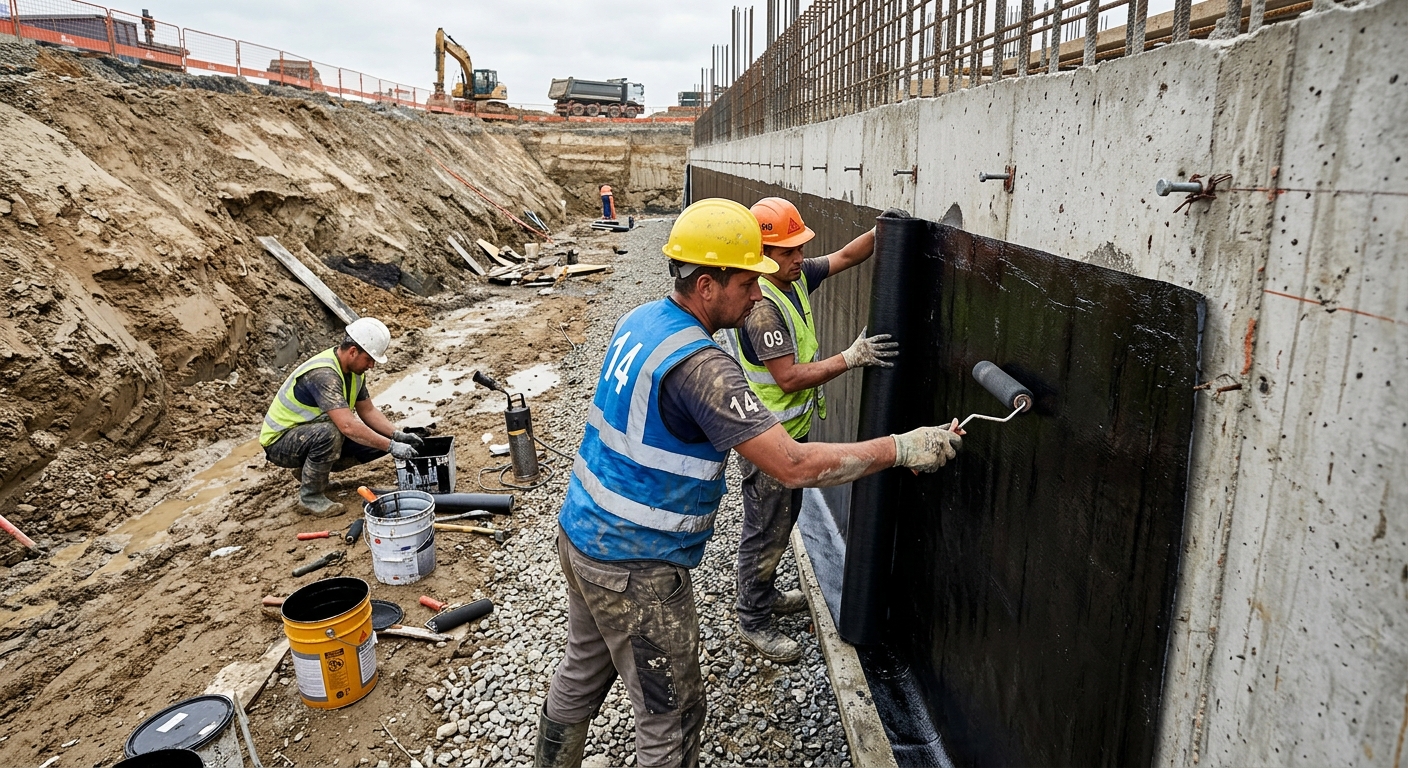
The fundamental difference is simple: exterior waterproofing (full excavation, new membrane, new drainage tile, and proper backfill) addresses the water before it reaches the basement wall, so it’s true “source control.” Interior waterproofing (perimeter drain channel, sump pit, and sump pump) manages water after it enters, which helps keep finishes dry but does not stop hydrostatic pressure from stressing the wall itself.
In Fort St. John, soil and water behaviour often point toward the best match. If you have poured concrete walls with cracks/joints that are present but not actively moving, crack injection is sometimes a practical first line of defence. However, where the water table is high, where the site’s grade/discharge issues are evident, or where older weeping tile has failed, exterior work becomes more compelling because it restores the pathway that once relieved lateral pressure. For block foundations—which can leak through mortar joints and micro-gaps—interior drainage is often a realistic complement, because even well-installed membranes can be challenged if fine water pathways persist internally.
Sump pump backup is also a Fort St. John reality. In British Columbia spring seasons, conditions that increase water infiltration can coincide with outages. A primary sump pump with a battery backup (or equivalent) reduces the risk of a basement flooding during the few hours that matter most.
For a dollar example: an exterior system is commonly priced in the $9,000–$20,000 range, while an interior perimeter drain and sump often sits in the $4,000–$12,000 band. In many Fort St. John cases, the extra cost of exterior work is justified when the goal is to stop the pressure at the wall—especially where older drainage is completely failed and seepage is continuous. If the basement shows mainly dampness near the perimeter with manageable crack behaviour, interior drainage may achieve the homeowner’s drying goal without the disruption of full excavation.
| Method |
Best For |
Addresses Source? |
Disruption |
Lifespan |
Price Band |
| Full exterior excavation + membrane |
Continuous seepage, failed weeping tile, high water pressure |
Yes |
High (re-excavation and landscaping restoration) |
Long-term (when drainage is correctly designed) |
$9,000–$20,000 |
| Interior French drain + sump system |
Hydrostatic management after entry; homes where exterior access is limited |
No (captures water) |
Moderate (perimeter floor access) |
Long-term with reliable pump maintenance |
$4,000–$12,000 |
| Crack injection — epoxy (structural) |
Non-moving, structural cracks in suitable foundation walls |
Partially (seals pathways; assumes crack is stable) |
Low to moderate |
Good when crack movement is controlled |
$400–$1,200 |
| Crack injection — polyurethane (active leak) |
Cracks with active seepage where flexible sealing is needed |
Partially (stops active flow) |
Low to moderate |
Good for active leaks when matched to conditions |
$500–$1,500 |
| Interior drain channel only (no sump) |
Intermittent dampness with low water accumulation |
No |
Moderate (perimeter work) |
Moderate (depends on drainage capacity) |
$3,000–$7,500 |
| Re-grading + downspout extensions |
Surface water issues (roof runoff discharging near footing) |
Indirectly (reduces load on foundation) |
Low to moderate |
Moderate (needs good maintenance) |
$1,000–$5,000 |
How to choose a waterproofing contractor in Fort St. John
Choosing a waterproofing contractor in Fort St. John is about verifying the basics first—then confirming the details of the scope. In British Columbia, you should verify licensing/registrations as applicable to the trade, liability insurance, and WSIB/WCB coverage. Here’s how to check each: (1) ask for their full business contact details and proof of their BC registration/licence; then confirm it using the relevant online registry; (2) request a current certificate of insurance, and ensure coverage is active for the job period; (3) request proof of clearance/coverage from WSIB/WCB (or applicable documentation for their coverage arrangement) and confirm the address/job site is acceptable; (4) for structural crack repairs, ask whether engineering support is included or subcontracted, and require it in writing.
Next, get 2–3 itemised written quotes—not lump sums. A good quote breaks labour and materials by line item (excavation, membrane, drainage tile, pump/sump components, disposal, and concrete reinstatement). Read what’s excluded: permit pull included or not, disposal included, backfill spec, restoration scope, and whether discharge location is defined. Ask about warranty terms: the length of workmanship warranty, the product/manufacturer warranty, and whether any warranty transfers to the next homeowner if you sell.
Finally, use a safe payment schedule. Never pay more than about 10–15% upfront; hold back until the job is complete and you’ve received operating instructions for pumps. Get a timeline in writing with a start date, sequencing plan (especially in freeze conditions), and estimated completion date.
- Ask for an itemised scope: membrane type, drainage tile type, filter fabric, and pump model/horsepower
- Confirm how discharge is routed (to daylight, sump basin, or approved drainage connection)
- Request photos of similar local jobs (Peace region basements) and ask about outcomes
- Verify insurance certificate dates match your project dates
- Verify WSIB/WCB clearance/coverage documentation is current
- Confirm whether permits are required and who will pull them
- Make sure disposal and backfill materials are included (not “allowance only”)
- Ensure restoration is listed: sod/seed, gravel, concrete/asphalt reinstatement, grading
- Ask how freeze–thaw timelines are handled (cold-weather concrete prep and curing)
- Check warranty details: workmanship length, exclusions, and transferability
- Demand a start and completion estimate, plus how delays are communicated
- Avoid contractors who won’t commit to what happens if water still appears after initial work
Red flags I see in Fort St. John waterproofing: (1) quoting an interior fix while ignoring evidence of exterior failure (collapsed or bypassed weeping tile), (2) vague discharge wording (no defined outlet), (3) no itemised breakdown—especially missing pump specs or disposal/restoration, (4) offering a short or non-specific warranty, and (5) refusing to show current insurance/WSIB/WCB documentation or engineering support for structural crack work.
Frequently asked questions — waterproofing in Fort St. John
How long does waterproofing last?
In Fort St. John and Northeast BC’s Peace region, “how long it lasts” depends on whether the job addresses source water pressure or only manages water after entry. Exterior systems (excavation, membrane, drainage tile) are designed for long-term source control when installed to handle local soil and high water events; interior drainage (French drain channel, sump, and pump) is also long-lasting but relies on the sump/power reliability. For typical homeowner budgets, exterior work often falls in the $9,000–$20,000 band, while interior drainage is commonly in the $4,000–$12,000 band—those scopes differ in what they’re built to withstand. Older homes (Statistics Canada, 2021 Census) built before 1981 can have multiple failing components, so the most durable results usually come from correcting the water pathway, not just sealing one area.
Can I waterproof my basement from the inside only?
Yes, you can waterproof from the inside only in many Fort St. John homes, especially when you have limited exterior access, landscaping restrictions, or you’re dealing with active seepage that needs immediate moisture control. Interior perimeter drains and sump setups—typically within the $4,000–$12,000 band—capture water that enters the basement and reduce mold risk. However, because interior systems don’t stop hydrostatic pressure against the wall itself, they perform best when cracks are treated appropriately (sometimes with injection) and when grading/downspouts are corrected so surface water isn’t constantly feeding the foundation. In Northeast BC’s freeze–thaw climate, if exterior drainage has fully failed and water pressure stays high, an interior-only approach may still keep you dry, but it may be more sensitive to pump performance and power interruptions—so backup is important.
What causes foundation cracks in Fort St. John?
Foundation cracks in Fort St. John are commonly driven by soil moisture changes and freeze–thaw movement. When fine-grained soils (including clay/silt pockets) stay saturated, water expands during freezing, and the freeze cycle can widen existing joints. Over time, repeated seasonal movement turns hairline seepage into active leaks, especially if older weeping tile or perimeter drainage no longer relieves pressure. In housing stock from the 1960s–1990s, failing weeping tile and minimal damp-proofing can also allow moisture to concentrate near the wall, increasing the likelihood of new cracking. If you have structural horizontal cracks or major step cracks in block walls, those can indicate more than simple shrinkage, and you’ll likely need a structural engineer assessment in addition to waterproofing repair.
How do I compare waterproofing quotes?
Compare quotes by matching scope, not just total price. Ask each contractor to provide an itemised breakdown of labour and materials: excavation depth, membrane and drainage tile specifications, filter fabric, pump model, and restoration. Confirm whether disposal and backfill are included. Also check what they’re solving—are they targeting source control (exterior) or capturing water after entry (interior). In Fort St. John, exterior projects often land around the higher end (for example, $9,000–$20,000), while interior drainage may be lower (often $4,000–$12,000). A quote that seems cheaper may be missing a critical component like proper drainage tile replacement, sump discharge design, or mold/efflorescence remediation before sealing. Finally, verify warranties and ask whether permits are included where required.
How long does basement waterproofing take in Fort St. John?
Typical timelines depend on whether the work is interior-only or involves exterior excavation. Interior perimeter drainage and sump installations can often be completed in a shorter window, but drying/curing times for patching and concrete work still matter—especially in colder parts of the season. Exterior excavation is slower because it involves deep dig, drainage installation, membrane application, backfill, and landscape restoration. In Northeast BC winters, contractors sometimes schedule around cold temperatures to meet concrete curing requirements, which can extend calendar time even when labour hours are steady. The fastest jobs are usually targeted repairs (like crack injection) and smaller drainage fixes (like window well drains). Larger exterior scopes are often the reason homeowners see longer project timelines—plan around staging access and permit scheduling where required.
What is a weeping tile and does my Fort St. John home have one?
A weeping tile is a perforated drainage system installed along or around the foundation perimeter to collect groundwater and direct it away from the basement wall. In Fort St. John, many older homes—especially those built before modern damp-proofing became common—may have had original weeping tile installed, but it may be partially failed or completely collapsed by now. That’s important because when weeping tile stops moving water, soils can hold moisture and apply hydrostatic pressure during spring melt and rainy periods, leading to seepage, efflorescence, or mould. You can sometimes locate it by viewing basement perimeter conditions, checking for older cleanout access points, or using probing/testing during an assessment. Because the housing stock is older in Northeast BC (Statistics Canada, 2021 Census), we often treat “existing weeping tile condition” as a key line item in the scope.