Basement waterproofing options and costs in Kelowna
Kelowna homeowners typically face waterproofing decisions sooner than expected, especially in older neighbourhoods where original drainage systems have had decades to fail. In Kelowna, 31.7% of homes were built before 1981, and many of those foundations relied on early tar-and-paper approaches and/or older weeping tile that can be undersized, clogged, or completely inactive. That’s why “same symptom” leaks—slab edge dampness, cold-joint seepage, or recurring wall weeping—can require very different repairs depending on whether water is coming from the exterior drainage line, a crack path, or window/grade issues.
In the Thompson–Okanagan, semi-arid valley conditions don’t remove the risk of water problems; they change how and when they show up. Spring snowmelt and heavy rain events can drive sudden infiltration, while freeze-thaw cycles widen existing joints and hairline cracks until they become active channels. Site soils in Kelowna—often mixes of sand, silt, and localized clay pockets—can hold water longer against the foundation, increasing lateral pressure compared with freely draining sandy sites. Cost also depends on excavation access (tight infill lots), the depth of foundation, and whether landscaping, decks, or sidewalks must be removed and reinstated. Contractor availability can also influence scheduling and price, particularly in high-demand areas like Rutland where 1960s–1990s housing stock commonly has aging exterior drainage and mature trees that complicate excavation. Use the options below as a starting point, then match the method to your leak source; the table will help you compare typical scopes side by side.
| Method |
What It Addresses |
Disruption Level |
Durability |
Price Range |
| Exterior excavation + new membrane + drainage tile |
Stops the source by rebuilding the waterproofing envelope; adds drainage to reduce hydrostatic pressure |
High (excavation, concrete/asphalt removal, backfill, reinstatement) |
Long-term (typically 20+ years with proper membrane system and drainage) |
$18,000–$40,000 |
| Interior perimeter drain channel + sump pit |
Captures and manages water after it enters; reduces seepage along slab edges and cold joints |
Medium (minor floor cutting; interior sump/catch system) |
Good (depends on continued maintenance and pump performance) |
$9,000–$22,000 |
| Foundation crack injection (epoxy or polyurethane) |
Seals cracks to stop infiltration (epoxy for structural/static cracks; polyurethane for active leaks) |
Low (core drilling and patching) |
Moderate to long-term (best when crack movement is properly assessed) |
$800–$3,500 |
| Sump pump installation (primary + battery backup) |
Keeps interior dry during high seepage periods; battery backup reduces risk during outages |
Low to Medium (pit excavation/cutting; electrical connections) |
Good (system-based durability; periodic testing recommended) |
$2,500–$5,500 |
| Window well drain installation |
Routes water away from window wells to prevent localized pooling and wall/footing seepage |
Medium (excavation in the window area; regrading) |
Good (long-term if discharge location and grading are correct) |
$2,000–$6,000 |
| Lot re-grading / downspout extension |
Reduces roof runoff and directs surface water away from the foundation to slow recurring wetting |
Low to Medium (soil work; may require sod/concrete reinstatement) |
Variable (only fully effective when drainage paths are maintained) |
$1,800–$7,500 |
Prices are estimates only and vary by project scope, site access and material selection.
What affects the price of waterproofing in Kelowna
In Thompson–Okanagan, you can see the same waterproofing “category” priced 30–50% apart across British Columbia because the real cost driver is the site, not the product label. Two homes with the same leak description can need very different excavation lengths, different drainage rebuilds, or a different mix of membrane, drain tile, crack repair, and sump systems. This is why a quote that starts around the interior band (for example, $9,000–$22,000 for interior drainage/weeping tile upgrades) can climb toward or past exterior excavation pricing (often $18,000–$40,000) when the contractor has to open up long wall runs, deal with dense roots, or reinstate major landscaping.
The three local drivers that separate Kelowna costs from the national average are soil type, water-table pockets, and freeze-thaw. Clay pockets and dense silts can hold water against foundation walls longer and increase lateral pressure, which accelerates crack cycling. High-water-table pockets—especially where properties sit closer to creeks or have poor downhill drainage—raise sump pump run times and require more reliable discharge piping. While Kelowna’s summers dry out, freeze-thaw cycles still widen existing microcracks and joints, so a “repair-now” approach can fail if the crack movement isn’t identified.
Concrete examples from typical Kelowna scenarios: (1) on a block foundation with a history of interior wall staining and slab edge dampness, interior drainage plus sump may be the most efficient first step, staying closer to the interior pricing range; (2) on poured-concrete walls with long crack lines and active seepage after spring storms, contractors often recommend targeted crack injection plus drainage improvements to avoid repeating an interior-only fix; (3) on tight infill lots with mature landscaping in Rutland or older cores near the lake-adjacent slopes, exterior excavation costs rise due to access constraints and higher reinstatement scope.
| Price Factor |
Why It Matters |
Cost Impact |
| Interior vs. exterior approach — interior is less disruptive but addresses symptoms |
Exterior targets the source; interior manages water after entry |
Can swing overall cost by roughly 30–50% depending on excavation needs |
| Foundation type — poured concrete vs. block vs. stone vs. ICF |
Crack behavior differs; membrane and crack repair compatibility varies |
Poured concrete often supports reliable sealing; block may require more interior capture |
| Soil type — clay expands more than sand, adding pressure |
Clay retains moisture and expands during freeze-thaw, increasing pressure |
More advanced drainage and crack detailing increases labour and materials |
| Crack type and length — hairline vs. structural horizontal cracks |
Active/seeping and structural movement change repair method and extent |
Structural-type work can add assessment and larger repair quantities |
| Sump pump backup system — battery or water-powered backup needed |
Outages during storm/wet conditions can turn a “temporary” leak into damage |
Backup can add several thousand dollars but often prevents interior loss |
| Access — landscaping, decks, or driveways must be removed for exterior |
More removal/reinstatement increases time and disposal/rebuild scope |
Exterior projects on infill lots frequently rise toward the upper exterior band |
| Weeping tile age — original tile (60+ years) may be completely failed |
Old systems can be clogged, broken, or disconnected |
Failure often means replacement or a full rebuild of drainage lines |
| Mould or efflorescence remediation required before sealing |
Moisture must be stabilized; sealing over contaminants leads to repeat issues |
Remediation adds labour and requires careful sequencing |
Permits & regulations in British Columbia
In British Columbia, some waterproofing and foundation-related work can require permits—especially when you’re altering foundation elements, changing lot drainage, or performing structural repairs. Typically, foundation excavation and any work that affects the foundation structure or its drainage system will trigger permit requirements. Structural crack repair—particularly horizontal cracks in block walls or cracks that suggest movement—often requires a structural engineer’s assessment to determine whether underpinning or other structural interventions are needed. If the plan involves connecting a sump pump discharge into the storm or sanitary sewer system, municipal approval is typically required.
Work that commonly does not require a permit (as long as you’re not altering structural capacity or re-routing services) includes: window well drain additions that remain strictly on-site and discharge to an approved point, interior perimeter drain channel installs in finished basements (without modifying foundation structural elements), and cosmetic patching after sealing. However, permit needs can change based on scope, location, and discharge destination—so the contractor should confirm in writing before starting.
To verify a contractor in Kelowna, homeowner steps should be: (1) confirm their business licence and status in BC using their company name and contractor category; (2) ask for a Certificate of Insurance showing liability coverage limits and effective dates; (3) confirm WSIB/WCB coverage with proof or a clearance letter; and (4) for structural repairs, verify they have engineering support or partner engineers for assessments and any required drawings. If they can’t provide documentation promptly, that’s a strong caution signal.
Interior vs exterior waterproofing — what does Kelowna need?
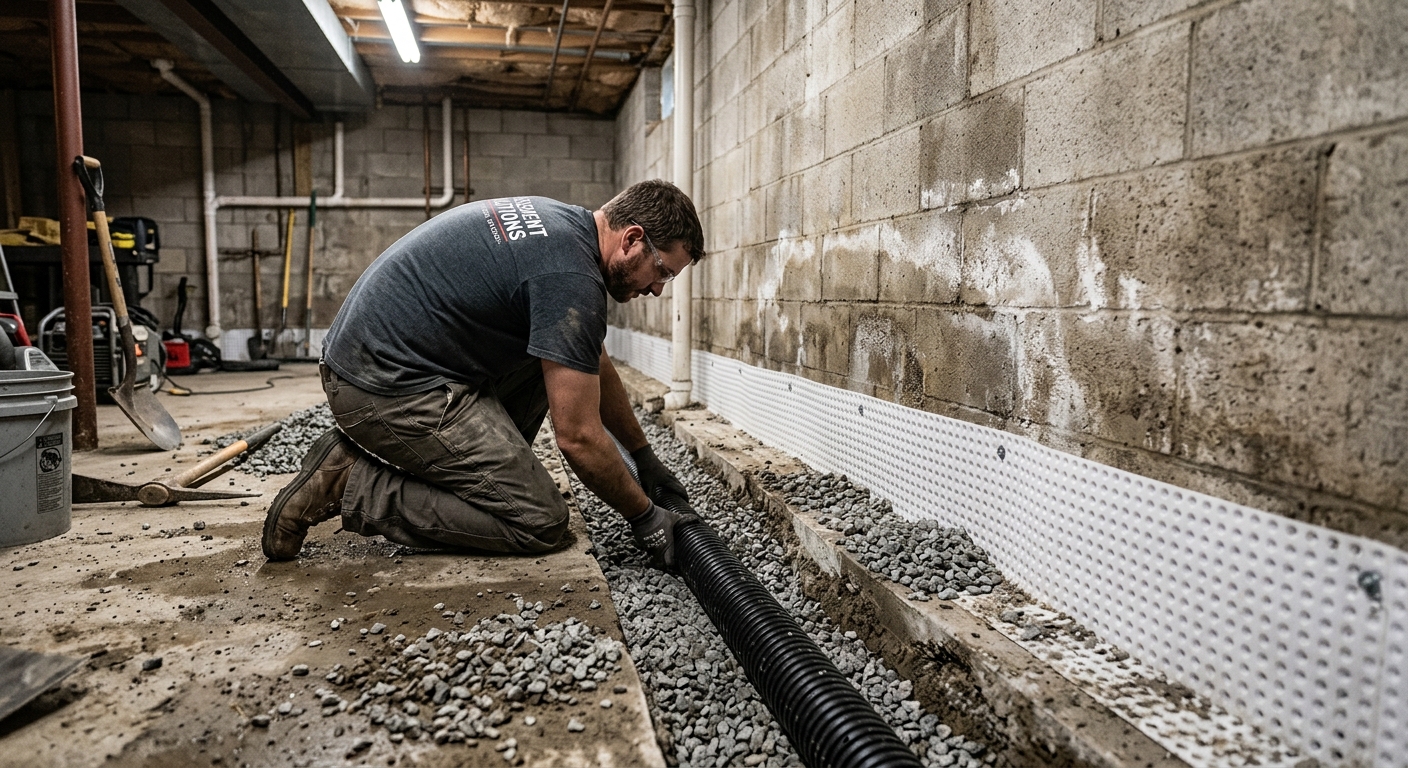
The core difference is simple: exterior waterproofing (full excavation, membrane installation, new drainage tile, and proper backfill/compaction) addresses the source by rebuilding the waterproofing envelope around the foundation. It costs more and causes more disruption, but when it’s done correctly, it usually provides the most complete long-term result. Interior waterproofing (perimeter drain channel, sump pit, and sump pump) addresses water after it enters by capturing and discharging seepage—often the most practical path where excavation access is limited or where the foundation can’t be fully uncovered without major reinstatement.
In Kelowna’s Thompson–Okanagan climate, exterior solutions are especially valuable where soils include clay pockets or dense silts that can keep water against foundation walls longer after storms. Freeze-thaw then turns that persistent moisture into repeating crack activity. That’s also why we see homeowners with older 1960s–1980s housing stock experience recurring wetting when original weeping tile fails. On poured concrete foundations, crack injection (when cracks are static) can seal well; on block walls, interior drainage is often a practical complement because block joints can transmit moisture even after localized sealing.
About sump pumps: in British Columbia, power interruptions can happen during storm events and winter/spring wet periods. A battery backup (or a second backup option) helps keep the system from failing when it matters. If a home is already at the stage of interior flooding, choosing interior drainage plus a reliable sump system can be the most cost-effective move—even though it doesn’t eliminate hydrostatic pressure at the wall.
For dollar perspective: if your situation needs full exterior excavation, you’re often looking at $18,000–$40,000. But for a contained leak pattern—say a short perimeter run with recurring slab edge seepage—interior drainage with sump can stay closer to $9,000–$22,000. A good contractor explains the leak path and recommends the option that reduces repeat repairs, not just the lowest immediate price.
| Method |
Best For |
Addresses Source? |
Disruption |
Lifespan |
Price Band |
| Full exterior excavation + membrane |
Widespread seepage, failed exterior drainage, clay-heavy/high seepage pockets, long exterior runs |
Yes (primary) |
High |
20+ years (system-dependent) |
$18,000–$40,000 |
| Interior French drain + sump system |
Limited access, recurring interior wetting, slab edge/cold-joint seepage where exterior excavation is constrained |
No (secondary management) |
Medium |
Good (depends on pump maintenance) |
$9,000–$22,000 |
| Crack injection — epoxy (structural) |
Cracks that are static and primarily allow water to migrate through surface channels |
Partially (stops water path through the crack) |
Low |
Moderate to long-term |
$1,100–$3,500 |
| Crack injection — polyurethane (active leak) |
Active seepage or cracks with some movement where epoxy may not hold under pressure |
Partially (stops the active water path) |
Low |
Moderate to long-term (best with correct crack assessment) |
$800–$3,200 |
| Interior drain channel only (no sump) |
Light seepage, low-risk sites, or temporary control while you schedule a fuller exterior correction |
No |
Medium to Low |
Shorter (depends on gravity discharge and conditions) |
$6,000–$14,000 |
| Re-grading + downspout extensions |
Surface-water driven wetting (roof runoff hitting foundation), modest dampness near grade |
No (treats contributing surface water) |
Low to Medium |
Variable (must be maintained) |
$1,800–$7,500 |
How to choose a waterproofing contractor in Kelowna
Choosing the right contractor in Kelowna is mostly about verifying proof—not promises. In British Columbia, ask for their current documentation and check it yourself. For licensing, confirm their contractor registration/business status through the appropriate online registry and ensure the company is active for the type of work they’re proposing. For insurance, request a Certificate of Insurance and verify liability coverage limits and dates. For worker protection, confirm WSIB/WCB coverage using a clearance letter or proof they can provide on request; don’t rely on a verbal statement.
Next, get 2–3 itemised written quotes. A strong quote breaks labour and materials line-by-line (excavation methods, membrane system components, drain tile/fittings, sump components, disposal, and reinstatement). Watch for inclusions/exclusions: whether permits are pulled (if required), whether disposal/haul-away is included, and what happens if unexpected conditions are found (like unmarked buried services or extensive concrete removal). Warranty matters too: insist on a workmanship warranty length, product/manufacturer warranty details, and whether the warranty transfers if you sell the home.
Payment schedule should be conservative: never pay more than about 10–15% upfront for mobilization, and hold back a meaningful portion until the job is complete and protected areas are restored. Finally, require a start date and completion estimate in writing, along with a plan for curing/weather delays—critical in Kelowna where spring rains can coincide with excavation and backfill schedules.
- Verify business status and suitability for waterproofing/foundation work in BC before signing.
- Request liability insurance certificate and confirm coverage dates and limits.
- Confirm WSIB/WCB clearance or proof of coverage for the workforce.
- Ask whether a site engineer is involved for structural crack evaluation.
- Get itemised quotes (labour + materials), not a single lump-sum number.
- Confirm what’s included for disposal, backfill, compaction, and reinstatement.
- Ask how they test/confirm discharge routing for sump or downspouts.
- Ensure crack injection method matches crack type (static vs active leak).
- Request photos or examples of similar Kelowna basement/foundation jobs.
- Review warranty length for workmanship and product; confirm transferability.
- Agree on payment schedule (small deposit, holdback until completion).
- Get start/completion dates and weather contingency notes in writing.
Red flags to watch for in Kelowna: (1) vague scopes like “fix the leak” with no leak-path description; (2) quotes that omit sump discharge details, compaction specs, or reinstatement scope; (3) claims that you “don’t need permits” without confirming the scope (especially for structural or drainage service connections); (4) no written warranty terms or a refusal to provide insurance/WSIB/WCB documentation; and (5) pressure to pay large upfront deposits or complete payments before waterproofing testing/close-out.
Frequently asked questions — waterproofing in Kelowna
Why is my basement leaking in Kelowna?
Basement leaks in Kelowna are commonly caused by water that’s entering through foundation joints, cracks, or window well areas—then getting trapped as ground moisture rises during spring rain and snowmelt. In the Thompson–Okanagan, freeze-thaw cycles can widen existing cracks, turning minor seepage into recurring wet patches. Soil also matters: if you have localized clay pockets or dense silt, the ground can hold water longer against the foundation instead of draining away. Older housing stock is more likely to have failing original drainage (weeping tile) and underperforming exterior drains—especially where homes were built before 1981. A proper diagnosis looks at leak timing, staining patterns (slab edge vs wall vs corners), and the exterior discharge path before choosing between exterior excavation or interior drain/sump solutions.
How do I know if a foundation crack is serious?
Not all cracks are emergencies, but some indicators point to a need for closer evaluation in Kelowna. Watch for cracks that widen seasonally, show water seepage, or have a stepped pattern along block mortar lines. Horizontal cracks (especially in block walls) or cracks that appear to shift rather than stay consistent can suggest structural movement and should be assessed before you seal them. Efflorescence (white mineral deposits) and active dampness around a crack usually mean water is finding a path, and sealing the surface alone may not solve it. If the crack is associated with water intrusion after heavy rain or during spring melt, it often needs targeted injection (epoxy for static/structural cracks; polyurethane for active leaks). The safest approach is to have the crack type confirmed so you don’t spend on an injection method that doesn’t match movement.
How much does foundation crack repair cost in Kelowna?
In Kelowna, crack repair pricing depends mainly on how many cracks, the crack length, and whether the crack is active/seeping. For typical injection-only projects, homeowners often see estimates in the range of $800–$3,500 for foundation crack repair, with the higher end when multiple runs must be opened and injected or when active leakage requires a flexible system. If structural concerns are suspected, there may be additional assessment costs due to engineering review before any repair strategy is selected. It’s also common that crack repair alone is not the full solution if exterior drainage is still failing; in those cases, interior drainage or (at the source level) exterior waterproofing may be needed. The best quotes break down labour, drilling/injection quantities, and surface patching so you can compare apples to apples.
Do I need a sump pump in Kelowna?
A sump pump is usually recommended when water is entering and accumulating faster than a gravity drain can handle, or when you have recurring seepage along slab edges/cold joints. In Kelowna’s Thompson–Okanagan climate, spring snowmelt and intense rain events can create short periods of high seepage risk, even if your basement seems fine most of the year. If your interior perimeter drains already exist but water still rises or backs up, the system may need a sump pit and properly sized pump. Because British Columbia weather can coincide with power interruptions, many homeowners choose primary pump plus a backup system (battery backup is common) to reduce the chance of flood damage during outages. Your contractor should evaluate discharge routing, pump size, and whether backup is required for your risk level rather than upselling a standard package.
How does Kelowna's soil affect my foundation?
Kelowna’s soils can vary significantly across the city due to glacial and alluvial deposits. In many areas, you’ll see mixtures of sand, silt, and localized clay pockets. Clay-heavy soils tend to hold moisture and expand more during freeze-thaw, which increases pressure on foundation walls and can worsen cracks over time. Dense silts can also slow drainage, keeping water in contact with the foundation longer after heavy rains. This is one reason quotes for waterproofing can differ so much even between nearby properties. If the ground doesn’t drain freely, the foundation sees more hydrostatic pressure and interior-only fixes may have to work harder (for example, longer sump run times). A good waterproofing assessment checks site drainage patterns and, when possible, the likely moisture sources so you can choose exterior drainage rebuilds or interior management systems appropriately.
Do I need a permit for foundation work in British Columbia?
Often, yes—depending on scope. In British Columbia, foundation excavation, structural crack repair that may affect structural capacity, and changes to lot drainage commonly require a building permit. If a sump pump discharge connects to storm or sanitary services, municipal approval is typically needed. For major structural crack situations (such as horizontal cracks in block walls or cracks that suggest movement), a structural engineer’s assessment is often required to confirm whether underpinning or other structural work is necessary. For homeowners in Kelowna, the best practical step is to ask your contractor to identify what permits are required before starting and to include permit responsibilities in the contract. Also verify the contractor’s credentials (insurance and WSIB/WCB). If they can’t clearly explain the permit pathway for your specific scope, pause and request confirmation in writing.