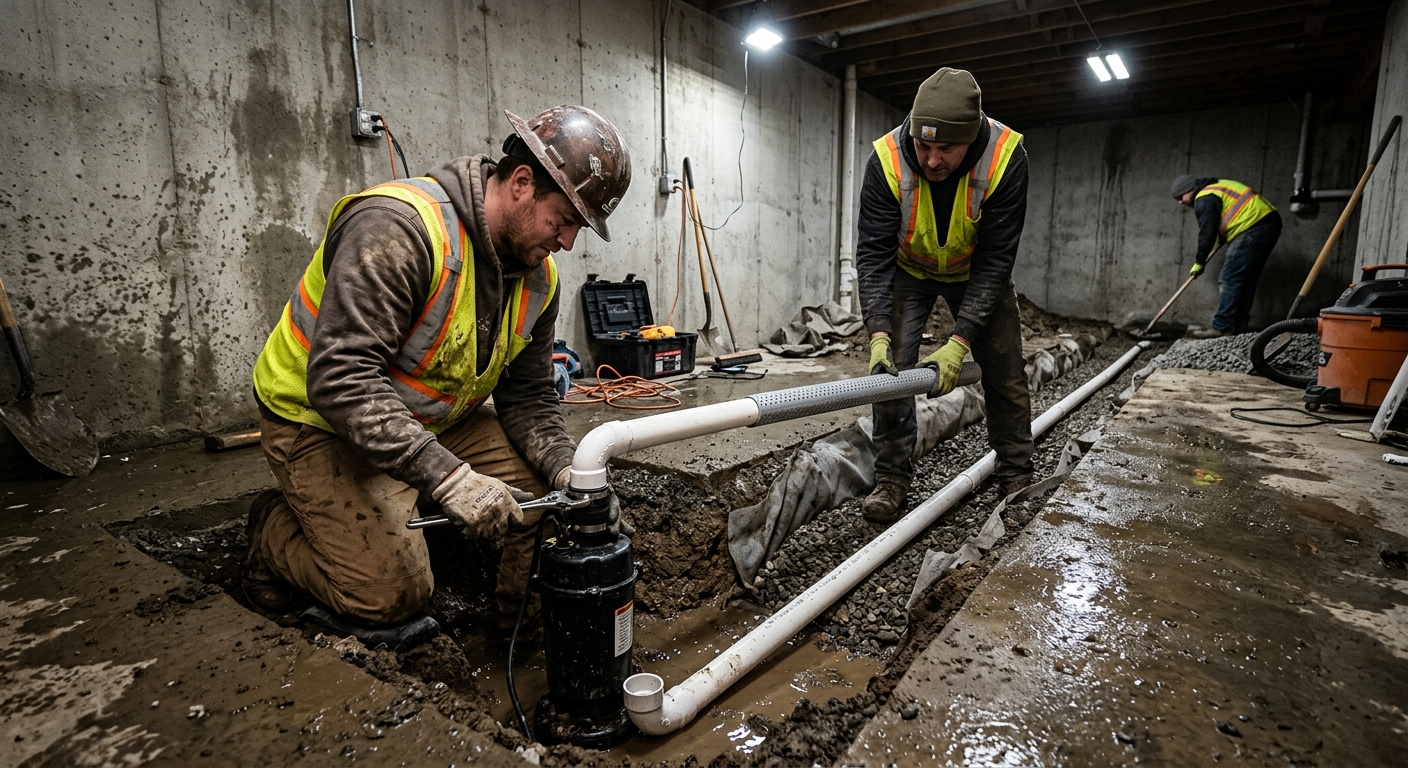
Basement waterproofing options and costs in Kamloops
In Kamloops, basement leaks usually aren’t a “one-product” problem—they’re a site-and-age problem. With 50.8% of local homes built before 1981, many foundations were originally protected by older, now-ineffective drainage approaches (and when we see weeping tile that’s decades old, it’s commonly partially blocked or collapsed). That means water finds its way to slab edges, block joints, or along cold joints, then shows up as dampness, seepage lines, or stained mortar. At the same time, Kamloops sits in a semi-arid Thompson–Okanagan environment where winter freeze-thaw cycles can widen existing cracks and turn minor seepage into active leaks over a few seasons.
Costs in the region vary because the Thompson–Okanagan’s glacial and alluvial soils can include mixes of sand, silt, and localized clay. Clay pockets and dense silts can hold water longer and add lateral pressure compared with freely draining sandy/gravelly sites. If your lot is near creeks, lakes, or lower-elevation drainage paths—or your original exterior drains are undersized—your drainage scope usually expands. On top of that, access constraints in high-demand areas like North Kamloops (especially around older neighbourhoods with mature landscaping and driveways near the foundation) can add labour for excavation, shoring, concrete/asphalt removal, and reinstatement.
Below is a practical comparison of the main waterproofing approaches we price in Kamloops, so you can match the remedy to the cause and then sanity-check what different contractors include.
| Method |
What It Addresses |
Disruption Level |
Durability |
Price Range |
| Exterior excavation + new membrane + drainage tile |
Hydrostatic water at the foundation wall; replaces failed exterior waterproofing and drainage |
High (excavation, removal, reinstatement of landscaping/concrete) |
Long-term (often 20+ years when installed correctly) |
$18,000–$40,000 |
| Interior perimeter drain channel + sump pit |
Water after it enters; intercepts seepage along slab edges or block joints |
Medium (interior floor cutting in targeted areas) |
Good (typically 10–20 years depending on discharge and maintenance) |
$9,000–$22,000 |
| Foundation crack injection (epoxy or polyurethane) |
Stops crack leakage; restores watertightness (product selection depends on active vs inactive cracks) |
Low (drilling ports, cleaning, sealing) |
Moderate to long (can last many years; active leaks may need exterior if pressure persists) |
$800–$3,500 |
| Sump pump installation (primary + battery backup) |
Controls recurring seepage; maintains a dry pit during power interruptions |
Medium (electrical prep, pit construction; minor interior disruption) |
High when paired with proper discharge and backup |
$2,500–$5,500 |
| Window well drain installation |
Surface water intrusion at window wells; reduces seepage around basement openings |
Low to medium (excavate around window wells) |
Good (often 10–15+ years) |
$1,200–$3,000 |
| Lot re-grading / downspout extension |
Redirects roof and surface water away from foundation |
Low (earthwork and drainage adjustments) |
Good (maintenance dependent) |
$1,000–$4,000 |
Prices are estimates only and vary by project scope, site access and material selection.
What affects the price of waterproofing in Kamloops
For the “same” basement leak, Kamloops homeowners often see quotes that differ by 30–50% across the Thompson–Okanagan and broader British Columbia. The biggest reason isn’t brand-to-brand—it’s that foundation water pressure is site-specific, and contractors price the hours and labour around excavation access, disposal, and the amount of drainage work required. National averages also don’t reflect British Columbia’s mix of tight lots, older housing stock, and frequent freeze-thaw impacts that compound crack movement over time.
Three drivers separate Thompson–Okanagan costs from the national average: (1) soil type, (2) water table pockets, and (3) freeze-thaw. Where clay-heavy deposits or dense silts exist, soils can hold water longer and exert more lateral pressure against foundation walls—pushing leaks through mortar lines and cold joints. In parts of Kamloops where drainage is less freely draining, weeping tile replacement and new gravity outlets (or upgraded discharges) can be required, raising scope. In spring and winter, repeated freeze-thaw cycles widen hairline cracks and can convert early seepage into active leaks, which increases labour for cleaning and targeted crack repairs.
Concrete examples: a similar-length leak line (say 12–15 feet) can be a straightforward $800–$3,500 crack injection when the crack is stable and the source is limited to one band. But if inspection shows failed exterior drainage and wet backfill, excavation plus membrane and drainage tile typically moves into $18,000–$40,000. Likewise, interior-only drainage may price nearer $9,000–$22,000, but only when the entry points are manageable and the discharge path is proven.
| Price Factor |
Why It Matters |
Cost Impact |
| Interior vs. exterior approach — interior is less disruptive but addresses symptoms |
Exterior reduces hydrostatic pressure at the wall; interior intercepts after entry |
Exterior can cost ~2x+ when excavation and reinstatement are required |
| Foundation type — poured concrete vs. block vs. stone vs. ICF |
Different wall construction and crack behaviour changes prep and repair method |
Poured concrete often responds well to targeted injection; block/stone may need interior drainage support |
| Soil type — clay expands more than sand, adding pressure |
Clay holds moisture and exerts higher lateral pressure during thaw cycles |
May increase drainage scope and crack repair frequency |
| Crack type and length — hairline vs. structural horizontal cracks |
Structural movement may require engineering and more than “sealing” |
Structural work can push a simple injection into higher-scoped repairs |
| Sump pump backup system — battery or water-powered backup needed |
Power interruptions during wet/spring periods can overwhelm a primary pump |
Backup adds cost but prevents flood events |
| Access — landscaping, decks, or driveways must be removed for exterior |
Excavation access controls labour time, shoring, and disposal |
Can materially increase exterior waterproofing totals |
| Weeping tile age — original tile (60+ years) may be completely failed |
Old perforated pipe often collapses or clogs |
Exterior scope may expand from “repair” to full replacement |
| Mould or efflorescence remediation required before sealing |
Sealing over active contamination without remediation risks failure and indoor air issues |
Additional steps and materials add time and cost |
Permits & regulations in British Columbia
In British Columbia, foundation excavation, structural crack repair, and changes to lot drainage typically require a building permit. Sump pump installations that connect into municipal drainage systems (storm or sanitary) need municipal approval, because discharge location and routing must meet local requirements. Where you have structural cracking—such as major step cracks in block walls or horizontal cracking that suggests movement—a structural engineer’s assessment is often required to determine whether underpinning or other structural work is needed.
For Kamloops homeowners, the practical rule is: if the work involves the foundation structure, altering drainage routing, or creating new discharge connections, plan on permits and paperwork. What typically does NOT require a permit is limited interior drying and sealing after you’ve already confirmed there is no structural concern—such as targeted interior drainage channel installation—though you should confirm with your contractor and local permit office because scopes vary.
Step-by-step, verify a contractor in British Columbia:
- Find the company’s licence/registration details through the relevant provincial registry where applicable for their trade category.
- Ask for a certificate of liability insurance and confirm the expiry date and named insured.
- Confirm WSIB/WCB coverage status (request documentation and clearance/coverage letters if applicable).
- For structural crack repairs, request whether they coordinate engineering support and whether it’s included or billed separately.
- Require a written scope that states what permits (if any) the contractor pulls, and what you’re responsible for.
Interior vs exterior waterproofing — what does Kamloops need?
In Kamloops, the core difference is whether you stop water at the foundation (exterior) or manage it after it enters (interior). Exterior waterproofing—full excavation, new membrane, new drainage tile, and backfill—addresses the source by reducing hydrostatic pressure against the wall. It costs more, but it’s the most “permanent” approach when the exterior drainage system has failed or the soil holds water longer (a realistic concern in Thompson–Okanagan clay pockets and silty zones). It also involves more disruption because landscaping, and sometimes concrete/asphalt, must be removed and reinstated.
Interior waterproofing (perimeter drain channel, sump pit, and sump pump) manages water after it gets in. It’s less invasive and often the better first move when access to the exterior is limited or when the wall condition is stable enough to repair from the inside. However, interior systems don’t eliminate hydrostatic pressure on the foundation wall itself; they intercept seepage at slab edges and along perimeter lines.
Which approach fits Kamloops? Poured concrete walls typically benefit from crack injection (when the crack is stable and properly prepped), while block foundations often need interior drainage as a practical complement because block joint movement and mortar voids can keep letting water in. If you have a long-running seepage line and wet backfill evidence, interior-only work may cost less upfront—often in the $9,000–$22,000 band—but can also lead to recurring pump cycles if exterior pressure remains high.
Example: if your investigation shows failed weeping tile and saturated soil around the wall, exterior waterproofing at $18,000–$40,000 is more justifiable than repeated interior interventions—especially through spring freeze-thaw and snowmelt events. If, instead, you have localized dampness controlled by short crack segments and a stable drainage outlet, interior crack repair plus sump management may be a more cost-effective fit.
| Method |
Best For |
Addresses Source? |
Disruption |
Lifespan |
Price Band |
| Full exterior excavation + membrane |
Exterior drainage failure, sustained seepage, wet backfill, or high-pressure conditions |
Yes |
High |
20+ years when maintained |
$18,000–$40,000 |
| Interior French drain + sump system |
Intermittent seepage, limited exterior access, or as a complement to wall repairs |
No (manages after entry) |
Medium |
10–20 years |
$9,000–$22,000 |
| Crack injection — epoxy (structural) |
Stable cracks that are not actively leaking under pressure |
Sometimes (seal only if crack is stable) |
Low |
Moderate to long |
$800–$3,500 |
| Crack injection — polyurethane (active leak) |
Active seepage where the crack is still moving water |
Sometimes (can stop leaks at the crack) |
Low |
Moderate (best paired with drainage strategy) |
$800–$3,500 |
| Interior drain channel only (no sump) |
Minor dampness or limited seepage where gravity drainage is adequate |
No |
Medium |
Limited by drainage discharge reliability |
$6,000–$14,000 |
| Re-grading + downspout extensions |
Surface runoff issues, gutter overflow, and water pooling near the foundation |
No (helps reduce entry) |
Low |
Good (often needs periodic maintenance) |
$1,000–$4,000 |
How to choose a waterproofing contractor in Kamloops
Choosing the right waterproofing contractor matters because waterproofing is partly science and partly “scope control.” Start with credentials. In British Columbia, verify the contractor’s licensing/registration where applicable to their trade category, then request proof of liability insurance (certificate of insurance) and WSIB/WCB clearance for their workers. Don’t accept “we’re covered” without documentation—ask for the certificate and confirm coverage details, including the policy period. If the contractor is proposing structural crack repairs, ask whether they coordinate with engineering support and whether it’s included in the quote or add-on.
Next, get 2–3 itemised written quotes. You want a breakdown of labour and materials, not just a lump sum: membrane type, drainage tile spec, pipe connections, disposal, concrete/asphalt removal, backfill, and how reinstatement is handled. Read exclusions carefully—especially whether the quote includes permit pulling, excavation shoring, and site restoration. Confirm what happens if they discover additional failed weeping tile lengths once excavation starts.
Warranty and payment schedule protect you long-term. Ask for the workmanship warranty length and whether the product/manufacturer warranty is transferable to future owners. For payment, never pay more than 10–15% upfront; hold back until key milestones are completed. Finally, require a timeline in writing: start date, number of working days, and estimated completion date.
- Ask for a written scope that names the exact crack length and repair method (epoxy vs polyurethane).
- Require an inspection plan: hose test, moisture mapping, camera inspection (where applicable).
- Confirm whether pump discharge is gravity to daylight or pumped to a permitted outlet.
- Check that excavation includes shoring/benching where required for safe access.
- Ensure disposal of old drainage materials and contaminated backfill is included.
- Verify reinstatement line items: topsoil, sod, paving/sidewalk repairs, or concrete patching.
- Ask what happens if exterior drainage can’t be upgraded to meet performance targets.
- Confirm warranty: workmanship (years) and what it covers (labour/material replacement).
- Ask whether the contractor’s warranties are backed by a service process you can contact later.
- Require clear product specs (membrane, drainage board, filter fabric, sealants).
- Get a schedule with milestones (rough-in, membrane install, backfill, testing, final inspection).
- Review payment terms and ensure holdback is written into the contract.
In Kamloops, common red flags include: quotes that don’t include excavation/disposal or reinstatement line items for exterior work; no documentation for liability insurance or WSIB/WCB coverage; vague “we’ll just seal it” language with no crack type decision (epoxy vs polyurethane); a lack of written scope for pump discharge and backup; and warranties that only cover “materials” with no workmanship coverage.
Frequently asked questions — waterproofing in Kamloops
Why is my basement leaking in Kamloops?
Basement leaks in Kamloops are usually caused by water pressure and entry points that worsen over time. With many homes built before 1981 (Statistics Canada, 2021 Census), older original drainage systems and sealing details can be less effective, and failed weeping tile commonly leads to seepage at slab edges and along cold joints. Thompson–Okanagan soils can include sand, silt, and localized clay, which means some lots drain quickly while others hold moisture longer and increase lateral pressure during thaw cycles. Freeze-thaw also plays a role: it widens existing cracks and joints, turning small dampness into active leaking. If the discharge route is undersized or clogged, interior symptoms can appear even when the real cause is exterior drainage.
How do I know if a foundation crack is serious?
Not all cracks mean structural failure, but you should treat certain patterns seriously. In British Columbia, “serious” cracks often show movement characteristics (horizontal cracking in block walls, step cracking that grows, or cracks that widen seasonally) and symptoms like active seepage, damp mortar, or persistent efflorescence. If you see water staining, dripping during spring snowmelt, or crack movement after freeze-thaw, prioritize investigation rather than cosmetic sealing. A qualified contractor should assess crack type and whether you need epoxy (for stable cracks) or polyurethane (for active leak conditions). For structural concerns, a structural engineer assessment may be required before sealing or underpinning is considered.
How much does foundation crack repair cost in Kamloops?
For many Kamloops homes, foundation crack repair is one of the smaller line items compared with drainage work. Typical crack repair budgets fall around $800–$3,500, depending on crack length, how many injection points are required, whether the crack is actively leaking, and how much prep/cleaning is needed. Stable, non-leaking cracks may be treated with epoxy, while active leaks generally need polyurethane to stop water flow at the crack. That said, if the crack is simply the “path” and the real cause is high exterior water pressure, injection alone may not be enough. In those cases, interior drainage (often $9,000–$22,000) or exterior excavation (often $18,000–$40,000) may be required.
Do I need a sump pump in Kamloops?
You may need a sump pump when seepage is recurring, the foundation perimeter water cannot be managed by gravity drainage, or power interruptions could cause backup flooding. Kamloops spring snowmelt and freeze-thaw can increase runoff and lead to higher seepage levels, especially in lower-elevation lots or where soil holds water longer. Many homeowners benefit from a primary pump paired with a backup system (battery backup is common) so a short outage doesn’t overwhelm the pit. If you’re considering an interior perimeter drain approach, a sump is often part of making the system reliable. A proper scope assessment should confirm discharge routing and whether a municipal approval is required for how and where the pump drains.
How does Kamloops's soil affect my foundation?
Soil affects waterproofing cost and performance because it controls how quickly water moves through—or how long it stays against your foundation. In the Thompson–Okanagan, glacial and alluvial deposits can include mixes of sand, silt, and localized clay. Clay pockets and dense silts tend to hold moisture longer and can create greater lateral pressure against foundation walls during thaw cycles. That can worsen cracks over time and increase the need for proper drainage tile, clean backfill, and membrane detailing. If your site is more freely draining (sandy/gravelly), you might be able to manage seepage with less excavation or with interior drainage solutions. The key is matching the waterproofing method to the actual site soil and water behaviour.
Do I need a permit for foundation work in British Columbia?
In British Columbia, permits are commonly required for foundation excavation, structural crack repair, and changes to lot drainage, because these can affect structural integrity and how water is managed. Sump pump installations that connect to storm or sanitary systems generally require municipal approval, since discharge routes must meet local requirements. Where structural cracking is suspected—like major step cracks or horizontal cracks—a structural engineer assessment is often needed to confirm whether underpinning or other structural work is required. To protect yourself, ask your Kamloops contractor to specify what permits they will pull, and request written confirmation of coverage for engineering support when it’s part of the scope. If a contractor won’t discuss permits and documentation, that’s a serious concern.