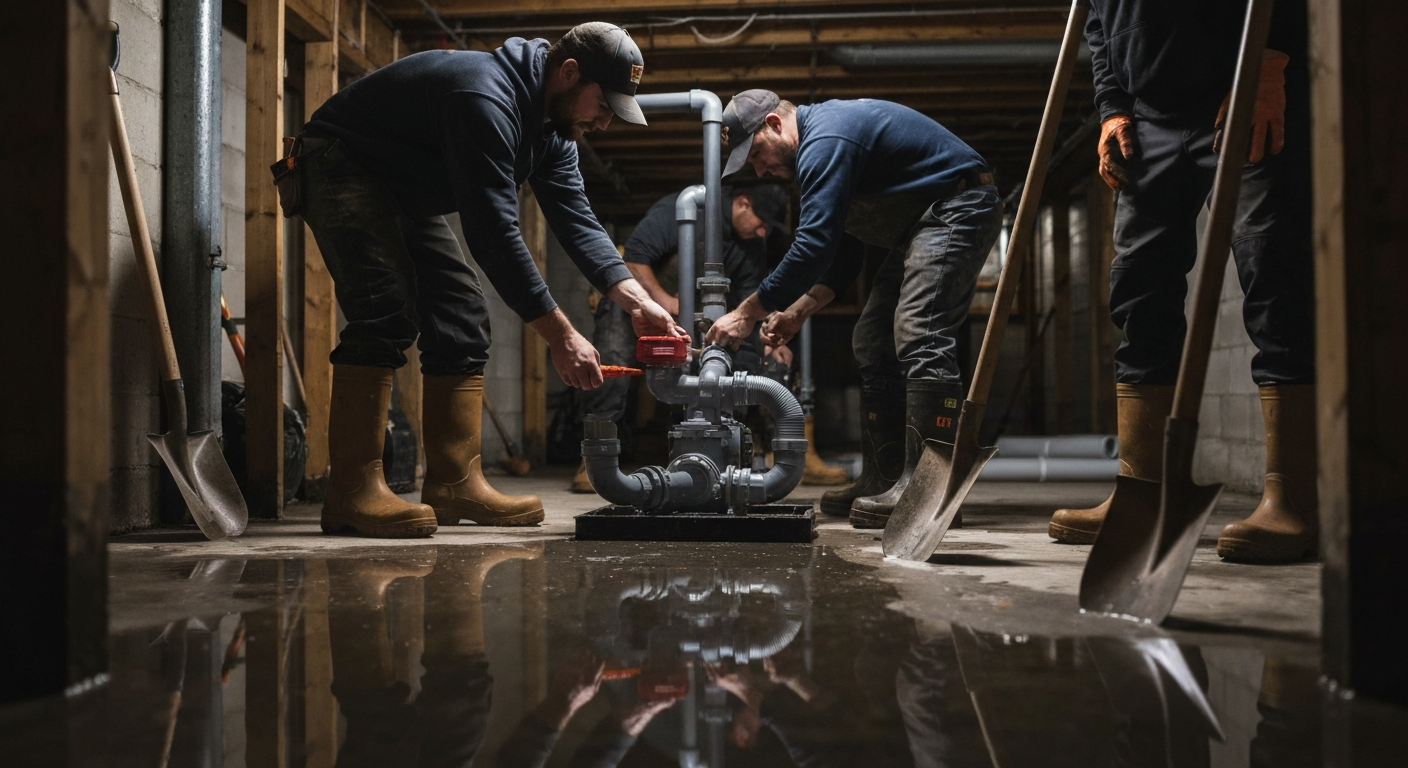
Basement waterproofing options and costs in Coquitlam
Coquitlam homeowners typically have a clear decision to make: whether to manage moisture from inside, or to remove the water source with a full exterior system. In Coquitlam, with a population of 148,625 (Statistics Canada, 2021 Census) and 38,790 homeowner households, many properties have been through multiple wet seasons and, for older houses, multiple drainage cycles. About 29.6% of homes were built before 1981 (Statistics Canada, 2021 Census), and those foundations are more likely to have aging waterproofing details and original weeping tile that no longer performs as intended.
In the Lower Mainland–Southwest, the cost equation is driven by soil saturation, groundwater behaviour, and long-running hydrostatic pressure. Even when a home is newer, intense, prolonged rainfall can keep the backfill saturated and increase water entry through cracks and joints. That’s why quotes in areas like Westwood Plateau and older pockets near Lougheed Highway can land at the higher end: excavation is labour-intensive on tighter lots, and contractors often need more mechanical breaking time where rocky sections slow down trenching.
Because of these local realities—plus wet, mild winters that still bring freeze-thaw stress—two contractors can quote different methods for the same leak. The most reliable way to compare options is to look at what each method addresses, how disruptive it is, and the realistic price range in our market, then choose the approach that matches your foundation, drainage condition, and budget. Use the table below as a starting point for discussing your scope.
| Method |
What It Addresses |
Disruption Level |
Durability |
Price Range |
| Exterior excavation + new membrane + drainage tile |
Primary water-source control by rebuilding the waterproofing and perimeter drainage system |
High (excavation, landscaping restoration) |
Long-term (often 20+ years with correct installation) |
$15,000–$30,000 |
| Interior perimeter drain channel + sump pit |
Captures water that enters and relieves pressure at the basement floor/wall junction |
Medium (floor/ceiling work, limited demolition) |
Good (commonly 10–20 years depending on discharge and backup) |
$8,000–$18,000 |
| Foundation crack injection (epoxy or polyurethane) |
Seals cracks; epoxy for repaired/mostly dry cracks, polyurethane for active seepage |
Low to medium (minor surface prep) |
Moderate to long-term (depends on crack movement and pressure) |
$500–$2,000 |
| Sump pump installation (primary + battery backup) |
Moves collected groundwater away to reduce seepage and basement flooding risk |
Low to medium (pit cutout and plumbing) |
Long-term if discharge and backup are maintained |
$1,000–$5,000 |
| Window well drain installation |
Stops rainwater and surface runoff from pooling and migrating under the window area |
Low (localized excavation) |
Good (localized system when installed to grade) |
$1,500–$4,500 |
| Lot re-grading / downspout extension |
Reduces surface water that contributes to saturated soil around the foundation |
Low to medium (topsoil, grading, minor landscaping) |
Variable (best when combined with drainage improvements) |
$2,000–$7,000 |
Prices are estimates only and vary by project scope, site access and material selection.
What affects the price of waterproofing in Coquitlam
In Coquitlam and across the Lower Mainland–Southwest, waterproofing quotes for the “same” basement leak can differ by about 30–50% because the underlying cause is often hidden until excavation, core samples, or camera inspections confirm where water is actually entering. Contractors may also price differently based on how much drainage rebuilding is required, how much masonry or slab-breaking they expect, and whether backup systems are included. In practice, you’re not only paying for materials—you’re paying for the excavation plan, disposal, patching/restoration, and the labour time needed on tight urban lots.
The three biggest regional cost drivers that separate Lower Mainland–Southwest work from the national average are soil/water behaviour, hydrostatic pressure from high groundwater, and freeze-thaw stress. Unlike clay-heavy, highly expansive soils in parts of Ontario and the Prairies that can push walls through expansion, coastal BC issues often show up as persistent saturation: backfill stays wet, hydrostatic pressure stays higher, and seepage continues through joints and cracks. When freeze-thaw hits, existing cracks widen and seals are stressed, especially around older penetrations. If the home is in an older housing pocket—again, those pre-1981 builds at 29.6%—original perimeter weeping tile and exterior drainage details are more likely to be partially clogged or completely failed.
Concrete examples from Coquitlam: (1) a poured-concrete foundation with stable vertical cracking may be resolved with crack injection in the $500–$2,000 band, while (2) a similar crack in block with active seepage frequently triggers a $8,000–$18,000 interior drainage retrofit because water continues to enter under pressure. (3) If excavation reveals rocky sections, costs rise—more mechanical breaking and longer trenching time push exterior waterproofing toward the $15,000–$30,000 end.
| Price Factor |
Why It Matters |
Cost Impact |
| Interior vs. exterior approach — interior is less disruptive but addresses symptoms |
Exterior rebuilds the water entry control; interior manages water after entry |
Interior often 30–50% less; exterior often 1.5–2.5x when excavation and restoration are needed |
| Foundation type — poured concrete vs. block vs. stone vs. ICF |
Different substrates and joint types affect crack sealing and drainage performance |
Block/older masonry typically costs more due to more difficult detailing and higher failure risk |
| Soil type — clay expands more than sand, adding pressure |
Soils change how quickly water saturates and how pressure builds against walls |
More pressure and movement usually increases drainage and seal scope |
| Crack type and length — hairline vs. structural horizontal cracks |
Active/structural cracks require different materials and sometimes engineer input |
Structural concerns can quickly move the project into higher bands |
| Sump pump backup system — battery or water-powered backup needed |
Reduces flood risk during outages during heavy spring wet periods |
Often adds a few thousand dollars depending on system type |
| Access — landscaping, decks, or driveways must be removed for exterior |
Tight sites increase demolition, excavation time, and restoration cost |
Can materially shift pricing toward the top of the exterior band |
| Weeping tile age — original tile (60+ years) may be completely failed |
Failed tile drives water inward and can overwhelm interior systems |
May require full replacement drainage and/or exterior excavation |
| Mould or efflorescence remediation required before sealing |
Moisture must be addressed first; porous surfaces need proper remediation |
Increases labour and materials prior to waterproofing steps |
Permits & regulations in British Columbia
In British Columbia, waterproofing and foundation-related work can trigger permits depending on how invasive it is and whether it affects drainage or structural performance. Typically, foundation excavation and changes that alter lot drainage (including redirecting or modifying how water is handled around the foundation) require a building permit. Structural crack repair—especially horizontal cracking in block walls or any crack pattern that suggests movement—often needs assessment by a structural engineer, and the permit path may follow that engineer’s recommendations.
Sump pump installations can also require municipal approval when discharge ties into storm or sanitary systems. The exact requirement depends on how the discharge line is routed and where it ultimately connects, so the safest approach is to confirm the intended discharge method before work starts.
For Coquitlam homeowners, the practical step-by-step verification is:
- Ask the contractor for their proof of British Columbia licence/registration where applicable, plus their company details and address.
- Request a current certificate of liability insurance showing the contractor is insured for the work.
- Ask for WSIB/WCB clearance (or the equivalent coverage documentation they use in BC). Verify dates and that it matches the legal name of the contractor.
- For structural crack repairs, confirm they have engineering support: either an engineer retained by them, or a process that coordinates with the homeowner’s engineer.
- Keep copies of everything submitted—permits, scope documents, and insurance pages—before any payment schedule starts.
If a contractor can’t show documentation promptly, that’s a sign to pause and request clarification in writing.
Interior vs exterior waterproofing — what does Coquitlam need?
The fundamental difference is simple: exterior waterproofing targets the source of water entry, while interior waterproofing manages water after it’s already entered the basement. In Coquitlam’s Lower Mainland–Southwest climate—where heavy rainfall saturates soil and where hydrostatic pressure can persist through wet seasons—an exterior system (excavation, new membrane, new drainage tile, and properly controlled backfill drainage) is the most permanent solution. However, it’s significantly more expensive and disruptive because it requires landscaping removal, mechanical excavation, and full restoration.
Interior waterproofing—perimeter drain channel, sump pit, and sump pump—does not stop water pressure from building against the foundation wall; instead, it captures water at the interior perimeter and helps prevent pooling and seepage from migrating. This can be the right fit when access is constrained, when the homeowner wants limited disruption, or when the foundation condition suggests interior drainage can reliably manage the inflow. In Coquitlam, poured concrete walls often respond well to properly matched crack injection (when the crack is not actively moving), while block foundations frequently benefit from a combined strategy: interior drainage plus targeted crack sealing or detailed interior wall treatment as a practical complement.
British Columbia power interruptions are rare, but outages during storms and wet periods do happen, so when a sump system is installed, backup matters. A basic primary-only sump can be vulnerable; adding battery backup (or a comparable backup method) reduces flood risk during high rainfall cycles.
For a dollar example: if you have a localized seep at a crack line and tests show minimal hydrostatic pressure, crack injection might fall in the $500–$2,000 band. But if the same home shows recurring water at the slab edge and the weeping tile is failing, an interior perimeter drain plus sump can be closer to the $8,000–$18,000 band—and that higher spend is justified because it addresses ongoing water entry, not just one crack.
| Method |
Best For |
Addresses Source? |
Disruption |
Lifespan |
Price Band |
| Full exterior excavation + membrane |
Persistent seepage, failing perimeter drainage, or high hydrostatic pressure |
Yes (most direct source control) |
High |
20+ years when properly detailed and maintained |
$15,000–$30,000 |
| Interior French drain + sump system |
Water collection inside after it enters; when exterior access is limited |
No (relieves and collects) |
Medium |
10–20 years depending on pump/discharge/backup |
$8,000–$18,000 |
| Crack injection — epoxy (structural) |
Cracks that are not actively leaking and are stable |
Mostly (seals the crack path) |
Low to medium |
Moderate to long-term if movement is controlled |
$500–$2,000 |
| Crack injection — polyurethane (active leak) |
Active seepage or damp cracks with ongoing water flow |
Partially (seals active seep while water is managed) |
Low to medium |
Moderate; may require drainage improvements if pressure is high |
$700–$2,500 |
| Interior drain channel only (no sump) |
Minor localized seepage where discharge can be gravity-fed |
No (collects inside) |
Medium to low |
Variable; depends on whether water can drain reliably |
$6,000–$12,000 |
| Re-grading + downspout extensions |
Surface-water problems at foundation edges, clogged or undersized downspouts |
Sometimes (reduces incoming load) |
Low to medium |
3–10+ years if grading remains correct |
$2,000–$7,000 |
How to choose a waterproofing contractor in Coquitlam
Choosing the right waterproofing contractor in Coquitlam is mostly about verification and clarity. Start by confirming British Columbia credentials: request their applicable licence/registration information and ask for proof of liability insurance showing coverage for the scope they’re bidding. Then ask for WSIB/WCB clearance documentation (or the BC-equivalent coverage evidence they provide for workers). Verify the certificate’s company name matches the contractor you’re hiring and that it’s current—expired paperwork is a common sign of poor admin controls.
Next, request 2–3 itemised written quotes. A good quote breaks down labour and materials line-by-line (excavation/disposal, membrane/drain tile, patching, sump pit work, pump and backup, and restoration), rather than one lump sum. Look for explicit inclusions and exclusions: is disposal included? Is the permit pull included (if required)? Is landscape restoration included to a defined standard? Will they camera-inspect or assess weeping tile condition before recommending an interior-only vs exterior plan?
Warranty matters. Ask for both workmanship warranty length and product/manufacturer warranty details. Confirm whether the warranty is transferable if you sell the house, and whether it covers labour for defects—not just materials. For payment, never accept a schedule with more than 10–15% upfront; hold back a portion until key milestones are complete. Finally, get the start date and an estimated completion timeline in writing, including what weather impacts the schedule in BC’s wet months.
- Confirm BC licence/registration and company legal name.
- Verify liability insurance is active and covers the project type.
- Request WSIB/WCB clearance (or equivalent BC coverage documentation) with current dates.
- Get 2–3 itemised quotes (not a lump sum) with labour/material breakdown.
- Ask what’s included in excavation, disposal, and restoration.
- Clarify whether permit pull is included when needed.
- Confirm the discharge plan for any sump pump (where it goes and how).
- Ask whether they recommend backup power and what type is included.
- Review warranty length for workmanship and product components separately.
- Ask if warranties are transferable to future owners.
- Set a milestone-based payment schedule with a holdback.
- Ensure timelines and key steps are written into the contract.
Red flags specific to waterproofing in Coquitlam include: vague scopes that don’t specify drain tile or membrane details; refusal to provide insurance/coverage documents; quoting an interior solution while ignoring evidence of failing perimeter drainage; “guarantees” that promise no future moisture without testing or inspection; and payment requests that ask for large upfront deposits with no milestone structure.
Frequently asked questions — waterproofing in Coquitlam
How much does basement waterproofing cost in Coquitlam?
In Coquitlam, typical basement waterproofing costs depend on whether you’re addressing the source outside or managing water entry inside. Exterior waterproofing (excavation, membrane, and new drainage tile) commonly lands in the $15,000–$30,000 range because access is tight and excavation/disposal plus restoration are labour-heavy. Interior waterproofing—such as a perimeter drain channel with sump pit and pump—often falls in the $8,000–$18,000 band. Local drainage fixes like re-grading and downspout extensions may be a lower-cost first step, but they’re usually appropriate when surface water is the main driver. If your home is one of the older Coquitlam builds (with 29.6% built before 1981, Statistics Canada, 2021 Census), failed weeping tile can increase the likelihood you’ll need a more comprehensive solution.
Interior vs exterior waterproofing — which is better?
“Better” depends on the cause of the leak. Exterior waterproofing is best when groundwater and hydrostatic pressure are the primary issue—because full excavation and new drainage tile rebuild the water path before it reaches your foundation. In Coquitlam’s Lower Mainland–Southwest climate, where prolonged wet periods keep backfill saturated, exterior solutions are often the most permanent. Interior waterproofing can be better when you can’t excavate due to site constraints or when you’re managing existing water that enters through cracks and joints. Interior systems like a perimeter French drain and sump pump in the $8,000–$18,000 band relieve pressure by capturing inflow, but they generally don’t stop hydrostatic pressure outside the wall. A good contractor will recommend the approach based on foundation type, drainage evidence, and likely water entry points—not just appearance.
Why is my basement leaking in Coquitlam?
Common causes in Coquitlam include failing perimeter drainage (weeping tile), water migrating from saturated backfill, and cracks or joints widened by wet/mild winters and freeze-thaw stress. Older foundations are more likely to have drainage that no longer performs; with 29.6% of homes built before 1981 (Statistics Canada, 2021 Census), many still rely on original drainage details that may be partially blocked or undersized. Leaks can also be driven by surface water—poor downspout discharge or grading that lets runoff pool near the foundation. If you only notice dampness at specific locations (for example, along a single crack line or near a window well), the cause may be localized, and targeted crack injection or a window well drain could help. But if water shows up repeatedly at the slab perimeter or floor area after heavy rain, it usually signals a drainage/pressure problem that requires a more comprehensive interior or exterior approach.
How do I know if a foundation crack is serious?
A foundation crack is more concerning when it’s horizontal (especially on block walls), shows signs of movement, widens over time, or is accompanied by active seepage, bulging, or moisture along the crack line. In Coquitlam, freeze-thaw can widen existing defects and turn a damp crack into an active leak, so what matters is whether the crack is stable and dry or actively transferring water. Hairline vertical cracks may be non-structural, but they still can leak during prolonged rain if the crack path is connected to groundwater. A professional should assess crack type, measure lengths, and confirm whether water is actively passing through. For stable cracks, epoxy injection may be considered; for active seepage, polyurethane is often used. If you’re seeing efflorescence (white mineral staining) or ongoing dampness, treat it as a priority before water accelerates deterioration.
How much does foundation crack repair cost in Coquitlam?
Foundation crack repair in Coquitlam often starts with injection sealing, and typical pricing usually sits in the $500–$2,000 band depending on the number of ports/patch locations, crack length, and whether the crack is actively leaking. Epoxy (commonly used for stable, mostly dry cracks) can be a lower-cost option when movement is minimal. Polyurethane injection is usually chosen for active seepage and may come out a bit higher because it’s designed to manage water flow during sealing. If the crack repair reveals larger drainage issues—such as failed weeping tile or ongoing hydrostatic pressure—the cost may shift from a small repair into a larger interior or exterior drainage project. That’s why reputable contractors evaluate the leak source first rather than quoting injection alone every time.
Do I need a sump pump in Coquitlam?
You may need a sump pump if water is collecting at the basement floor after it enters and gravity drainage isn’t reliable. In Coquitlam’s Lower Mainland–Southwest climate, heavy rainfall can keep soil saturated and maintain higher groundwater pressure, which means a passive interior drain channel might not be enough. A sump pump installation commonly falls within the $1,000–$5,000 range, with the upper end often related to adding backup power. Because British Columbia can experience power interruptions during severe weather events, backup systems (battery or comparable options) are frequently recommended when basement flooding would cause major damage. If you have repeated water in the same area after storms or you see pooled water at the slab edge, that’s strong evidence your system benefits from active pumping. A contractor should confirm discharge routing and, when required, obtain approvals before connecting discharge to storm or sanitary systems.