Basement waterproofing options and costs in Coldstream
Basement waterproofing in Coldstream usually starts with one question: where is the water coming from—surface runoff, failed weeping tile, foundation cracks, or a combination? Coldstream’s housing stock is older than many parts of Metro Vancouver; with 45.2% of homes built before 1981, it’s common to find aging tar-and-paper style systems and original weeping tile that no longer drains reliably. In a town where 3,675 homeowner households make up most occupied homes ((Statistics Canada, 2021 Census)), homeowners tend to preserve foundations once interior water shows up, which drives steady demand for both interior and exterior waterproofing work.
In the Thompson–Okanagan, costs are strongly site-driven. Semi-arid valleys and variable soils (sand/silt mixes with localized clay pockets) can mean some streets drain quickly while others hold water against the foundation longer. When freeze-thaw repeats, fine cracks widen and turn intermittent seepage into seasonal, measurable leaks. Spring snowmelt and heavy rain events can also raise seepage risk near creeks and low areas, and that’s when contractors in the Coldstream area around the North Coldstream / Highlands side of town often get the most calls for drainage upgrades.
The sections below outline common repair paths and what each method typically addresses, then summarizes realistic cost ranges for Coldstream projects in the table.
| Method |
What It Addresses |
Disruption Level |
Durability |
Price Range |
| Exterior excavation + new membrane + drainage tile |
Water at foundation exterior, failed weeping tile, hydrostatic pressure |
High (excavation, regrading, landscaping/concrete reinstatement) |
High (source control; typically best long-term fix) |
$18,000–$40,000 |
| Interior perimeter drain channel + sump pit |
Water that has entered the foundation, slab edge/sill seepage |
Medium (interior demolition along perimeter) |
Medium to High (depends on continued entry points) |
$9,000–$22,000 |
| Foundation crack injection (epoxy or polyurethane) |
Cracks and joints—epoxy for non-moving/structural cracks; polyurethane for active leaks |
Low to Medium (minor drilling/patching) |
Medium (highly dependent on crack type and wall movement) |
$800–$3,500 |
| Sump pump installation (primary + battery backup) |
Relieves interior water; manages intermittent or seasonal seepage |
Low (usually confined to sump location and minor piping) |
Medium to High (backup improves resilience during power outages) |
$2,500–$5,500 |
| Window well drain installation |
Localized water around egress/window wells and perimeter grading |
Medium (excavation around window area) |
Medium (best when paired with correct downspouts/grade) |
$1,200–$3,200 |
| Lot re-grading / downspout extension |
Reduces surface water pushing toward foundation |
Low to Medium (depends on landscaping and access) |
Low to Medium (a prevention step, not a sole fix) |
$2,000–$6,500 |
Prices are estimates only and vary by project scope, site access and material selection.
What affects the price of waterproofing in Coldstream
Even when homeowners in Coldstream are dealing with the “same” symptom—wet concrete after a storm—quotes can differ by 30–50% across the Thompson–Okanagan and across British Columbia. The main reason is that waterproofing is priced by site conditions and how much correction is required, not just by the brand of membrane or the thickness of pipe.
Three drivers separate local Thompson–Okanagan pricing from the national average: soil type, water table behaviour, and freeze-thaw. Clay-heavy soils and dense silts can hold water against foundation walls longer and increase lateral pressure, which can worsen cracks over a few seasons. In high-water-table pockets, sump systems run more frequently, which increases piping scope and makes backups more valuable. In British Columbia’s weather swings, heavy rain can saturate backfill quickly when original drainage fails, so interior work can expand to manage persistent inflow.
To make it concrete: a homeowner with an older foundation where the original weeping tile is likely failed (common in pre-1981 homes—remember 45.2% of Coldstream stock is that age ((Statistics Canada, 2021 Census))) may need full exterior excavation that falls in the $18,000–$40,000 band. Another homeowner on a better-draining, sandier lot might resolve the issue with an interior perimeter drain plus sump, landing in the $9,000–$22,000 range.
In Coldstream, access matters too: infill-style yards or areas with decks, patios, or mature landscaping can push costs higher because removal and reinstatement isn’t optional on exterior digs. Freeze-thaw also changes the crack story; hairline cracks often respond well to injection, while horizontal or step-like cracking can require longer repair runs and engineering-led decisions.
| Price Factor |
Why It Matters |
Cost Impact |
| Interior vs. exterior approach — interior is less disruptive but addresses symptoms |
Interior systems manage water after entry; exterior addresses the entry point |
Interior often costs less upfront, but may increase long-term maintenance if source control is needed |
| Foundation type — poured concrete vs. block vs. stone vs. ICF |
Different wall materials respond differently to cracking, sealing, and drainage |
Block walls frequently need interior drainage as a practical complement; poured concrete may seal better with targeted injection |
| Soil type — clay expands more than sand, adding pressure |
Clay can hold moisture and intensify hydrostatic and freeze-thaw pressures |
Can move a project from mid-range interior work toward higher-scope drainage and exterior corrections |
| Crack type and length — hairline vs. structural horizontal cracks |
Structural movement changes repair strategy (and time/materials) |
Long or horizontal cracks can shift work from injection-only to engineered repairs, increasing cost |
| Sump pump backup system — battery or water-powered backup needed |
Power stability during heavy spring periods matters for preventing interior flooding |
Backup adds cost but reduces risk of a failure during outage; often increases value perception |
| Access — landscaping, decks, or driveways must be removed for exterior |
Excavation is slower and reinstatement is required |
Exterior projects can climb significantly in tight yards where removal/disposal is extensive |
| Weeping tile age — original tile (60+ years) may be completely failed |
Failed tile can mean ongoing seepage even after patching cracks |
May require full exterior replacement or a more complete interior drain/sump system |
| Mould or efflorescence remediation required before sealing |
Sealers and membranes don’t perform well on active moisture contamination |
Adds labour and materials; also delays sealing until surfaces are properly treated |
Permits & regulations in British Columbia
In British Columbia, foundation excavation, structural crack repair, and changes to lot drainage typically require a building permit. If you’re altering how stormwater is managed near the foundation (for example, modifying discharge routes, changing grades, or tying into an approved collection point), you should expect permit or municipal approval requirements depending on the scope.
Work that often does require a permit includes: exterior foundation excavation, replacing or substantially reconfiguring perimeter drainage systems where plumbing and drainage connections are involved, and any structural crack repair where the repair scope could affect load paths (commonly the case with significant horizontal cracks in block walls or major step cracking). For those structural scenarios, a structural engineer’s assessment is often needed to confirm whether underpinning, targeted repairs, or other structural measures are required before waterproofing proceeds.
Work that often does not require a permit usually includes smaller interior-only moisture management steps (like installing a sump pit and pump when not altering plumbing connections) and localized crack injection where the contractor confirms the repair is non-structural. However, permit rules can vary with exact scope, connections, and engineering involvement—so verification is part of a professional quote.
To verify a Coldstream contractor’s legitimacy in BC, follow this step-by-step approach: (1) confirm credentials and standing using the relevant online registry; (2) request a certificate of insurance for liability and ensure it’s current; (3) ask for proof of WSIB/WCB coverage or an exemption letter where applicable; (4) for structural repairs, request confirmation of engineering support and whether they will coordinate with your engineer if needed. Keep copies of these documents in writing.
Interior vs exterior waterproofing — what does Coldstream need?
The difference between interior and exterior waterproofing is fundamental. Exterior waterproofing involves full excavation, new membrane, new drainage tile, and controlled backfill—so it addresses the source of water entry and hydrostatic pressure at the foundation wall. It costs more and disrupts landscaping, but it’s the most permanent route when the weeping tile system has failed or when localized clay pockets are holding water against the exterior.
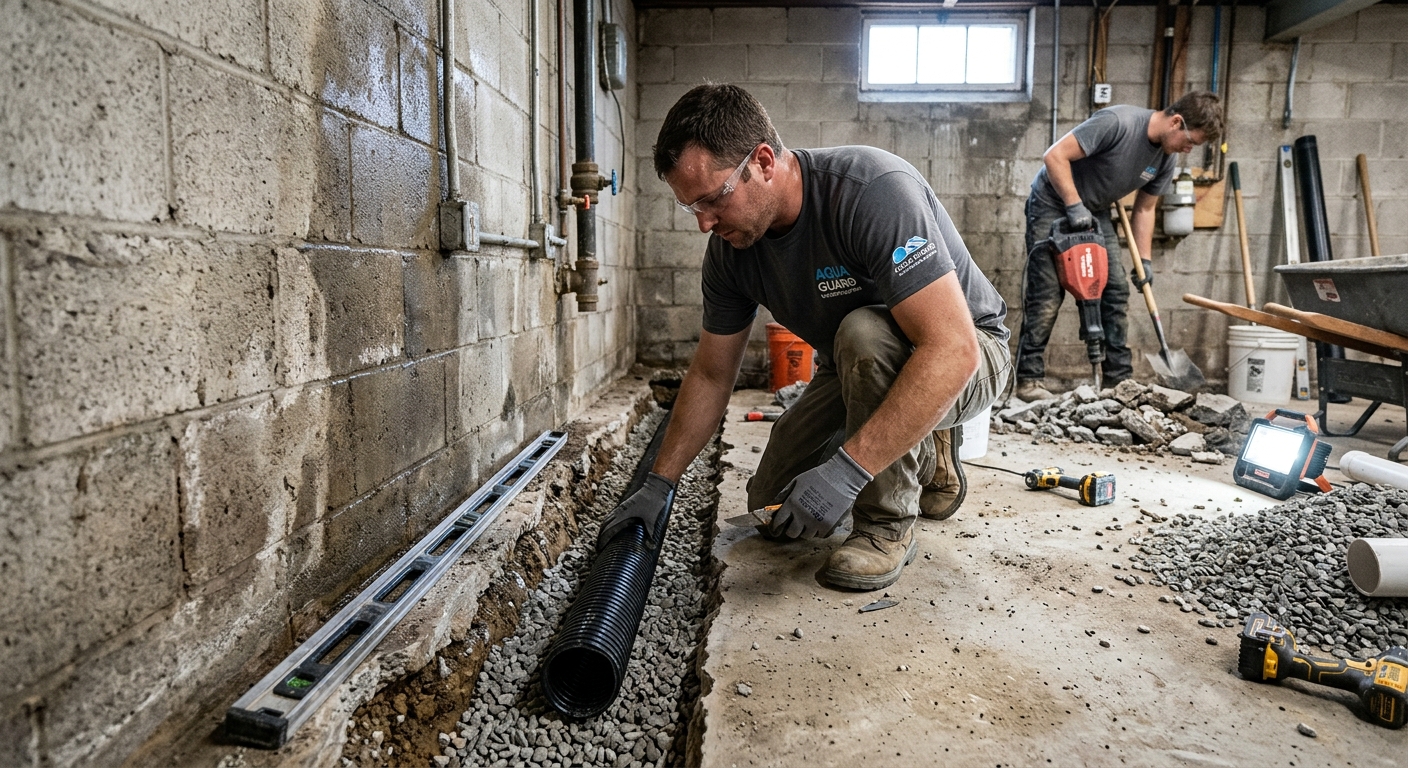
Interior waterproofing typically includes a perimeter drain channel, a sump pit, and a sump pump to collect water that has already entered. This is usually less invasive and more affordable upfront, but it does not stop water pressure against the wall itself. In Coldstream’s Thompson–Okanagan conditions, where freeze-thaw can widen cracks, interior systems are often best when paired with crack repairs or when the exterior is impractical due to access constraints.
Foundation type matters in our area. Poured concrete walls often respond better to targeted crack injection because the structure is more consistent and crack movement can be controlled—when the leak is non-moving. Block foundations, which are common in older housing, often benefit from interior drainage as a practical complement because water pathways can be more irregular. For sump solutions, British Columbia homeowners should also consider backup capability—spring snowmelt and heavy rain can coincide with power disruptions, and backup helps avoid a “no pumping during outage” failure.
As a pricing example: if you’re comparing a full exterior approach in the $18,000–$40,000 range versus interior perimeter drain and sump work in the $9,000–$22,000 band, the exterior cost can be justified when inspection shows failing weeping tile, active seepage along cold joints around the whole perimeter, or repeat water events that interior work can’t sustainably manage. If the issue is localized (one window well, one crack run, or surface runoff pushing toward the foundation), interior plus targeted corrections can be the better value.
| Method |
Best For |
Addresses Source? |
Disruption |
Lifespan |
Price Band |
| Full exterior excavation + membrane |
Failed exterior drainage, widespread seepage, clay pockets holding water |
Yes |
High |
Long-term (often best overall) |
$18,000–$40,000 |
| Interior French drain + sump system |
Interior seepage along slab edges, partial exterior access limitations |
No (manages water after entry) |
Medium |
Medium to long-term with correct grading and crack control |
$9,000–$22,000 |
| Crack injection — epoxy (structural) |
Non-moving or structural cracks where wall movement is minimal |
Partial (stops passage through targeted cracks) |
Low to Medium |
Medium (depends on crack stability) |
$800–$3,500 |
| Crack injection — polyurethane (active leak) |
Active seepage through cracks or joints with moisture pressure |
Partial (helps stop active flow through targeted openings) |
Low to Medium |
Medium (often excellent for active leaks but not a replacement for drainage) |
$800–$3,500 |
| Interior drain channel only (no sump) |
Very minor seepage where water can be intermittently managed |
No (relieves water but not full pumping capacity) |
Low to Medium |
Short to Medium (risk increases during heavy events) |
$5,500–$14,000 |
| Re-grading + downspout extensions |
Surface runoff issues and early-stage moisture |
Prevention only |
Low to Medium |
Short to Medium (works best with other corrections) |
$2,000–$6,500 |
How to choose a waterproofing contractor in Coldstream
Choosing the right waterproofing contractor in Coldstream is mostly about verification and clarity. In British Columbia, confirm licensing credentials where applicable and request proof of liability insurance. Ask for WSIB/WCB coverage (or an exemption letter) in writing before any work begins. A reputable contractor won’t hesitate to email certificates and documentation; they’ll also clearly state who is responsible for permits when structural or drainage work is required.
Next, get 2–3 itemised written quotes rather than lump sums. You want labour and materials separated, with line items for excavation/disposal (if exterior), membrane/drainage materials, sump pump (if included), piping, and reinstatement of landscaping or concrete. Read the scope carefully: what is excluded (for example, mould remediation, engineering letters, or backfill material type), is disposal included, and is permit pulling included or extra?
Warranty matters. Ask for the workmanship warranty length and whether it’s backed by a documented process, not just “best efforts.” Also request the product/manufacturer warranty terms and whether they’re transferable to future owners. For payment scheduling, avoid large deposits: a common best practice is never paying more than 10–15% upfront, then holding back a portion until the job is complete and inspected. Finally, insist on a written timeline with a start date and completion estimate, including weather-related allowances for excavation and curing.
- Verify current liability insurance and request the certificate before signing.
- Confirm WSIB/WCB coverage or exemption letter (not just “we’re insured”).
- Ask who pulls permits and whether that’s included in the quote.
- Request an itemised breakdown (labour, disposal, materials, reinstatement).
- Confirm whether inspection includes crack mapping and moisture-driven decision-making.
- Ask for sump details if recommended: basin size, discharge line routing, check valves.
- If power outages are a concern, request battery backup specs and expected runtime.
- Confirm the difference between epoxy vs polyurethane injection and how they pick based on crack behaviour.
- Require disposal and haul-away listed (especially for exterior excavation).
- Get reinstatement scope in writing (topsoil, sod, concrete/landscape patching).
- Check warranty length for workmanship and product, and whether it’s transferable.
- Agree on a payment schedule with a holdback until final punch list is complete.
Red flags in Coldstream include contractors who (1) recommend exterior work without confirming the drainage condition (failed weeping tile, slope, or discharge route), (2) promise “unlimited” crack fixes without identifying crack type (structural vs active), (3) avoid showing insurance/WSIB/WCB paperwork, (4) provide only a lump-sum without scope exclusions, and (5) request large deposits upfront. If you see two or more of these, slow down and ask for clarification or an additional quote.
Frequently asked questions — waterproofing in Coldstream
What is the difference between waterproofing and damp-proofing?
In British Columbia, “damp-proofing” is usually a lighter approach intended to control minor moisture—think preventing dampness from wicking through concrete surfaces. “Waterproofing” is designed to resist or manage water under pressure, including hydrostatic pressure when soils stay saturated after rain or spring snowmelt. In Coldstream, where variable soils can include localized clay pockets and where freeze-thaw can widen cracks, damp-proofing often isn’t enough once seepage becomes seasonal or starts forming along cold joints and slab edges. A true exterior waterproofing system (membrane plus drainage tile) targets the water before it enters, while interior perimeter drains and sump systems manage water that has already made its way in.
Will basement waterproofing affect my property value in Coldstream?
Yes, properly documented waterproofing can support property value in Coldstream because it reduces the risk of future interior water damage and the associated repair surprises. Homebuyers typically look for evidence that the root cause was addressed—especially for older homes built before 1981, which represent 45.2% of the local stock ((Statistics Canada, 2021 Census)). A homeowner with clear reports (crack mapping, drainage tile condition, sump specs) and transferable workmanship/product warranties tends to have a stronger story than someone who only did surface-level sealing. In practical terms, if your project moves from a basic prevention step toward source control (often in the $18,000–$40,000 exterior range), it’s easier to explain “why this won’t come back” compared with symptom management alone.
What drainage issues are most common in Coldstream homes?
The most common issues I see in Coldstream are (1) failed or underperforming weeping tile, often from original installations in older foundations; (2) poor lot grading or downspouts that discharge too close to the foundation; and (3) freeze-thaw–widened cracks at perimeter cold joints and slab edges. Thompson–Okanagan soils can be a mix of sand, silt, and pockets of clay, so some yards drain fast while others hold water and increase seepage duration. When that happens, homeowners notice wetness after spring snowmelt, heavy rain events, or a freeze period followed by warm-up. If window wells are involved, a common secondary problem is standing water that should be managed with a dedicated drain rather than relying on evaporation.
How do I choose a waterproofing contractor in Coldstream?
Start by choosing contractors who can prove they’re properly covered for the work in British Columbia: request liability insurance and WSIB/WCB coverage (or an exemption letter) before signing. Then ask for an itemised quote with scope details—what’s included for excavation/disposal, membrane and drainage components, and reinstatement. A good quote should also state whether permits are included when drainage changes or structural crack repair is part of the plan. Look for a contractor who explains the crack type and why they recommend epoxy versus polyurethane injection, rather than guessing. Finally, insist on written start and completion timing, a workmanship warranty, and a payment schedule with limited upfront deposit. If they only quote one number, don’t show documents, or won’t discuss exclusions, keep looking.
What is a battery backup sump pump and do I need one in Coldstream?
A battery backup sump pump is a secondary pump system powered by battery storage so it can continue to remove water during a power outage. In Coldstream and across British Columbia, power interruptions can coincide with spring storms—when seepage risk is highest after snowmelt and heavy rain. If your waterproofing plan includes a sump, backup is especially worth considering if you’ve had previous outages, the sump basin holds a meaningful volume, or the discharge pathway is hard to restore quickly. That said, you don’t need backup for every minor dampness issue; if the job is a localized, low-risk seepage problem, some homeowners can manage without it. In most cases where interior drainage is actively controlling water, backup raises resilience. Typical sump pump installation budgets in the region are around $2,500–$5,500, with backup options included depending on the scope.
How much does basement waterproofing cost in Coldstream?
Basement waterproofing cost in Coldstream depends mainly on whether you’re addressing the source (exterior) or managing water after it enters (interior). For exterior waterproofing with excavation, drainage tile, and membrane, budgets typically fall in the $18,000–$40,000 range. Interior perimeter drainage and sump installation are commonly in the $9,000–$22,000 band for full perimeter systems, while foundation crack injection often ranges from $800–$3,500 depending on crack type, length, and access. If you’re only improving surface runoff with re-grading and downspout extensions, it’s usually less than full systems, but it won’t stop hydrostatic pressure if the weeping tile is failed. Your final figure depends on access (decks, driveways, landscaping), the foundation type, and whether mould or efflorescence needs remediation first.