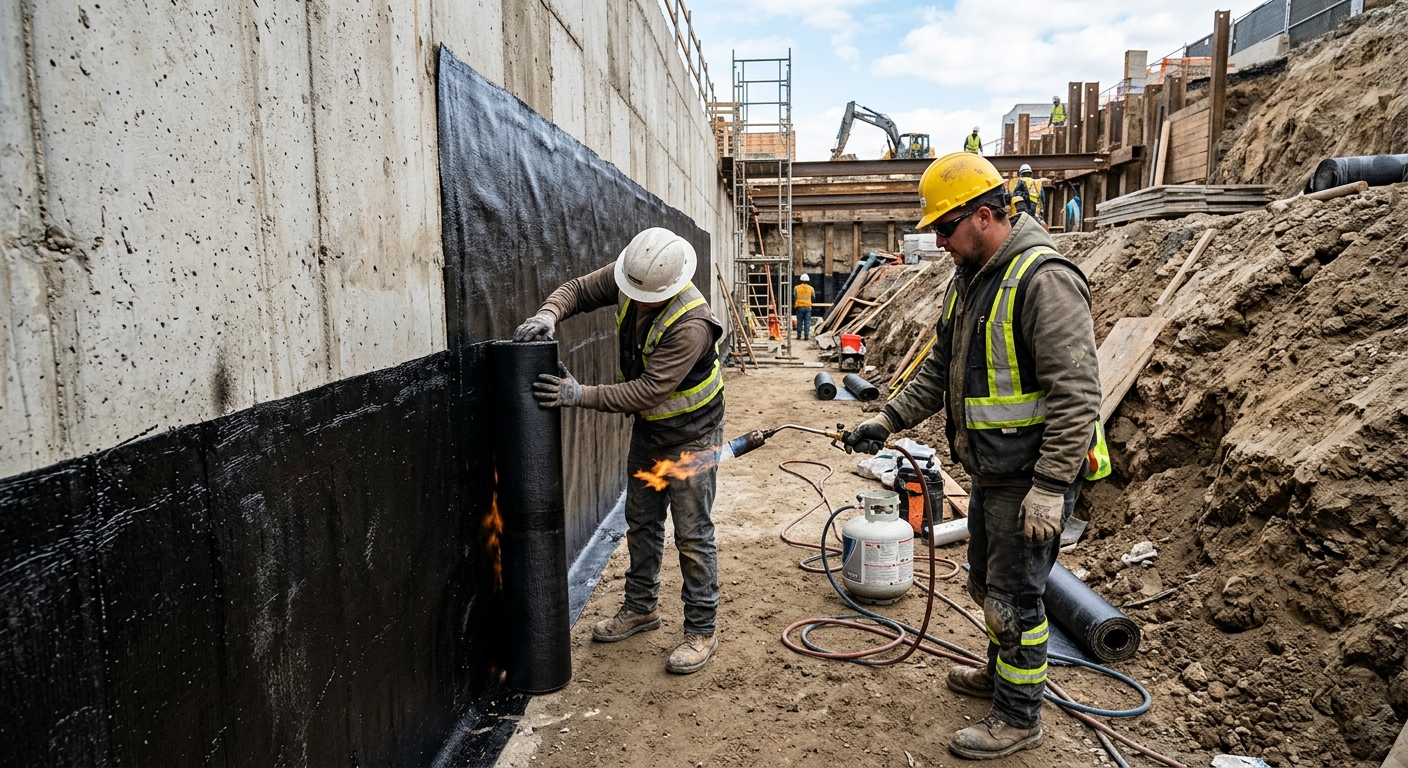
Basement waterproofing options and costs in Salmo
Salmo is one of those Kootenay communities where basements quietly age until winter exposure and wet seasons finally show you the problem. With 65.5% of local homes built before 1981 (Statistics Canada, 2021 Census), many foundations were originally protected with approaches that didn’t anticipate today’s performance standards, and we often see older weeping tile that has failed or been undersized. That matters because Kootenay soil and water conditions can change fast: glacial and alluvial materials around Salmo can be well-draining in spots but moisture-holding in others, so water can build up against your walls instead of moving away. On top of that, repeated freeze–thaw cycles widen existing joints and cracks, increasing the chance that seepage will become a recurring season-by-season issue. In practice, you’ll feel the cost difference on site too—excavation scope, haul distance for spoil, and access through steep yards or mature landscaping in areas like the Valleyview–downtown corridor can raise labour time and equipment hours.
If you’re comparing quotes, it helps to anchor your expectations to the method being proposed and the level of disruption. The table below outlines the common waterproofing routes we recommend in Salmo and what each one is meant to address.
| Method |
What It Addresses |
Disruption Level |
Durability |
Price Range |
| Exterior excavation + new membrane + drainage tile |
Stops water at the source, reduces hydrostatic pressure with engineered drainage |
High (excavation, landscaping restoration) |
High (long-term system) |
$18,000–$35,000 |
| Interior perimeter drain channel + sump pit |
Collects and redirects water after it enters; helps with wet floors and seepage |
Medium (floor/crawlspace disruption) |
Medium to high (depends on wall condition) |
$9,000–$20,000 |
| Foundation crack injection (epoxy or polyurethane) |
Seals cracks to reduce leakage; polyurethane helps with active seepage |
Low to medium (surface prep and injection ports) |
Medium (epoxy) to high (polyurethane in the right crack) |
$800–$2,500 |
| Sump pump installation (primary + battery backup) |
Manages collected water and provides resilience when power is interrupted |
Low to medium |
High (with reliable backup) |
$2,500–$5,500 |
| Window well drain installation |
Reduces water intrusion at basement windows during heavy shoulder-season rains |
Low to medium |
Medium to high |
$1,500–$3,800 |
| Lot re-grading / downspout extension |
Moves roof and surface water away from foundation |
Low (minor yard work) |
Low to medium (supporting measure) |
$900–$2,500 |
Prices are estimates only and vary by project scope, site access and material selection.
What affects the price of waterproofing in Salmo
In Salmo and across the Kootenays, waterproofing quotes for what looks like the “same problem” can swing by 30–50% because the underlying water path and foundation condition aren’t identical from house to house—and because excavation and drainage design are heavily site-driven. Regions with older housing stock tend to price higher on repairs because failing weeping tile, seeping block or poured-concrete walls, and freeze–thaw damage show up more often during inspections. Nationally, many contractors average costs assuming typical soil behaviour, but Kootenay pricing can diverge from the national average mainly due to three separating drivers: soil type, groundwater level (water table), and freeze–thaw severity. Clay-heavy soils expand during freeze–thaw and can exert higher lateral pressure, worsening cracks over time; in Salmo, even modest seasonal saturation can stress the foundation if perimeter drainage is ineffective. Higher local groundwater or slow-draining alluvial areas raise sump pump run times and require properly sized discharge routing. Also, when exterior drainage fails, rainfall saturates backfill quickly—so contractors may need additional drainage capacity and longer monitoring.
Two practical examples we see in Salmo: (1) an exterior job becomes more expensive when the yard is tight and mature landscaping must be removed and rebuilt, and (2) interior-only solutions can be cheaper upfront, but if exterior drainage is missing you often end up needing more pump runtime and additional interventions. With homes built before 1981 forming the majority of the area’s stock (Statistics Canada, 2021 Census), it’s common to start with drainage correction at the mid-range bands—interior waterproofing is often in the $9,000–$20,000 range, while true exterior excavation with new membrane and drainage tile often sits in the $18,000–$35,000 range when access allows a full system rebuild.
| Price Factor |
Why It Matters |
Cost Impact |
| Interior vs. exterior approach — interior is less disruptive but addresses symptoms |
Exterior reduces water at the source; interior collects after intrusion |
Interior can be ~40–60% less than full exterior when walls are still salvageable |
| Foundation type — poured concrete vs. block vs. stone vs. ICF |
Crack behaviour and sealing methods differ; block joints can leak through mortar voids |
Block/stone often adds labour for probing, patching, and targeted drainage; ICF may reduce cracking but not drainage failures |
| Soil type — clay expands more than sand, adding pressure |
Freeze–thaw and moisture retention can increase hydrostatic pressure and crack movement |
Clay-heavy sites may require stronger drainage design and can extend rehab time |
| Crack type and length — hairline vs. structural horizontal cracks |
Epoxy vs. polyurethane and the need for engineering assessment changes scope |
Structural patterns increase investigation time and may require additional structural steps |
| Sump pump backup system — battery or water-powered backup needed |
BC storms and spring melt can overwhelm systems during outages |
Backup typically increases system cost but reduces risk of basement flooding |
| Access — landscaping, decks, or driveways must be removed for exterior |
Excavation time and restoration scope directly drive labour and material costs |
Access constraints can push exterior jobs upward within the band |
| Weeping tile age — original tile (60+ years) may be completely failed |
Old tile often clogs or disconnects; water routes change |
May require replacement drainage design and additional outlet work |
| Mould or efflorescence remediation required before sealing |
Sealers won’t perform reliably over active contamination |
Adds prep time and materials; may affect the order of operations |
Permits & regulations in British Columbia
In British Columbia, foundation excavation, structural crack repair, and changes to lot drainage commonly require a building permit, particularly when work affects drainage patterns near the foundation, involves structural elements, or modifies load-bearing components. Sump pump installations that connect to the storm or sanitary sewer typically need municipal approval or at least a review process, because improper connections can create backflow or drainage compliance issues. For structural crack repair—especially horizontal cracks in block walls or major step cracks—a structural engineer’s assessment is often required to determine whether underpinning, stitching, or other structural remediation is necessary.
For Salmo homeowners, the verification process is straightforward. Step 1: ask the contractor for their British Columbia registration/licence information (and confirm the correct company name matches the paperwork). Step 2: request a current certificate of liability insurance showing adequate coverage for the job; don’t accept expired certificates. Step 3: confirm they hold active WSIB/WCB coverage where applicable for their workers—ask for the clearance letter or proof of coverage documentation. Step 4: for structural-scope jobs, verify they either employ an engineering partner or coordinate directly with a licensed structural engineer, and that engineering recommendations are included in the written scope.
Also ask whether permit pulling is included in the quote and whether the contractor will document any inspections. Knowing what requires a permit versus what typically doesn’t helps you compare bids fairly.
Interior vs exterior waterproofing — what does Salmo need?
Exterior waterproofing is the “source control” solution. Full excavation, new membrane, new drainage tile, and proper backfill systems are designed to keep water from building up against your foundation and to relieve hydrostatic pressure before it enters the basement. It costs more and causes more disruption because it requires excavation around the house and then landscape restoration. Interior waterproofing focuses on “handling the water once it gets in.” A perimeter drain channel, sump pit, and sump pump manage seepage after intrusion—often with less landscaping disturbance—but it doesn’t eliminate the pressure acting on the wall itself.
In Salmo’s Kootenay conditions, the right choice depends on what type of foundation you have and whether your house is dealing with persistent seepage. Poured concrete walls often seal more predictably with crack injection where movement is limited, but if exterior drainage is failing or the water table is high in a particular yard pocket, interior systems alone may only reduce the symptoms. Block foundations, common in older resource-era builds, often leak through joints and mortar voids; in those cases, interior drainage can be a practical complement, especially when excavation access is limited. Freeze–thaw also matters: ongoing movement can overwhelm “patch-only” approaches and push you toward exterior drainage upgrades.
Because spring melt and wet-season events can spike water volumes in British Columbia, a sump pump backup system is worth considering. If the basement is near-flooding during a power outage, a primary pump without backup is a bigger risk. As a concrete budgeting example, if you’re choosing between interior perimeter drainage and a full exterior system, interior solutions are commonly priced around $9,000–$20,000, while full excavation and membrane-plus-drainage tile often lands around $18,000–$35,000. The higher price is justified when you’re actively fighting hydrostatic pressure, failed weeping tile, or recurring exterior-side seepage.
| Method |
Best For |
Addresses Source? |
Disruption |
Lifespan |
Price Band |
| Full exterior excavation + membrane |
Ongoing exterior seepage, high-risk water entry, failed drainage around the entire perimeter |
Yes |
High |
Long-term (engineered system) |
$18,000–$35,000 |
| Interior French drain + sump system |
Wet floors, seepage that enters below grade, partial access limits for exterior work |
No (manages after entry) |
Medium |
Medium to long-term |
$9,000–$20,000 |
| Crack injection — epoxy (structural) |
Stable, dry-to-damp cracks where movement is limited and you’re sealing for water control |
Partial (seals the pathway) |
Low |
Medium (best with stable cracks) |
$800–$2,500 |
| Crack injection — polyurethane (active leak) |
Cracks with active seepage where water pressure is pushing through |
Partial (seals active pathway) |
Low |
Medium to high (when paired with drainage) |
$800–$2,500 |
| Interior drain channel only (no sump) |
Light dampness or localized seepage where gravity discharge is feasible |
No |
Medium |
Lower (depends on drainage capacity) |
$6,000–$14,000 |
| Re-grading + downspout extensions |
Surface runoff issues and minor foundation splash-back |
No (mitigates contributing water) |
Low |
Short to medium (supporting measure) |
$900–$2,500 |
How to choose a waterproofing contractor in Salmo
Choosing a waterproofing contractor in Salmo starts with verifying credentials that match the scope you’re buying. In British Columbia, ask for their licensing/registration information for the trade they’re performing, plus current liability insurance. Get the certificate of insurance and confirm the company name and address match the quote paperwork. Next, ask for proof of WSIB/WCB coverage for their workers; a clearance letter or active coverage documentation should be available on request. For projects involving structural crack patterns, confirm they have engineering support—either in-house coordination or documented collaboration with a licensed structural engineer—so you’re not paying for guesswork.
Then compare quotes properly. Request 2–3 itemised written quotes with a labour-and-materials breakdown (don’t rely on lump sums). Make sure the scope is explicit about: permit pulling (included or not), disposal/haul for excavated material, what repairs are included for landscaping restoration, and whether downspout drains and discharge routes are part of the work. Clarify inclusions/exclusions for vapour barriers, membrane type, pipe spec, and how they’ll test drainage performance. Warranty matters too: ask for the workmanship warranty length and whether it’s transferable to future owners, plus separate product/manufacturer warranty details.
On payment schedule, don’t pay more than 10–15% upfront. Hold back part of the payment until the work is completed, cleaned up, and any promised performance checks are done. Finally, get a start date and a completion estimate in writing.
- Confirm the contractor’s British Columbia registration/licence matches the legal entity on your quote.
- Request a current certificate of liability insurance before any work begins.
- Verify active WSIB/WCB coverage with documentation (clearance letter or proof of coverage).
- Ask for an itemised quote: labour hours, equipment, membrane/drain materials, pumps, and disposal/haul.
- Ensure the scope states whether permits are included and who pulls them.
- Clarify exclusions: what happens if they discover failed weeping tile beyond the original scope.
- Ask how they handle discharge routing for exterior drains and pump discharge to prevent re-entry.
- Confirm warranty: workmanship duration, product warranty duration, and transferability.
- Request the expected drainage fall/grade plan for the perimeter system (not just “we’ll slope it”).
- Check for a backup plan: sump pump backup option (battery) where required by the site risk.
- Confirm prep steps: mould/efflorescence remediation and crack surface preparation.
- Use a conservative payment schedule: limit upfront payment and hold retainage until completion.
Red flags we see in Salmo include: vague scopes that don’t specify membrane and drain details, refusing to provide insurance/WSIB/WCB proof, offering only interior sealing when exterior drainage is clearly failing, quoting major work without a site inspection, and starting excavation without confirming permits when drainage modification or structural crack work is involved.
Frequently asked questions — waterproofing in Salmo
How much does basement waterproofing cost in Salmo?
Basement waterproofing in Salmo typically comes down to whether you’re solving the water entry from the outside or managing it after it enters. For many Kootenay basements, interior solutions like an interior perimeter drain and sump pit commonly fall around $9,000–$20,000, especially when there’s seepage and damp floors. If your weeping tile has failed and water is building up against the foundation, exterior excavation with a new membrane and drainage tile usually lands around $18,000–$35,000, with costs higher when access is tight and landscaping restoration is significant. Projects in older homes (many built before 1981) may require additional crack sealing or remediation before systems can perform reliably. (Statistics Canada, 2021 Census)
Interior vs exterior waterproofing — which is better?
Exterior waterproofing is generally best when you want to address the source: excavate the perimeter, install membrane, replace drainage tile, and design discharge so water can’t build up and push into the foundation. It’s more disruptive, but it relieves hydrostatic pressure at the wall. Interior waterproofing is better when exterior access is limited or when the goal is to manage existing intrusion with a perimeter drain channel, sump pit, and sump pump. In Salmo’s freeze–thaw cycle conditions, interior-only approaches can still work well, but they manage symptoms rather than preventing wall-side pressure. In practice, poured concrete cracks may seal better with injection when movement is limited, while block foundations often benefit from interior drainage as a practical complement.
Why is my basement leaking in Salmo?
Most basement leaks in Salmo come from water finding a route into the foundation during wet seasons and spring melt, then worsening as freeze–thaw expands cracks and joints. Common causes include failed or undersized weeping tile, poor grading that lets roof runoff or surface water collect near the foundation, and foundation crack pathways that were never properly sealed. In older homes (Salmo has a large share built before 1981), original damp-proofing and drainage details can be worn out, and corrosion or disconnections can redirect water into the basement. Soil that holds moisture in certain yard pockets can also lead to higher groundwater pressure against basement walls, pushing water into cracks and mortar joints over time.
How do I know if a foundation crack is serious?
A crack can be “serious” when it shows signs of ongoing movement or structural concern. In general, horizontal cracks in block walls, widening step cracks, cracks that appear to “grow” over successive inspections, or large displacement near corners and openings should be assessed before you rely on simple sealing. If you see active seepage, staining, or efflorescence expanding along the crack line, that points to a pathway needing targeted injection and drainage control. In Salmo, freeze–thaw can widen existing hairline cracks into leak pathways, so timing matters—take photos before and after a wet period. For structural-scope cracks, expect to involve engineering to decide whether underpinning or other structural work is necessary.
How much does foundation crack repair cost in Salmo?
Crack repair pricing in Salmo is typically based on crack length, number of injection points, and whether the crack is stable or actively leaking. For many homeowners, foundation crack injection falls in the $800–$2,500 range for localized repairs, with more extensive work costing toward the top end when multiple cracks or longer runs are involved. If the contractor determines the crack is active leakage, polyurethane injection is commonly recommended because it can respond to moisture pressure. If the crack pattern suggests structural movement, sealing alone may not be enough and engineering input may be needed, which can change the overall project cost.
Do I need a sump pump in Salmo?
You may need a sump pump when water intrusion is persistent or when interior drains must remove collected water to prevent seepage from re-wetting the basement. In Salmo and across British Columbia, spring melt and intense rainfall events can drive higher water volumes against foundations, and power interruptions can turn a “working” setup into an emergency. If you’re installing interior perimeter drainage, a sump pit and primary pump are often the practical way to keep floors dry. Many homeowners also consider backup pumping—such as a battery backup system—because it reduces risk during outages during wet seasons. If your site conditions allow gravity drainage (rare in true basements), you may be able to manage without a sump, but that should be confirmed on-site with drainage outlet planning.