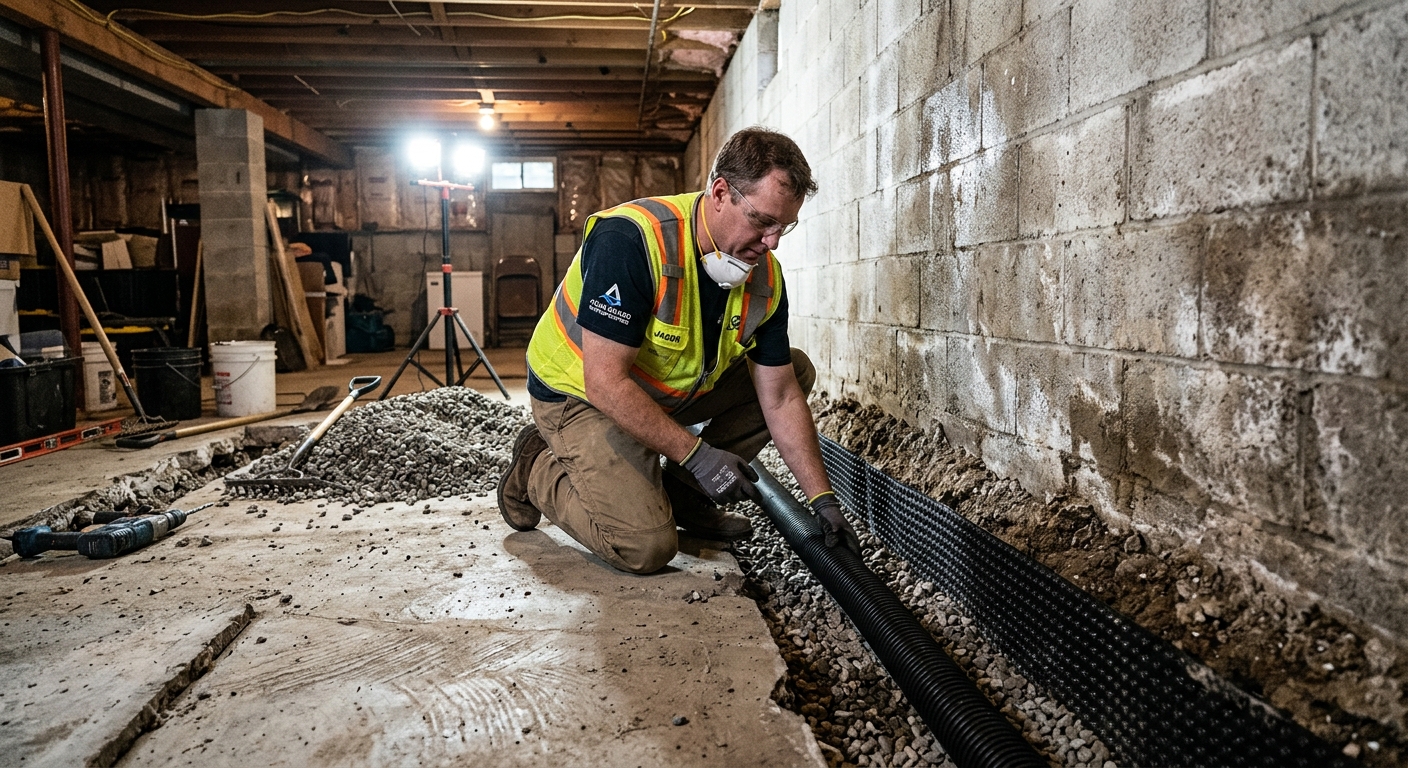
Basement waterproofing options and costs in North Vancouver
North Vancouver homeowners typically face the same question: do we stop the water from getting in, or do we manage it after it shows up inside? The answer usually comes down to where the moisture is entering, how the original drainage was built (if it was built at all), and how much of the foundation has been affected. With 44.0% of local homes built before 1981 (Statistics Canada, 2021 Census), many basements are dealing with aging perimeter systems—sometimes corroded weeping tile, undersized discharge capacity, or waterproofing that has simply aged out. That older housing stock is one reason waterproofing demand is especially strong around Lynn Creek, where hillsides and older lot layouts can create unpredictable drainage paths.
In the Lower Mainland–Southwest, pricing is heavily influenced by hydrostatic pressure from persistent groundwater and prolonged rainfall. Contractors often need to excavate in tight urban lots, deal with rocky sections, and rework landscaping and walkways afterward. Even when the foundation is newer, wet winters can keep backfill saturated for longer periods, widening cracks through repeated freeze-thaw. For a typical North Vancouver basement, you’ll often see two or three solution “layers”: drainage improvements outside, supplemental drainage inside, and targeted crack repairs.
Below are the most common waterproofing methods homeowners compare in North Vancouver, along with what each approach addresses, expected disruption, durability, and realistic cost ranges. Use this table as a budgeting starting point before you request itemised quotes.
| Method |
What It Addresses |
Disruption Level |
Durability |
Price Range |
| Exterior excavation + new membrane + drainage tile |
Bulk water at the foundation; hydrostatic pressure management with full perimeter drainage and waterproofing membrane |
High (excavation, landscaping disruption) |
High (when installed to specs) |
$15,000–$30,000 |
| Interior perimeter drain channel + sump pit |
Water that has already entered; intercepts seepage and relieves slab/wall seepage using drain rock/channel |
Medium (partial floor/wall access) |
High (with proper sump sizing) |
$8,000–$18,000 |
| Foundation crack injection (epoxy or polyurethane) |
Crack leaks and seep paths (epoxy for structural/sealed cracks; polyurethane for active leaks) |
Low to medium |
Medium to high (depends on crack movement and wall type) |
$500–$2,000 |
| Sump pump installation (primary + battery backup) |
Discharge reliability during heavy rains and power interruptions |
Low to medium |
High (when discharge lines and backup are sized correctly) |
$1,000–$5,000 |
| Window well drain installation |
Localized groundwater intrusion near egress windows |
Low to medium |
Medium to high (depends on seal and discharge) |
$1,500–$4,500 |
| Lot re-grading / downspout extension |
Surface water control to reduce how much water reaches the foundation (gutters, downspouts, grading) |
Low to medium |
Medium (helps performance; does not replace a failed perimeter system) |
$2,000–$7,500 |
Prices are estimates only and vary by project scope, site access and material selection.
What affects the price of waterproofing in North Vancouver
In North Vancouver and across the Lower Mainland–Southwest, it’s common to see quotes for the “same” basement waterproofing project come back 30–50% apart. The main reason is that waterproofing isn’t a one-size job: the cost changes with soil saturation patterns, water-table behaviour, foundation details, and how much disruption is required to reach the work. Labour availability also matters—when multiple crews are booked for full perimeter excavations in wet seasons, access and excavation scheduling can push costs upward.
Three drivers separate Lower Mainland–Southwest costs from the national average: soil/wet saturation, groundwater levels, and freeze-thaw. In British Columbia’s coastal climate, heavy rainfall saturates backfill quickly when original drainage fails, and the foundation experiences sustained moisture rather than short, seasonal bursts. Freeze-thaw still matters too: expanding ice in cracks and joints can widen pathways, increasing the amount of water you must control. Where regions in Canada have clay-expansive soils that expand dramatically, the Lower Mainland more often “charges” the foundation with persistent hydrostatic pressure—so you may need more drainage capacity, more sump capacity, and more thorough backfill and membrane detailing.
Two practical examples we see often in North Vancouver: (1) a partially blocked or failing weeping tile discharge line can turn a “small seep” call into a full perimeter excavation, because the exterior system can’t evacuate water; (2) poured concrete basements with crack patterns that are stable may be addressed with crack injection and a targeted sump upgrade, whereas block foundations with multiple mortar-line seep points frequently require interior drain channels as a practical complement.
Budget-wise, interior perimeter drainage commonly lands in the $8,000–$18,000 band when demolition access is limited, while full exterior excavation can swing to the $15,000–$30,000 range once excavation, mechanical breaking (rock/aggregate), and full perimeter membrane are included.
| Price Factor |
Why It Matters |
Cost Impact |
| Interior vs. exterior approach |
Interior solutions manage water after entry; exterior solutions address entry by managing hydrostatic pressure |
Exterior typically adds major excavation and restoration costs (often increases total by 30%–100% depending on site) |
| Foundation type |
Poured concrete, block, stone, and ICF behave differently and require different repair techniques |
Block and older stone often increase labour time for drainage and sealing prep |
| Soil type |
Soil influences how fast water saturates and how much pressure builds |
Heavier/clayey saturation conditions can increase drainage requirements and repair coverage |
| Crack type and length |
Hairline vs. structural/horizontal cracks change the repair method and whether movement must be accommodated |
Structural repair or longer injection runs raise material and labour |
| Sump pump backup system |
British Columbia basements can flood faster during outages when heavy rain coincides with spring/wet events |
Battery or alternative backup can add incremental cost, but reduces failure risk |
| Access |
Tight lots, decks, driveways, and retaining walls can require more careful, time-consuming removal and reinstallation |
Access constraints increase labour hours and disposal/restoration |
| Weeping tile age |
Original tile that’s 60+ years old (or already failing) may be completely compromised |
Replacement vs. partial retrofit can be a major scope change |
| Mould or efflorescence remediation required before sealing |
Water-affected surfaces often require cleaning and sometimes antimicrobial treatment before sealing |
Added remediation steps can increase prep time and materials |
Permits & regulations in British Columbia
In British Columbia, the specific triggers vary by scope, but foundation excavation, structural crack repair (when cracks suggest structural movement), and changes to lot drainage typically require a building permit. Sump pump installations that connect to the storm system or sanitary system need municipal approval before work proceeds. For structural crack repair—especially horizontal cracks in block walls and major step cracks—a structural engineer’s assessment is often required to determine whether underpinning, wall stabilization, or other structural work is needed. Even when we’re only sealing a leak path, we coordinate with engineering support when the crack pattern or wall movement indicates it might not be “just water.” A reputable contractor should carry appropriate liability insurance, WSIB/WCB coverage, and (when required) access to engineering resources for your conditions.
How homeowners in North Vancouver should verify a contractor’s credentials, step-by-step:
- Confirm the contractor’s BC licence/registration status using the relevant online government registry page for contractors (search the company name and principals).
- Request a current certificate of liability insurance and verify the policy is active for the correct legal name and address.
- Ask for WSIB/WCB clearance (or applicable proof of coverage) before work starts; verify it matches the trade/person who will be on site.
- For structural crack repair or major foundation work, confirm the contractor provides or coordinates engineering support (ask for the engineer’s involvement in writing).
- Request the permit responsibility: who pulls the permit, who pays, and what inspections are included in the quoted scope.
- Get a written scope that indicates whether any sewer/tile connection approvals are required for the discharge plan.
Interior vs exterior waterproofing — what does North Vancouver need?
For North Vancouver homeowners, the fundamental difference is source control versus symptom control. Exterior waterproofing involves full excavation, new membrane, and a perimeter drainage system. When done correctly, it reduces or eliminates the hydrostatic pressure that pushes water toward basement walls and slabs. It’s also the more expensive option and requires landscape disruption, which in the Lower Mainland often means working around tight driveways, steep sites, and mature plantings.
Interior waterproofing—perimeter drain channel, sump pit, and sump pump—manages water after it enters. It can be less invasive, and on many North Vancouver jobs it’s the practical first step, especially when exterior access is constrained or the foundation is partially inaccessible. However, interior work does not stop water pressure from building against the wall, so it must be paired with good crack repair where needed and dependable pumping.
Local fit matters. Poured concrete walls often respond well to crack injection when cracks are stable, because the leak path can be sealed and the wall remains dimensionally consistent. Block foundations often have many small mortar-line seep points and joint pathways; in those cases, an interior perimeter drain channel is frequently the more reliable complement. In both approaches, sump pump reliability is critical in British Columbia’s wet, mild winters—power outages during intense rain events mean homeowners increasingly ask for battery backup.
A concrete example: for a basement that only shows localized seepage near the floor/wall line, interior perimeter drainage plus a primary sump (and optional backup) may land in the $8,000–$18,000 range. If the homeowner also wants full source control—excavation, membrane, and new exterior drainage—budget the $15,000–$30,000 band. That extra cost is justified when exterior drainage is failed, multiple walls seep, or you’re planning long-term risk reduction rather than short-term mitigation.
| Method |
Best For |
Addresses Source? |
Disruption |
Lifespan |
Price Band |
| Full exterior excavation + membrane |
Ongoing seepage on multiple walls; failed weeping tile; long-term source control goals |
Yes (full perimeter source control) |
High |
Long (often 20+ years with correct installation and maintenance) |
$15,000–$30,000 |
| Interior French drain + sump system |
When exterior access is limited or exterior drainage is unavailable/too disruptive |
No (water is managed after entry) |
Medium |
Long (commonly 15–25 years depending on sump performance) |
$8,000–$18,000 |
| Crack injection — epoxy (structural) |
Stable cracks in poured concrete that are not actively leaking under pressure |
Indirect (seals crack pathways to reduce entry) |
Low to medium |
Medium to long if crack movement is controlled |
$500–$2,000 |
| Crack injection — polyurethane (active leak) |
Active seepage where water is still moving through cracks |
Indirect (stops leak path) |
Low to medium |
Medium to long (depends on ongoing hydrostatic pressure) |
$700–$2,400 |
| Interior drain channel only (no sump) |
Low-incident seepage where gravity drainage to a discharge route is practical |
No |
Medium |
Shorter to medium (risk increases during high groundwater periods) |
$6,000–$12,000 |
| Re-grading + downspout extensions |
Surface water issues: poor gutter drainage, pooling near perimeter |
Partially (reduces water reaching foundation) |
Low to medium |
Medium (best as a maintenance/secondary measure) |
$2,000–$7,500 |
How to choose a waterproofing contractor in North Vancouver
Choosing a contractor in North Vancouver starts with verification, not sales pitch. In British Columbia, make sure the company can show active liability insurance and proof of WSIB/WCB coverage for workers assigned to your job. To check licensing, use the BC government contractor registry search and confirm the business name and registration details match the legal entity on your quote. Then request a current certificate of insurance: review the policy’s validity dates and ensure the certificate lists the insured party correctly. For clearance, ask for documentation showing WCB/WSIB coverage (or the applicable equivalent) before any work begins.
Next, get 2–3 itemised written quotes, not lump-sum estimates. The breakdown should clearly list labour tasks, membrane/drain components, crack injection materials, disposal, and restoration. Pay close attention to exclusions: ask whether permit pulling is included, whether saw cutting and concrete reinstatement are part of the scope, and whether the contractor handles excavation backfill compaction and grading. A warranty matters too: look for a workmanship warranty length, product/manufacturer warranty terms, and whether the warranty transfers to a new owner if you sell.
For payment, avoid large upfront deposits—keep it at roughly 10–15% maximum and hold back a portion until you receive final documentation and the work is complete (including clean-up and any restoration). Finally, insist on a written schedule: the start date, sequence of inspections (if permits apply), and a completion estimate.
- Confirm BC licensing/registration details match the quote and contract.
- Request liability insurance certificate (active dates and correct legal name).
- Verify WSIB/WCB coverage for workers assigned to your project.
- Ask who pulls permits and whether permit fees are included.
- Get an itemised quote with labour + materials (no vague allowances).
- Ensure the scope describes disposal, backfill compaction, and final re-grading.
- Clarify discharge location for sump ejection and any municipal approvals required.
- Confirm crack repair method (epoxy vs polyurethane) matches whether it’s active leaking.
- Ask about sump size/float control and whether a backup system is offered.
- Require documentation of warranty: workmanship and product/manufacturer terms.
- Agree on payment schedule: maximum 10–15% upfront; hold back until completion.
- Get start date and completion estimate in writing, with allowance for wet-weather impacts.
Red flags in North Vancouver: (1) quoting “one method fits all” without a site assessment of drainage and crack conditions; (2) no willingness to document product specs, sump sizing, or discharge plan; (3) missing proof of insurance or unclear WSIB/WCB coverage; (4) offering a warranty that doesn’t specify workmanship length or transferability; and (5) vague exclusions like “restoration not included” when exterior excavation is planned.
Frequently asked questions — waterproofing in North Vancouver
Will basement waterproofing affect my property value in North Vancouver?
It often helps, especially when moisture issues are visible or recurring. North Vancouver buyers generally view active seepage, mould odours, or repeated flooding as a risk that can translate into future repair costs. A well-documented waterproofing project—with an itemised scope, warranty details, and proof of what was repaired (exterior drainage vs interior perimeter drains vs crack injection)—can reduce perceived risk. In the Lower Mainland–Southwest market, where persistent rainfall and high groundwater behaviour can keep hydrostatic pressure active, buyers like knowing the source has been controlled or that pumping capacity is upgraded. With 53.3% of households owning in the area (Statistics Canada, 2021 Census), many owners prioritize long-term fixes rather than temporary patch jobs. Even a smaller scope can add value when it resolves the specific leak path; however, full exterior source control typically carries the strongest “risk reduction” narrative.
What drainage issues are most common in North Vancouver homes?
The most common issues we see in North Vancouver are failed or underperforming perimeter drainage (weeping tile issues), floor/wall seepage at foundation joints, and localized intrusion near window wells. Many older homes—44.0% built before 1981 (Statistics Canada, 2021 Census)—were installed with drainage that’s simply reached the end of its service life, so water can build behind foundation walls during prolonged storms. Freeze-thaw cycles then widen existing cracks and joints, increasing seepage. On tight urban lots, downspouts may discharge too close to the foundation or grading may have shifted over time, adding surface water load. When interior solutions are chosen, seepage is often controlled with interior perimeter drains and sump pits, but we also recommend confirming discharge routes and checking whether the exterior system is still moving water away.
How do I choose a waterproofing contractor in North Vancouver?
Start by verifying BC credentials and coverage before you sign anything. Ask for proof of active liability insurance and WSIB/WCB coverage, and confirm the company’s BC licensing details using the provincial online registry. Then request 2–3 itemised quotes so you can compare labour, disposal, and materials (not just a single number). In Lower Mainland projects, the scope can change drastically based on site access and whether excavation is needed, so insist the quote states whether permits are included and who will pull them. For crack repairs, require the contractor to match the method to the condition—epoxy for stable sealed cracks versus polyurethane when leaks are active. Finally, review warranty terms: workmanship length, product warranty coverage, and whether the warranty transfers if you sell.
What is a battery backup sump pump and do I need one in North Vancouver?
A battery backup sump pump is a second pumping system that can keep draining water even if the main power goes out. In North Vancouver’s wet-season conditions, prolonged rainfall can raise groundwater levels quickly; if power interruptions happen during the heaviest events, the basement can start collecting water before the main pump can run again. A battery backup is especially helpful when you have a history of nuisance flooding, have a sump already installed but it’s not protected, or when the sump is your primary line of defence (often with interior perimeter drainage). If your waterproofing plan includes a sump upgrade, pricing can vary depending on system type, but it typically sits within the $1,000–$5,000 band for installations. Whether you “need” it depends on your risk tolerance and how often power disturbances occur, which your contractor can discuss based on your discharge setup and basement layout.
How much does basement waterproofing cost in North Vancouver?
Cost depends on whether you’re treating the water at the source (exterior) or managing it after entry (interior). For many North Vancouver basements, interior perimeter waterproofing and weeping tile-style drainage upgrades commonly fall within the $8,000–$18,000 range. If the project requires full exterior excavation with a new membrane and perimeter drainage tile, many homeowners budget the $15,000–$30,000 band due to excavation, access constraints, and landscaping restoration. Crack repairs are often a smaller add-on; foundation crack repair typically ranges from $500–$2,000 depending on crack type and total length. Your site conditions—rocky excavation sections, tight lot access, groundwater behaviour, and whether mould/efflorescence remediation is required before sealing—are what most strongly move the final number.
Interior vs exterior waterproofing — which is better?
Neither is universally “better”—the better choice is the one that matches your leak source and foundation conditions in British Columbia. Exterior waterproofing is best when you need source control: full excavation, membrane, and new drainage tile reduce hydrostatic pressure against basement walls. Interior waterproofing is best when exterior access is limited or disruption costs are too high; it manages seepage after water enters using perimeter drains and a sump system, which is often a practical complement for block foundations and joint-driven seepage. In North Vancouver, poured concrete walls can sometimes be addressed effectively with crack injection (when cracks are stable), but sustained groundwater pressure still means you may need interior drainage or a sump depending on observed water behaviour. As a rule of thumb, if you’re seeing widespread perimeter wetness or repeated flooding, exterior treatment usually provides stronger long-term risk reduction, while interior approaches can be the right first step when the exterior system can’t be accessed.