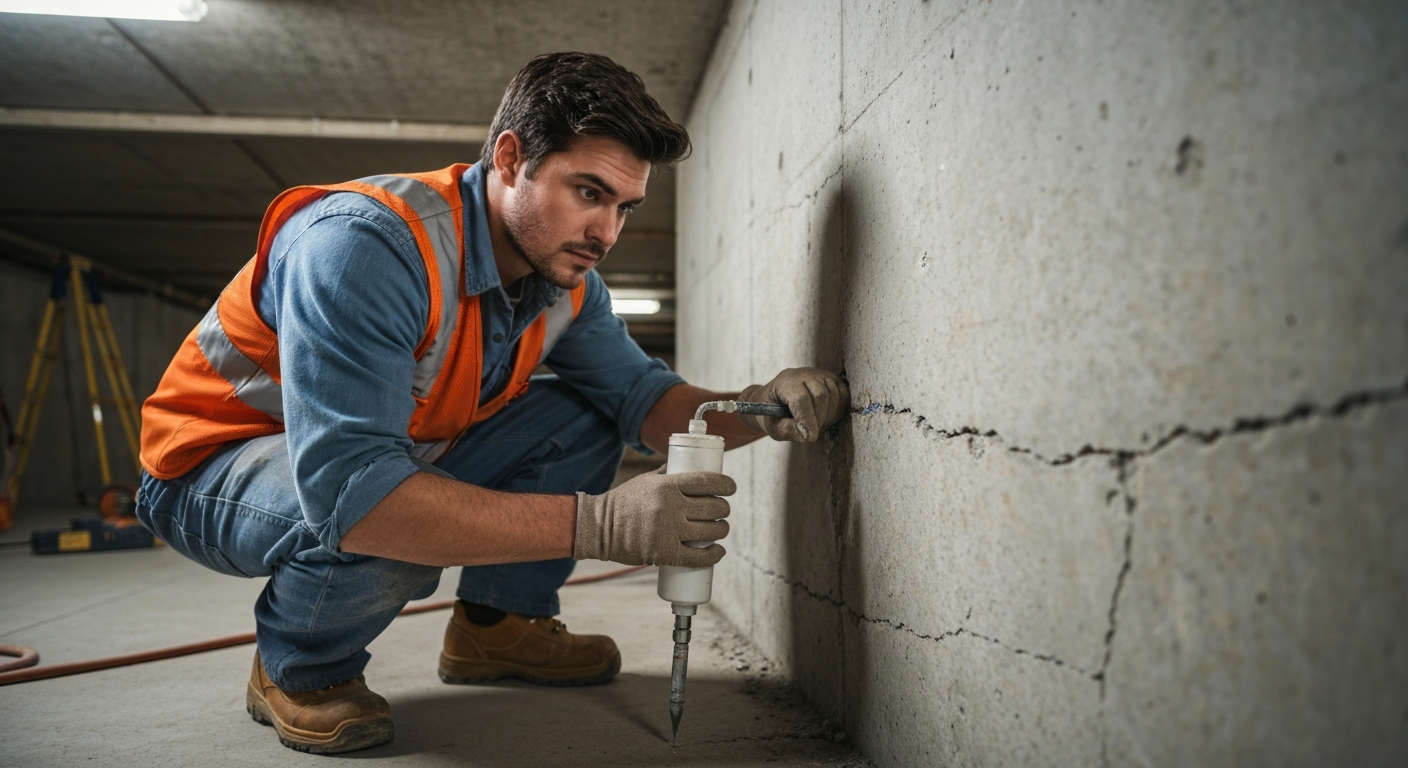
Basement waterproofing options and costs in Maple Ridge
Basement waterproofing in Maple Ridge typically comes down to where the water is entering, how long it has been getting in, and how your site sheds water. In Maple Ridge, 28.6% of homes were built before 1981, and that age band is where we most often see original tar-and-paper systems failing alongside corroded or blocked weeping tile. Many of these older basements also show the early “trio” of symptoms—damp corners, salt staining (efflorescence), and recurring musty odours—which usually means the drainage system can’t keep up anymore.
In the Lower Mainland–Southwest, the cost drivers are soil saturation and hydrostatic pressure more than dramatic expansion/contraction. Intense, prolonged rainfall keeps backfill soils wet, and persistent ground moisture maintains pressure against basement walls and slabs. In winter, freeze-thaw cycles widen existing joints and cracks, so repairs that don’t address drainage often fail to hold for long. Labour can also be higher here due to access constraints on tighter lots, and excavation work sometimes requires mechanical breaking where there’s rocky material.
In practice, we see especially strong demand in neighbourhoods like Thornhill and the newer fringe areas where grading/drainage has changed over time, leaving older drainage infrastructure underperforming. Homeowners in these pockets often start with an interior retrofit, but if tests show sustained hydrostatic pressure, most end up budgeting for exterior drainage to stop the source of the problem. That’s why the options below are priced as bands—use this table to align your expectations before you request itemised quotes.
| Method |
What It Addresses |
Disruption Level |
Durability |
Price Range |
| Exterior excavation + new membrane + drainage tile |
Primary water entry; replaces failed weeping tile; creates a new drained envelope |
High (excavation, landscaping restoration) |
High (best source control) |
$15,000–$30,000 |
| Interior perimeter drain channel + sump pit |
Water after it enters; reduces lateral pressure at the floor/wall junction |
Medium (access through interior floor/footing line) |
Medium to high (depends on wall condition and discharge strategy) |
$8,000–$18,000 |
| Foundation crack injection (epoxy or polyurethane) |
Crack sealing; epoxy for non-moving cracks, polyurethane for active seepage |
Low (limited demolition) |
Medium (works best when drainage is corrected) |
$1,500–$4,000 |
| Sump pump installation (primary + battery backup) |
Controls collected groundwater; prevents basement flooding during outages |
Low to medium |
Medium to high (system quality matters) |
$1,000–$5,000 |
| Window well drain installation |
Intercepts roof runoff/ground water at egress areas |
Low (targeted excavation) |
Medium (often needs periodic checks) |
$1,500–$6,000 |
| Lot re-grading / downspout extension |
Improves surface drainage; reduces water reaching foundation perimeter |
Low to medium (minor landscaping disruption) |
Medium (helps most when combined with drainage) |
$3,000–$10,000 |
Prices are estimates only and vary by project scope, site access and material selection.
What affects the price of waterproofing in Maple Ridge
In Maple Ridge and across the Lower Mainland–Southwest, two quotes for the “same” basement can differ by 30–50% because the work is rarely identical at the drainage-source level. A contractor may quote only what they see inside (interior channel, sump, patching), while another accounts for exterior conditions (excavation limits, failed weeping tile replacement, membrane system selection, and disposal). Product choice and system capacity also vary—especially where groundwater runs high and drainage has to be engineered to keep up.
Three drivers separate Lower Mainland–Southwest costs from the national average: soil type/saturation behaviour, water table pressure, and freeze-thaw. In Ontario and the Prairies, clay-heavy soils can expand during freeze-thaw and push hard on foundations; in our region, the bigger issue is persistent saturation that keeps hydrostatic pressure active after prolonged rain. When soils stay wet, sump pump run times increase and the drainage plan has to be more robust. Heavy coastal BC rainfall saturates backfill quickly when original drainage fails, so exterior remediation typically ranges at the higher end—often in the $15,000–$30,000 band for excavation-based work. Meanwhile, interior-focused retrofits usually land closer to $8,000–$18,000 when the foundation perimeter is treated with a drain channel and pump system.
Concrete examples from Maple Ridge: (1) If your lot has a low corner where water ponds after storms, exterior drainage and re-grading costs rise because more excavation and drainage modifications are required; (2) if your foundation is older block or has failing weeping tile (common in pre-1981 homes), interior-only sealing often costs less upfront but can underperform during extended rain seasons; and (3) if cracks are active and wet, polyurethane injection adds material and testing time—pushing repair work toward the higher end of the crack repair band (often $500–$2,000 per cracked zone depending on length and access), and it’s usually recommended to pair with a sump solution.
| Price Factor |
Why It Matters |
Cost Impact |
| Interior vs. exterior approach — interior is less disruptive but addresses symptoms |
Exterior typically tackles the water entry path; interior manages water after it enters |
Interior can be ~30–60% less, but may require longer-term monitoring or added systems |
| Foundation type — poured concrete vs. block vs. stone vs. ICF |
Crack patterns and water pathways differ by foundation system |
Block and stone often need interior drainage complements; poured concrete usually responds better to targeted sealing |
| Soil type — clay expands more than sand, adding pressure |
Expansion increases crack movement during freeze-thaw and can reopen failed seals |
Clay-prone sites can push repairs toward higher bands; saturated soils can increase pump capacity requirements |
| Crack type and length — hairline vs. structural horizontal cracks |
Active or structural cracks require different materials and sometimes engineer review |
Structural/active crack work can add significant labour and materials; epoxy vs polyurethane changes costs |
| Sump pump backup system — battery or water-powered backup needed |
Prevents basement flooding during outages |
Backup can add several thousand dollars, commonly pushing closer to the upper sump band |
| Access — landscaping, decks, or driveways must be removed for exterior |
Excavation footprint and disposal logistics determine labour intensity |
Tight lots and hardscaping drive up excavation time and restoration |
| Weeping tile age — original tile (60+ years) may be completely failed |
Old drainage systems often collapse internally or clog |
If replacement is needed, exterior work moves toward the higher excavation membrane pricing |
| Mould or efflorescence remediation required before sealing |
Sealers won’t bond reliably over active salts/mould |
Additional prep and drying time increases labour; sometimes requires targeted remediation |
Permits & regulations in British Columbia
In British Columbia, foundation excavation and structural crack repair typically trigger permit requirements, especially when work could affect a foundation element or involves modifications beyond cosmetic patching. Changes to lot drainage that alter how stormwater is directed or where it discharges can also require municipal approval. If you’re installing or altering a sump pump discharge connection that ties into storm or sanitary systems, you should plan for municipal review before the contractor starts.
For major structural crack situations (such as horizontal cracks in block walls, step cracks with significant displacement, or signs that wall movement is ongoing), a structural engineer’s assessment is often required to confirm whether underpinning or other structural remediation is needed. Before you sign, ask whether the contractor provides or coordinates engineering support for structural-scope repairs.
Step-by-step, here’s how a Maple Ridge homeowner can verify a contractor’s legitimacy in BC: (1) Confirm the contractor’s business licence/registration and service authority using the appropriate online registry for their trade and the company name; (2) request a current certificate of insurance—general liability (and ensure it’s valid for the project address), plus coverage details for any subs; (3) obtain proof of WSIB/WCB coverage where applicable and check that it’s active; (4) ask for clearance/coverage documents (not just policy numbers); and (5) for structural crack work, request the engineer’s scope/letter or written plan that outlines whether the job is engineered and how.
Interior vs exterior waterproofing — what does Maple Ridge need?
Exterior waterproofing is the “source control” approach: full excavation, new membrane, replacement drainage tile, and properly engineered backfill drainage. That system reduces the chance of water ever building up against the foundation wall in the first place. It costs more and creates more landscape disruption, but it’s the most dependable long-term option when your exterior drainage is failing or your site sheds water poorly.
Interior waterproofing is about managing water after it enters: a perimeter drain channel, sump pit, and a sump pump that collects seepage and discharges it away from the home. This approach is less invasive, but it doesn’t stop hydrostatic pressure against the wall itself. In Maple Ridge’s Lower Mainland–Southwest conditions—where prolonged rainfall keeps soils saturated and freeze-thaw can enlarge existing joints—interior solutions usually perform best when paired with sealing (crack injection where appropriate) and when the foundation can handle the moisture load without structural compromise.
Foundation type matters. Poured concrete walls often respond well to properly selected crack injection (epoxy for non-moving cracks; polyurethane for active seepage), and interior drains can keep the floor perimeter dry. Block foundations more commonly develop moisture pathways through mortar joints and weeping tile failures, so interior drainage is often a practical complement. Sump pump backup is also important here: during spring flooding or storm-related outages, a battery or water-powered backup can prevent a small leak from turning into a costly cleanup.
For a realistic dollar example: if your exterior perimeter drain is completely failed and the lot slopes toward the house, moving from an interior retrofit alone (often within the $8,000–$18,000 band) to a full exterior drainage system (commonly within $15,000–$30,000) can be justified because it addresses the constant rainfall-driven source—not just the symptoms. On the other hand, if inspections confirm stable grading and localized seepage, crack injection plus a sump upgrade may solve the issue without full excavation.
| Method |
Best For |
Addresses Source? |
Disruption |
Lifespan |
Price Band |
| Full exterior excavation + membrane |
Failed exterior drainage, recurring seepage, high groundwater impacts |
Yes |
High |
Long (multi-decade when properly installed) |
$15,000–$30,000 |
| Interior French drain + sump system |
Existing basement symptoms where exterior access is limited |
No (manages water after entry) |
Medium |
Longer if water levels and discharge are maintained |
$8,000–$18,000 |
| Crack injection — epoxy (structural) |
Non-moving cracks in poured concrete or stable foundation walls |
Partially (seals pathways in the crack) |
Low |
Medium to long if crack is truly non-active |
$1,000–$3,000 |
| Crack injection — polyurethane (active leak) |
Active seepage and water-driven cracks/joints |
Partially (seals active pathways; drainage still recommended) |
Low |
Medium (best with drainage corrections) |
$1,500–$4,500 |
| Interior drain channel only (no sump) |
Light seepage situations where discharge can be managed without pumping |
No |
Medium |
Short to medium (depends on ability to keep it dry) |
$4,000–$10,000 |
| Re-grading + downspout extensions |
Surface water management issues and small foundation wetting |
Helps reduce source exposure |
Low to medium |
Medium (often needs ongoing maintenance) |
$3,000–$10,000 |
How to choose a waterproofing contractor in Maple Ridge
Choosing a waterproofing contractor in Maple Ridge starts with verifying credentials. In British Columbia, ask for their business and trade licensing as applicable for the scope, then request proof of liability insurance with the certificate showing your job site address or a matching coverage description. For coverage, confirm WSIB/WCB status where applicable: ask for an active clearance document (or proof letter) rather than relying on a policy number. If they’re proposing structural crack work or engineered underpinning pathways, require written confirmation of engineering support and liability coverage that aligns with that higher-scope risk.
Next, get 2–3 itemised written quotes. You want labour and materials broken out (excavation, membrane, drainage tile, pump and backup, disposal, restoration, and any testing). A proper quote should also list what’s excluded—like landscaping restoration beyond a defined scope, permit fees, or any remediation required if mould/efflorescence is found. Ask whether permit pull is included in the price or billed separately. Clarify disposal, especially for exterior excavation where soil removal and trucking can be a cost driver.
Warranty matters: confirm the workmanship warranty length, what it covers (product failures vs installation issues), whether the product manufacturer warranty is separate, and whether it’s transferable if you sell your home. For payments, a common best practice is never paying more than 10–15% upfront, and holding back a portion until the job is complete and tested. Finally, insist on a written timeline with start date, expected milestones, and completion estimate—weather and inspection schedules can affect waterproofing work in BC’s rainy season.
- Request a written site assessment plan (inspection method, moisture testing approach, and drainage evaluation).
- Ask which water discharge route the sump system uses and whether it requires municipal approval.
- Confirm whether weeping tile replacement (not just “repair”) is included if inspections show failure.
- Get itemised line items for excavation/disposal and for landscaping restoration scope.
- Require a clear materials list (membrane type, drainage board, pipe size, sump model, check valves).
- Ask how cracks will be tested to decide epoxy vs polyurethane.
- Verify backup system type (battery vs water-powered) and the conditions it covers.
- Confirm pump discharge elevation and discharge hose/pipe route details.
- Check that warranty is in writing with start date tied to substantial completion.
- Review exclusions: mould remediation, structural assessment, engineering fees, and permit responsibilities.
- Ensure permits are handled (or spelled out clearly as your responsibility) before demolition starts.
- Confirm payment schedule: limit upfront to 10–15% and keep holdback until operational testing/clean-up.
Red flags we frequently see in Maple Ridge include: quotes that avoid talking about drainage discharge and only promise “dry walls,” no written scope for excavation/restoration, refusing to provide certificate of insurance or WSIB/WCB clearance, warranty language that covers no workmanship defects, and proposals that treat active seepage cracks with epoxy when polyurethane should be considered based on crack conditions.
Frequently asked questions — waterproofing in Maple Ridge
How does Maple Ridge's soil affect my foundation?
In Maple Ridge and the broader Lower Mainland–Southwest, the more common problem isn’t extreme soil expansion—it’s persistent saturation after prolonged rain. When the backfill around your foundation stays wet, it maintains hydrostatic pressure against the walls and slab, which is why interior systems like perimeter drains and sump pumps often run more during wet seasons. That said, soil behaviour still matters: if drainage is poor and water can’t move away from the house, even a basement with “solid” concrete can get damp at the wall-floor junction. If your home is older (28.6% of Maple Ridge homes were built before 1981), you’re also more likely to have older weeping tile that’s failed or clogged, which reduces the soil’s ability to drain. (Statistics Canada, 2021 Census)
Do I need a permit for foundation work in British Columbia?
Often, yes—at least for foundation excavation and structural-scope crack repairs in British Columbia. As a rule, if the work could affect a foundation element (for example, significant crack repairs in block walls, or underpinning/structural remediation), you should plan on a permit and, in many cases, a structural engineer assessment. Exterior excavation and changes to lot drainage that affect how water is routed can also require municipal approval. For sump pump installations, municipal approval is commonly needed if the discharge connects to storm or sanitary systems. To confirm what applies to your address in Maple Ridge, ask your contractor to outline which permits they pull and provide the documentation. If a quote is “permit not included” but they start demolition immediately, that’s a concern you should address before work begins.
How long does waterproofing last?
It depends on which part of the system is corrected. Exterior drainage and membrane systems are designed to stop the source of water entry, so when properly installed, they can last many years and often align with the longest service life. Interior waterproofing solutions—like a perimeter drain and sump—can also last a long time, but performance depends on pump reliability, discharge routing, and whether the foundation remains under continuous high hydrostatic pressure. In Maple Ridge’s rainy cycles and freeze-thaw season, cracks and joints can reopen if the water source isn’t controlled. That’s why you’ll see different service expectations between approaches: exterior work is typically in the $15,000–$30,000 band for full excavation-based systems, while interior retrofits often fall in the $8,000–$18,000 band. The lower cost can still work well, but only when the system matches the water-entry conditions.
Can I waterproof my basement from the inside only?
Sometimes, yes. Interior waterproofing can be an effective choice when exterior access is limited, landscaping can’t be disturbed, or the main issue is water that already enters through the floor perimeter and then needs to be collected. Typical interior options include a perimeter drain channel, sump pit, and sometimes sump pump upgrades (including backup). However, interior-only work doesn’t stop hydrostatic pressure against the foundation wall itself. In Maple Ridge’s Lower Mainland–Southwest climate—where prolonged rainfall keeps soils saturated—full source control often requires correcting the exterior drainage or replacing failed weeping tile. If your home is older (28.6% built before 1981), the likelihood of failing perimeter drainage rises, and that can make interior-only fixes temporary unless cracks and moisture pathways are properly sealed and pumped. The best decision comes from a careful inspection and testing of where water is entering first.
What causes foundation cracks in Maple Ridge?
Foundation cracks in Maple Ridge are usually driven by moisture and temperature cycling, plus the condition of drainage around the home. Freeze-thaw cycles can widen existing joints and hairline cracks, and that’s often compounded by prolonged saturation. If your perimeter drainage (weeping tile) is failing, backfill remains wet and hydrostatic pressure increases, which can stress walls and floors over time. Older homes are also more likely to have foundation movements tied to aging materials and earlier drainage systems. The local housing stock matters: with 28.6% of homes built before 1981, many basements have older sealing systems and perimeter drainage that may not be performing as originally intended. (Statistics Canada, 2021 Census) Cracks can be hairline (often non-structural) or active/seeping, and the crack type determines whether epoxy injection or polyurethane is appropriate.
How do I compare waterproofing quotes?
Start by comparing scope, not just total price. Ask each contractor to provide itemised labour and materials: excavation and disposal (if exterior is proposed), membrane/drainage components, pipe and tile sizes, sump pump model and backup type, and any crack injection details (epoxy vs polyurethane). Confirm what’s excluded—especially mould/efflorescence remediation, permit pull, and landscaping restoration limits. Make sure each quote addresses the same problem: source control versus symptom management. In Maple Ridge, the wrong comparison often happens when one quote assumes failing exterior weeping tile must be replaced (pushing toward the $15,000–$30,000 exterior band) while another only proposes interior drainage (often closer to the $8,000–$18,000 interior band). Finally, verify warranties, payment schedules, and proof of insurance and WSIB/WCB coverage before choosing.