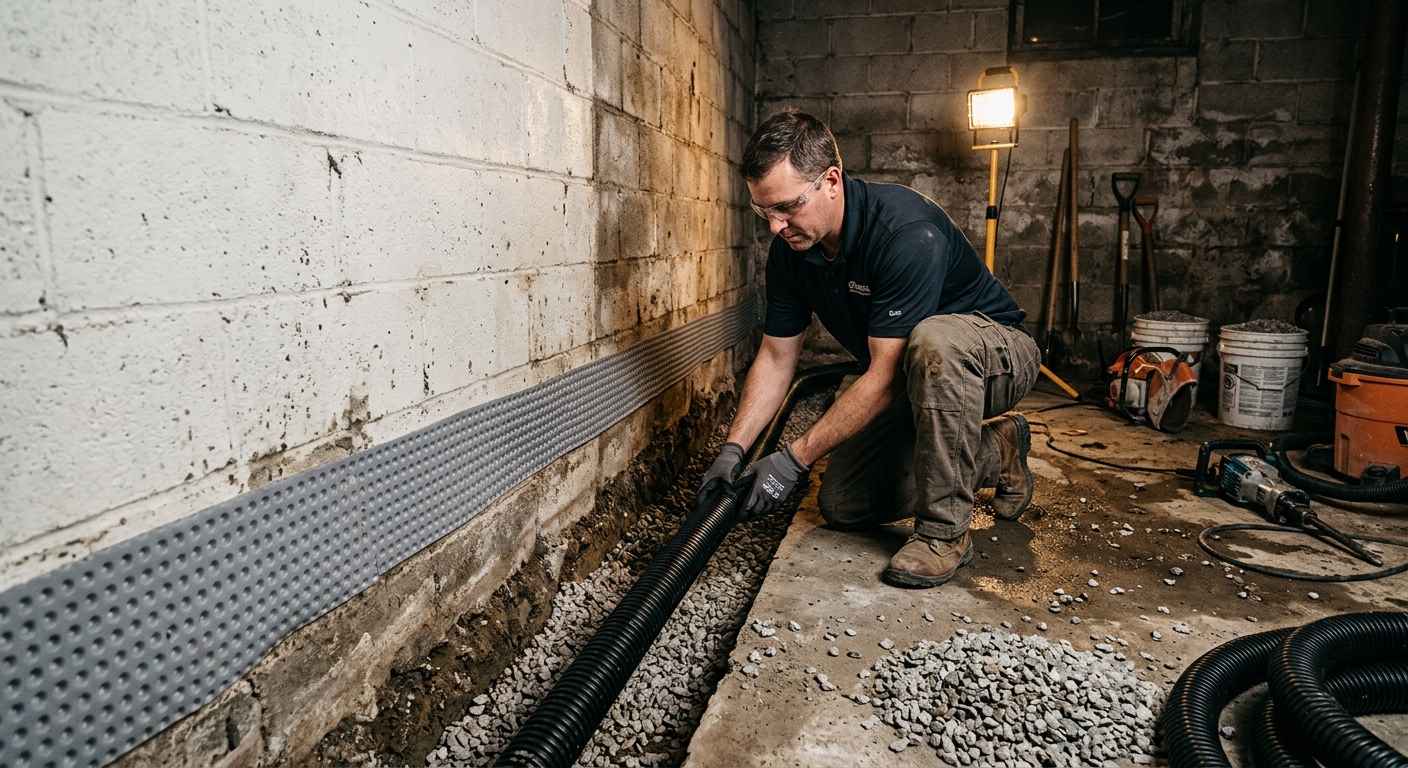
Basement waterproofing options and costs in Creston
Creston has a lot of older homes, and that matters when you’re choosing basement waterproofing. In the 2021 Census profile, 57.5% of homes in the area were built before 1981, which means many foundations were originally protected with early damp-proofing methods or undersized drainage. When those systems age, water pathways develop at joints, at footing lines, and through cracks—especially once freeze–thaw cycles start widening minor movement in poured concrete and block foundations.
In the Kootenays, the biggest cost drivers are soil conditions, groundwater behaviour, and weather. Around Creston, glacial and alluvial soils can shift from well-drained gravels to moisture-holding silts and clays, which affects how quickly hydrostatic pressure builds against your basement walls. With stronger snowmelt and shoulder-season rains, older perimeter drains can’t always keep up—so projects near the downtown core and the older residential pockets around Creston’s hill-and-valley transitions tend to book out faster. Labour is also impacted by how much exterior excavation is required (driveways, gardens, stairs, or fences) and whether disposal and regrading are included.
Because of that, two homes can experience the same symptoms (damp walls, efflorescence, sump cycling) but need different solutions. Use the comparison table below to match your risk level to the right approach—then we’ll talk about the price factors that explain the variation across Kootenay towns and the broader province.
| Method |
What It Addresses |
Disruption Level |
Durability |
Price Range |
| Exterior excavation + new membrane + drainage tile |
Stops water entry by rebuilding the exterior waterproofing system and perimeter drainage |
High (excavation, landscaping restoration) |
Long-term (typically decades when installed to spec) |
$18,000–$35,000 |
| Interior perimeter drain channel + sump pit |
Manages water after it enters; reduces hydrostatic pressure inside the basement |
Medium (cutting concrete/finishes limited to interior perimeter) |
Long-term when paired with proper sump discharge |
$9,000–$20,000 |
| Foundation crack injection (epoxy or polyurethane) |
Seals cracks (epoxy for non-moving structural cracks; polyurethane for active leaks) |
Low to medium (drilling/patching only) |
Good to long-term depending on crack movement and wall type |
$800–$2,500 |
| Sump pump installation (primary + battery backup) |
Prevents flooding during high-water periods and power outages |
Medium (pit, discharge, electrical tie-in) |
High reliability with backup power |
$2,500–$5,500 |
| Window well drain installation |
Keeps surface water from pooling and entering at below-grade windows |
Low (localized excavation) |
Moderate to long-term when maintained |
$1,200–$3,800 |
| Lot re-grading / downspout extension |
Directs roof runoff away and reduces water build-up against foundation |
Low (yard work) |
Moderate (depends on long-term grading stability) |
$950–$2,900 |
Prices are estimates only and vary by project scope, site access and material selection.
What affects the price of waterproofing in Creston
In Creston, and across the Kootenays, you can see quotes for the “same” waterproofing job vary by 30% to 50%. The differences usually aren’t because one contractor is trying to be expensive—they’re driven by how much excavation is actually required, whether the soil holds water, and how the work is engineered for freeze–thaw and groundwater pressure. A waterproofing scope that includes excavation, drainage tile, membrane, and sump redundancy will almost always land higher than a targeted interior solution, even when the symptoms look identical.
The three local drivers that separate Kootenay pricing from national averages are soil type, water table behaviour, and freeze–thaw. In clay-heavy conditions, soils hold moisture and expand as temperatures drop, which increases lateral pressure on foundation walls and can worsen cracks over time. Where the water table is high or the site sits near drainage pathways, sump systems run more often and require better discharge detailing. And with strong seasonal freeze–thaw, older concrete and block can experience recurring joint movement—meaning sealing materials and crack types can’t be treated as one-size-fits-all.
Here are a few concrete examples from Creston-area basements. A home built in the pre-1981 era (remember, 57.5% of homes in the area fit that bracket) often has older perimeter drainage—so “exterior re-do” work may be necessary instead of simply topping up gravel. If you have a poured-concrete wall with a non-moving, hairline crack, crack injection might stay in the $800–$2,500 band; if the crack is actively leaking, a polyurethane approach plus drainage adjustments can push you toward the $9,000–$20,000 interior waterproofing range. On the other hand, straightforward site fixes like downspout extensions and re-grading can be relatively economical—if they’re addressing the root cause—typically within the smaller lot-work ranges.
| Price Factor |
Why It Matters |
Cost Impact |
| Interior vs. exterior approach |
Interior work manages water after it enters; exterior addresses the water source and hydrostatic pressure path |
Interior is usually less disruptive; exterior often costs more due to excavation and restoration |
| Foundation type |
Poured concrete, block, stone, and ICF respond differently to sealing, drainage, and crack movement |
Block and older assemblies may require more interior drainage for practicality |
| Soil type |
Clay holds water and expands during freeze–thaw, increasing pressure against walls |
More water retention often increases sump pump sizing and drainage detailing |
| Crack type and length |
Hairline/non-structural cracks behave differently than structural horizontal or step cracks |
Structural repairs may require engineering and can raise crack repair costs |
| Sump pump backup system |
Backup is critical during heavy shoulder-season rainfall and outages |
Battery or water-powered backup can add cost but reduces flood risk substantially |
| Access |
Landscaping, decks, driveways, and walkways increase labour and restoration |
Limited access can raise both labour hours and disposal/restoration items |
| Weeping tile age |
Original weeping tile can fail over decades and contribute to chronic seepage |
Complete failure often forces more comprehensive exterior or interior drain replacement |
| Mould or efflorescence remediation required before sealing |
Sealers don’t adhere well to untreated contamination or wet salts |
Remediation can add time and materials before waterproofing begins |
Permits & regulations in British Columbia
In British Columbia, certain basement and foundation waterproofing-related activities typically trigger permit requirements—especially when you’re changing drainage systems, performing structural crack repair, or excavating near a foundation. As a general rule: foundation excavation, structural crack repairs (when there’s potential structural impact), and changes to lot drainage commonly require a building permit. If your sump pump discharge is connected to storm or sanitary services, you may also need municipal approval before tying into existing infrastructure.
For structural cracks—such as major horizontal cracks in block walls or significant step cracking—an assessment by a structural engineer is often needed to confirm whether underpinning or other structural measures are required. A competent contractor should clearly explain whether engineering support is included for structural repairs and provide proof of appropriate coverage.
How homeowners in Creston can verify a contractor in BC, step-by-step:
- Confirm the contractor’s British Columbia licence through the online registry and verify the correct business type.
- Request a certificate of insurance (liability) and check dates and coverage limits.
- Ask for proof of WSIB/WCB coverage (work-related insurance) and confirm it matches the crew performing the work.
- For structural projects, ask whether they retain engineering support and who signs off on the repair plan.
- Get the permit plan in writing—whether the contractor pulls it, and what documentation they will submit.
Interior vs exterior waterproofing — what does Creston need?
The fundamental difference is that exterior waterproofing (full excavation, new membrane, new drainage tile, and backfill) aims to permanently stop water from getting into your basement in the first place. It’s the most direct fix for ongoing hydrostatic pressure, but it’s significantly more disruptive and labour-intensive because it requires excavation along foundation walls. Interior waterproofing (a perimeter drain channel, sump pit, and sump pump) manages water after it enters and relieves pressure inside the basement. It’s usually less invasive, but it doesn’t stop the outside water from pushing against the wall; instead, it collects and discharges it.
For Creston’s Kootenay conditions—freeze–thaw, older housing stock, and variable soils—the right approach often depends on the foundation type and how active the leaks are. In general, poured concrete walls can respond well to crack injection when cracks are non-moving, because sealing is less likely to be defeated by constant movement. With block foundations, interior drainage is often a practical complement because water can travel through mortar joints and capillary pathways; pairing targeted crack work with interior drainage and a sump system is commonly the safest risk-management combination.
On power reliability: a sump pump with a battery backup is worth considering in British Columbia, especially during spring snowmelt and heavy rain cycles when basements can see rapid water rise. The cost premium can be justified when flooding would mean significant damage and restoration.
Example: if your situation is clearly site-runoff related (roof water and poor grading), re-grading/downspout work can be the lowest-cost path, sometimes starting around the smaller lot-work band. But if you’re seeing persistent wall seepage and sump cycling, it’s usually better to budget for interior perimeter drainage in the $9,000–$20,000 range than to spend a little on cosmetic sealing. If the exterior drainage system is failed, excavation-level work in the $18,000–$35,000 band can be the “pay once” solution.
| Method |
Best For |
Addresses Source? |
Disruption |
Lifespan |
Price Band |
| Full exterior excavation + membrane |
Active hydrostatic pressure, long perimeter leaks, failed original drainage |
Yes (primary source) |
High |
Many years to decades with proper backfill and drainage |
$18,000–$35,000 |
| Interior French drain + sump system |
Basements with recurring seepage, high spring water, or impossible exterior access |
No (controls water after entry) |
Medium |
Long-term if discharge, sump sizing, and backup are correct |
$9,000–$20,000 |
| Crack injection — epoxy (structural) |
Non-moving, hairline to non-horizontal cracks in poured concrete |
Partial (stops seepage through the crack) |
Low |
Good long-term when the crack is stable |
$800–$2,500 |
| Crack injection — polyurethane (active leak) |
Cracks with active moisture or where water is finding a pathway |
Partial (stops seepage as it flows) |
Low to medium |
Good when paired with drainage; can be limited if movement continues |
$1,000–$3,200 |
| Interior drain channel only (no sump) |
Light seepage and cases where water volume is manageable |
No |
Medium (interior perimeter work) |
Moderate; risk increases if water rises quickly |
$6,500–$13,500 |
| Re-grading + downspout extensions |
Roof-runoff over-saturation, surface pooling near footing line |
Sometimes (if water is primarily from outside surface runoff) |
Low |
Moderate; depends on long-term yard settling |
$950–$2,900 |
How to choose a waterproofing contractor in Creston
Choosing a waterproofing contractor in Creston is less about flashy ads and more about verifying three things: correct licensing, proper insurance, and the ability to build a scope that matches your water pathway. In British Columbia, start by asking for (and reviewing) their licence details, then request a certificate of insurance showing liability coverage. Finally, confirm their WSIB/WCB coverage for the workers who will be on your property—don’t just accept a verbal answer.
Next, get 2–3 itemised written quotes, not lump sums. A good quote breaks out labour and materials (excavation quantities, membrane/drainage components, pump and backup system, disposal, backfill, and landscaping restoration). Read the exclusions carefully: does the quote include permit pulling, concrete disposal, saw-cutting, haul-away, and patching/finish restoration? If mould or efflorescence is present, the remediation steps should be listed so you’re not paying for sealing over contaminated surfaces.
Warranty matters in waterproofing. Ask for the workmanship warranty length, whether it’s backed by the company that’s installing it, and whether the manufacturer product warranty applies to the materials used. Also ask if warranties are transferable if you sell your home.
On payment: avoid large deposits—most homeowners do best keeping upfront payments around 10% to 15%. Hold back remaining funds until the job is complete and you’ve received documentation, including photos of drainage connections, membrane tie-ins, and test runs where applicable. Require a start date and completion estimate in writing.
- Verify BC licence number and correct trade designation in their documentation.
- Confirm liability insurance certificate and the coverage period.
- Confirm WSIB/WCB coverage for the project crew.
- Ask for an itemised quote with quantities (not “allowance-only” scopes).
- Check whether permit pulling is included (or your responsibility) in writing.
- Confirm disposal/haul-away of excavated material is included if excavation is part of the scope.
- Look for a clear plan for discharge (where the sump discharges, and whether it’s code-compliant).
- Ask how they address freeze–thaw risks in the design (drainage slopes, backfill, and seal details).
- Confirm sump pump type and whether battery backup is optional or included.
- Require warranty terms for both workmanship and materials.
- Request before/after photos and documentation of drainage and membrane installation.
- Make sure the quote includes a timeline and a clear change-order process.
Red flags in Creston include: contractors who won’t put the scope in writing; “one-size-fits-all” claims that ignore whether your foundation is poured concrete vs block; quotes that omit how discharge will be handled; warranties that cover only labour but not installed systems; and crews that ask for large upfront payments beyond what’s needed to mobilize.
Frequently asked questions — waterproofing in Creston
How much does foundation crack repair cost in Creston?
In Creston, foundation crack repair is usually priced based on crack length, depth, and whether water is actively tracking through. For many typical sealing jobs, homeowners can expect work to fall within the $800–$2,500 band for crack injection—assuming the crack is stable and the scope is limited to the identified locations. If the crack is actively leaking or requires more drilling/ports to reach the full pathway, pricing can move higher within the same overall range depending on labour and materials. In older homes (and remember, a large share locally were built before 1981), freeze–thaw can worsen minor cracks over time, so it’s important to confirm crack type before choosing epoxy vs polyurethane.
Do I need a sump pump in Creston?
You may need a sump pump in Creston if water levels in your basement rise during spring snowmelt or heavy shoulder-season rains, or if interior drainage is capturing ongoing seepage. If your basement already shows recurring dampness, frequent sump cycling, or you’re getting water through the footer line, a sump helps control water after entry and reduces the chance of flooding. For budgeting, sump pump installation typically falls in the $2,500–$5,500 range, and adding battery backup can be especially valuable in British Columbia during outages that coincide with storms. If you only have minor localized seepage, sometimes re-grading and downspout changes reduce pressure enough that a sump isn’t required—but that decision should be based on an inspection of water pathways.
How does Creston's soil affect my foundation?
Creston-area soils can vary from well-drained gravels to moisture-holding silts and clays, and that variability influences how quickly water builds up against your basement walls. Clay-prone areas tend to hold moisture and expand during freeze–thaw, which increases lateral pressure and can worsen cracks or joint leakage over time. When older perimeter drains fail, the soil stays wetter for longer, so you can see damp walls, efflorescence, and higher water table pressure during spring. That’s why two homes with similar symptoms can require different solutions: one may respond well to targeted exterior drainage restoration, while another needs interior perimeter drainage and sump discharge detailing to manage recurring hydrostatic pressure.
Do I need a permit for foundation work in British Columbia?
Often, yes—foundation excavation, structural crack repair, and changes to lot drainage commonly require a building permit in British Columbia. If the work involves major excavation near the foundation, or structural-level repairs (for example, significant horizontal cracks in block walls), expect additional scrutiny and, in many cases, an engineer’s assessment. Sump pump discharge connections to storm or sanitary systems may also require municipal approval. The best way to confirm is to ask the contractor to state clearly: what permit(s) they will pull, what documentation is required, and who is responsible for inspections. For your own due diligence in Creston, verify that the contractor carries appropriate insurance and that their quote explains permit responsibilities before work begins.
How long does waterproofing last?
When installed correctly to match site conditions, waterproofing systems can last many years. Exterior waterproofing—new membrane plus drainage tile and properly designed backfill—tends to have the best long-term performance because it addresses the source of water entry and reduces hydrostatic pressure against the foundation. Interior systems can also perform for decades, but longevity depends heavily on sump sizing, discharge routing, and whether backup power is included for high-water events. In Creston, freeze–thaw makes maintenance and correct design details especially important, particularly for older foundations (many of which were built before 1981). If you notice recurring seepage, smells from damp areas, or new efflorescence after the repair, it’s a sign to reassess drainage and crack movement rather than simply re-sealing.
Can I waterproof my basement from the inside only?
Yes, many Creston homeowners waterproof from the inside only—especially when exterior excavation is difficult due to landscaping, fences, or access. Interior approaches typically use a perimeter drain channel and, often, a sump pump to collect water after it enters. That said, interior-only work doesn’t stop hydrostatic pressure from pushing on the wall; it manages the water pathway. In cases involving block foundations and joint leakage, interior drainage is often a practical complement, while poured-concrete walls may respond well to crack injection when cracks are stable. If the exterior drainage and weeping tile are completely failed, exterior work may be the more permanent solution. The best decision depends on where the water is coming from and whether cracks are actively leaking.