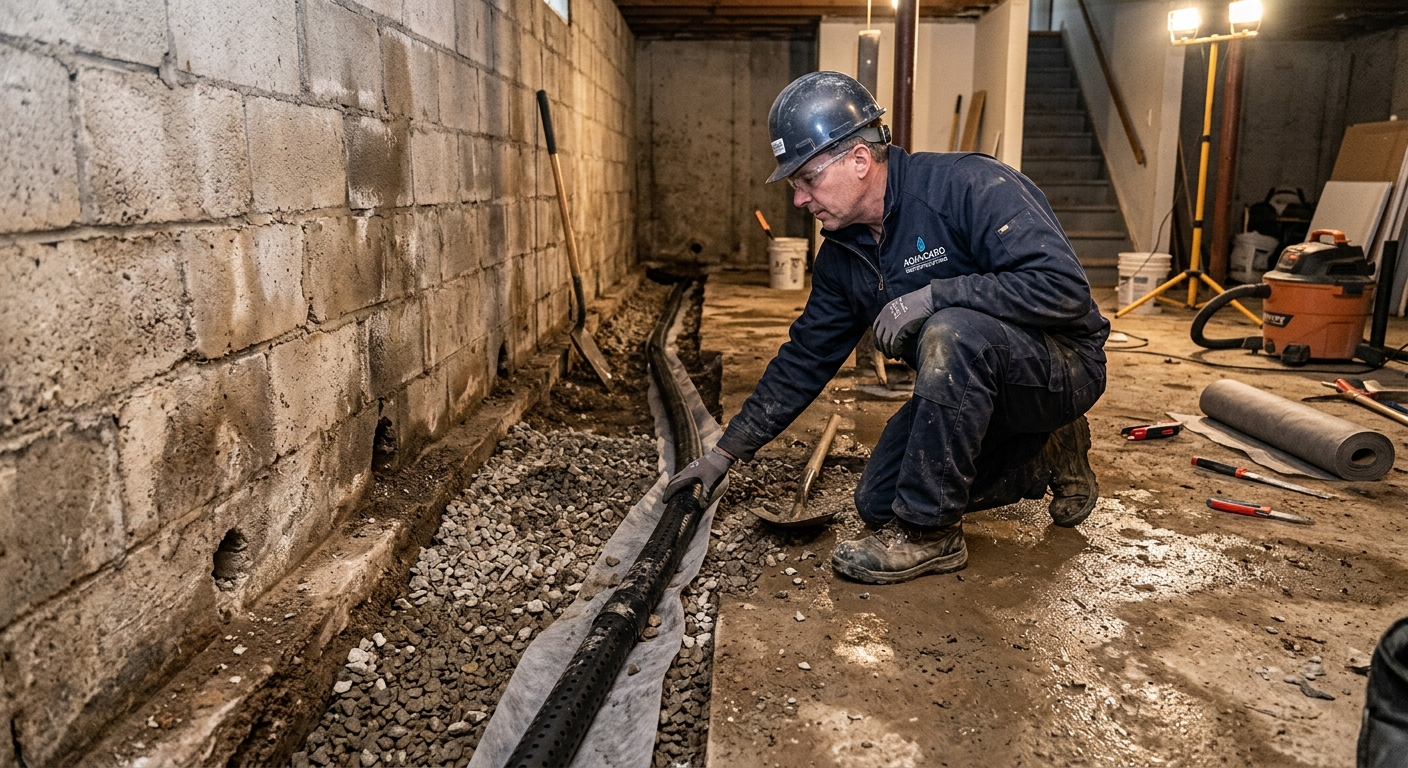
Basement waterproofing options and costs in Vauxhall
Vauxhall homeowners tackling basement dampness usually start with one question: which waterproofing method actually fits the problem under your footing line. With 80.5% of local dwellings being single-detached homes, most jobs are designed around common basement layouts and wall types, not condo systems. It also matters that 67.0% of homes in the broader Vauxhall area were built before 1981 (Statistics Canada, 2021 Census)—that older housing stock is far more likely to have aging tar-and-paper waterproofing and weeping tile that has failed long before the crack shows up inside.
In the Lethbridge–Medicine Hat economic region, pricing is shaped by silt loam to clay loam soils and seasonal saturation periods that build hydrostatic pressure against below-grade walls. Even though this region is generally drier than many parts of Canada, intense rain events and snowmelt can still overload drainage, especially when grading is off or downspouts discharge too close to the foundation. Freeze-thaw cycles then widen hairline cracks, which can increase labour for crack preparation and sealing.
Contractor availability and excavation cost also swing based on site access. In Vauxhall’s more established residential pockets near the central core, we frequently see tight side yards and older driveways that must be temporarily removed for exterior excavation and drainage line installation—pushing jobs toward the upper end of exterior ranges (especially when disposal is included). If you’re comparing bids, that’s exactly why the options below are priced by method and scope—so you can line up like-for-like before you decide.
| Method |
What It Addresses |
Disruption Level |
Durability |
Price Range |
| Exterior excavation + new membrane + drainage tile |
Source water entry; reduces hydrostatic pressure by redirecting groundwater |
High (excavate around perimeter, landscaping impacts) |
High (long-term when drainage slope and membrane are correct) |
$14,000–$28,000 |
| Interior perimeter drain channel + sump pit |
Water after it enters; manages seepage and reduces basement flooding risk |
Medium (interior floor cutting near walls) |
Medium to high (depends on floor condition and discharge routing) |
$9,000–$18,000 |
| Foundation crack injection (epoxy or polyurethane) |
Stops active leaks and/or restores crack integrity to reduce water pathways |
Low (selective ports/patching) |
Medium to high (best when crack type is correctly matched) |
$600–$2,500 |
| Sump pump installation (primary + battery backup) |
Overcomes peak inflow during storms and spring melt; keeps system running in outages |
Low to medium (pump location requires cutting and routing) |
High (with backup and proper discharge) |
$1,800–$3,500 |
| Window well drain installation |
Rain/snowmelt runoff entering through or around window wells |
Low to medium (excavation around specific wells) |
Medium to high (depends on downspout/grade around wells) |
$1,200–$3,200 |
| Lot re-grading / downspout extension |
Reduces the chance surface water flows toward the foundation |
Low (yard work; may include small trenching) |
Medium (helps most when paired with drainage corrections) |
$1,000–$4,000 |
Prices are estimates only and vary by project scope, site access and material selection.
What affects the price of waterproofing in Vauxhall
In Vauxhall and the wider Lethbridge–Medicine Hat region, the same “basement waterproofing” label can produce quotes that differ by 30–50% because contractors may be solving different parts of the water problem: source water control versus after-entry management. National averages also miss the local realities of clay loam soils, seasonal saturation, and freeze-thaw cycling that stresses joints and cracks. In Alberta, those three drivers—soil type, water-table behaviour, and freeze-thaw—often separate regional costs from typical national pricing assumptions.
Here’s how it plays out in practice. First, clay-heavy backfill can swell when it’s wet and shrink when it dries, which exerts lateral pressure on block or poured concrete walls. That means more labour for crack prep and a higher chance you’ll need injection rather than “sealant only.” Second, while the region isn’t coastal-wet, heavy rain and snowmelt can still temporarily raise local moisture and increase sump run times when exterior drainage is missing or undersized. Third, repeated freeze-thaw widens existing defects; if you have a foundation built before 1981, it’s more likely original weeping tile is undersized or failed—leading to more time spent on interior drainage and pump sizing.
Concrete Vauxhall examples that move price up or down: (1) Tight side yard access near older properties can add excavation and labour, pushing interior work closer to the upper range of $9,000–$18,000; (2) If a contractor can verify working exterior discharge and only needs targeted membrane work, exterior excavation may land nearer $14,000–$28,000 instead of the high end; (3) If structural cracks are present and injection must match a structural horizontal crack scenario, the job may be priced higher than simple cosmetic sealing.
| Price Factor |
Why It Matters |
Cost Impact |
| Interior vs. exterior approach |
Interior controls water after entry; exterior reduces source water pressure |
Interior typically lower disruption; exterior often adds excavation and disposal cost |
| Foundation type |
Block, poured concrete, stone and ICF behave differently under pressure and cracking |
Block and stone often need interior drainage reinforcement; poured concrete may take well to crack injection |
| Soil type |
Clay expands more than sand, increasing lateral pressure during freeze-thaw |
Clay loam and clay-rich backfill can increase prep work and drainage scope |
| Crack type and length |
Hairline cracks can differ from structural horizontal cracks |
Structural-type cracks generally require more surface prep, routing/ports, and careful material selection |
| Sump pump backup system |
Backup prevents downtime during power interruptions during spring melt and heavy rain |
Battery backup adds cost but reduces risk of basement flooding |
| Access |
Landscaping, decks, driveways and narrow side yards change excavation difficulty |
Exterior work can jump due to removal/rebuild of elements and slower excavation |
| Weeping tile age |
Original tile (often 60+ years) may be collapsed, disconnected, or undersized |
Failed tile can require full replacement strategy or an interior-only plan |
| Mould or efflorescence remediation required before sealing |
Sealers don’t bond well to ongoing moisture or contaminated surfaces |
Extra cleaning, drying time, and remediation materials add labour and schedule impact |
Permits & regulations in Alberta
In Alberta, foundation excavation, structural crack repair, and changes to lot drainage commonly require a building permit. If you’re adding or modifying a sump system where the pump discharges to municipal infrastructure (storm or sanitary), municipal approval is typically required as part of the permit process—don’t assume “it’s just a pump.” For structural crack repair—especially horizontal cracks in block walls, major step cracks, or cracks that suggest movement—many homeowners are required (or strongly advised) to get a structural engineer’s assessment to determine whether underpinning, braces, or other structural work is needed before sealing.
Because requirements can vary by scope, the safest approach is to have the contractor confirm what permit(s) apply to your exact Vauxhall site. Step-by-step, here’s how a homeowner can verify the contractor before work begins: (1) Ask for their Alberta licence/registration details and company identification; (2) request a certificate of insurance showing general liability for the full project period; (3) ask for WSIB/WCB clearance or documentation of coverage; and (4) for structural-type repairs, ask whether they have engineering support available or will coordinate it.
Where to look: the contractor’s own insurance certificate should list you as an “additional insured” when applicable; for licences and registrations, use the relevant provincial online registry (search the contractor name and business number). Finally, insist on written confirmation of who pulls the permit, what’s included (including inspection scheduling), and whether the scope changes trigger new approvals.
Interior vs exterior waterproofing — what does Vauxhall need?
For most Vauxhall basements, the decision comes down to whether you want to stop the water at the foundation or manage it after it enters. Exterior waterproofing involves full excavation, new membrane, and new drainage tile with proper backfill and grading. It permanently addresses the source of water entry by reducing hydrostatic pressure—but it costs more and disrupts landscaping, fences, and sometimes driveways. Interior waterproofing—such as a perimeter drain channel and sump pit—does not stop pressure at the wall; instead, it collects and pumps water once it finds the path indoors. It’s typically less invasive and faster for many homes, but performance depends on the completeness of the interior drainage system and the discharge strategy.
Given Vauxhall’s silt loam to clay loam soils and freeze-thaw cycles, exterior systems often become the best long-term solution when weeping tile is failed or unknown and clay-rich backfill is trapping moisture. If you’re dealing with poured concrete walls, crack injection can complement interior work—many poured foundations respond well to correctly matched injection materials. For block foundations, interior perimeter drainage is frequently a practical complement because block joints and mortar can transmit moisture even when surface crack sealing looks “tight.”
Backup sump pumps are also worth planning for. During spring melt, power interruptions can turn a well-performing system into a failure. Adding a battery backup can cost extra, but it’s the difference between an actively managed basement and standing water when the grid is unstable.
Dollar logic example: If your quotes show interior waterproofing around $9,000–$18,000 and exterior excavation around $14,000–$28,000, the higher exterior number is justified when exterior drainage is clearly failing and soil conditions suggest ongoing hydrostatic pressure. If the issue is localized window well runoff or downspout discharge, spending at the interior range may be wasteful.
| Method |
Best For |
Addresses Source? |
Disruption |
Lifespan |
Price Band |
| Full exterior excavation + membrane |
Widespread seepage, failed or absent weeping tile, clay-rich backfill conditions |
Yes |
High |
Long-term |
$14,000–$28,000 |
| Interior French drain + sump system |
Interior seepage, high water events, when exterior access is limited or budget is tighter |
Not directly (manages after entry) |
Medium |
Medium to long-term |
$9,000–$18,000 |
| Crack injection — epoxy (structural) |
Dry-to-damp cracks where the goal is to restore integrity and limit water pathways |
Partial (depends on crack activity) |
Low |
Medium to high |
$600–$2,500 |
| Crack injection — polyurethane (active leak) |
Active seepage through cracks where the material must expand/flow into pathways |
Partial (reduces leak pathway) |
Low |
High when matched correctly |
$900–$3,200 |
| Interior drain channel only (no sump) |
Light seepage where gravity drainage and a suitable discharge route exists |
No |
Low to medium |
Limited (more risk in high-water periods) |
$6,500–$12,000 |
| Re-grading + downspout extensions |
Surface-water issues, wet spots near foundation corners, missing/short downspouts |
Yes (for surface water) |
Low |
Medium |
$1,000–$4,000 |
How to choose a waterproofing contractor in Vauxhall
When you hire a waterproofing contractor in Vauxhall, start by verifying the essentials in Alberta: (1) licensing/registration for the contracting business; (2) general liability insurance; and (3) WSIB/WCB clearance for workers. You can check licensing by searching the contractor’s name and business number in the appropriate provincial registry online. For insurance, request a certificate of insurance and confirm the coverage period matches your job dates. For WSIB/WCB, ask for clearance documentation or equivalent proof—don’t accept “we’re covered” without paperwork.
Next, insist on 2–3 itemised written quotes. “Itemised” should include labour and materials breakdown (membrane, drainage tile, pumps, injection materials), and separate line items for excavation, interior cutting, disposal, and any engineering/assessment coordination if structural cracks are suspected. Read the scope carefully: what is excluded (e.g., mould remediation, concrete replacement, backfill compaction testing, restoration of landscaping)? Is permit pulling included? Is disposal of excavated soil included? In Alberta, you want clarity on discharge routing and whether municipal approval is required for the sump discharge.
Warranty matters, too. Ask for the workmanship warranty length and whether it’s tied to the property or transfers to future owners. Product/manufacturer warranties differ from labour warranties—get both in writing. For payment scheduling, avoid large upfront payments; a common safe approach is never more than 10–15% upfront, with a holdback until the job is complete and inspected. Finally, require a written timeline with a start date, estimated duration, and conditions that could delay the work (curing time, weather restrictions, excavation drying time).
- Request Alberta licence/registration details in writing before signing.
- Confirm liability insurance on the certificate of insurance (match project dates).
- Provide WSIB/WCB clearance documentation for worker coverage.
- Get 2–3 quotes that list labour vs materials separately (not just a lump sum).
- Ask whether disposal and backfill compaction testing are included.
- Clarify whether permit pulling is included and who is responsible for inspections.
- Make sure the quote states the system design: sump size, discharge route, pump model, and backup approach.
- Confirm crack injection approach matches crack type (epoxy for structural vs polyurethane for active leaks).
- Ask how they test for active leaks and manage damp walls before sealing.
- Check warranty terms: workmanship length, exclusions, and transferability.
- Payment schedule: no more than 10–15% upfront; hold back until complete and cleaned up.
- Demand a written start date, duration estimate, and contingency plan for weather delays.
Red flags we see in Vauxhall include: contractors offering “one-size-fits-all” sealant only without identifying crack type, vague quotes that don’t list disposal or discharge routing, refusing to provide insurance/WSIB/WCB documentation, promising a sump pump without discussing battery backup for spring melt risk, and skipping site access assessment (leading to surprise costs for decks/driveways/yard restoration).
Frequently asked questions — waterproofing in Vauxhall
How do I compare waterproofing quotes?
Start by comparing quotes on scope, not just totals. In Vauxhall, a “waterproofing” quote can mean interior perimeter drains and a sump, or full exterior excavation with membrane and drainage tile—and those aren’t apples-to-apples. Ask each contractor to itemise labour and materials, including disposal of excavated soil, and confirm whether the quote includes a permit if lot drainage changes are required. Also compare system design details: sump discharge route, pump model, and whether battery backup is included. If one quote only proposes sealant for cracks and the others propose crack injection or interior drainage, you’re likely comparing symptom treatment to source control.
How long does basement waterproofing take in Vauxhall?
Timing depends on whether you’re doing interior drainage, crack injection, or full exterior excavation. Typical timelines in Alberta for interior perimeter drain and sump installations are often measured in days, but schedule can stretch if concrete needs cutting, floors require prep, and drying/curing time is needed for membrane or sealants. Crack injection is usually faster (often within a short on-site window) but still depends on drying and crack prep. Exterior excavation is longer due to excavation, membrane installation, drainage tile placement, inspection steps, backfill compaction, and landscaping restoration. In damp spring conditions around Lethbridge–Medicine Hat, contractors may plan around rain, which can affect when they can re-grade and close the excavation.
What is a weeping tile and does my Vauxhall home have one?
Weeping tile is the underground drainage line around your foundation that collects groundwater and channels it to a sump or discharge point. Many homes in this area—especially older houses built before 1981—had original weeping tile installed, but it can fail after decades due to collapse, disconnection, or undersizing. In Vauxhall, because 67.0% of homes were built before 1981 (Statistics Canada, 2021 Census), it’s common for us to find weeping tile that’s either not functioning or not present at all. You can’t always confirm by looking in a basement; an exterior inspection or video inspection of drainage lines often gives the clearest answer. If the tile is failed, interior waterproofing or a full exterior rebuild may be recommended.
Can I waterproof my basement in winter in Vauxhall?
Winter waterproofing is possible, but it depends on the method and conditions. Interior crack injection and targeted interior work often can be done when surfaces can be properly prepped and kept at workable temperatures. Exterior excavation is harder in freeze conditions because soils can be frozen solid, and membrane application requires correct temperature and curing conditions. In Vauxhall’s freeze-thaw climate, rushing exterior work can increase the risk of gaps in backfill contact or reduced bonding. If you’re trying to solve an active leak, injection may be the most practical option. For a sump installation, winter work can be scheduled if the area is accessible and the discharge routing can be completed safely and legally.
What is the difference between waterproofing and damp-proofing?
In plain terms, waterproofing aims to manage or stop water infiltration under conditions that can create hydrostatic pressure, including driving rain events and saturated soils. Damp-proofing is more about controlling minor moisture and preventing surface dampness—often using lighter coatings or sealants that may not perform when water pressure increases behind the wall. In Vauxhall, where clay loam soils can trap water and freeze-thaw can widen joints, true waterproofing typically includes systems like drainage tile, perimeter drains, sump pumps, and correctly matched crack injection. If a contractor only offers damp-proofing with surface sealant and doesn’t address drainage or active cracks, you may see problems return after heavy snowmelt or rain. That’s why method matters when you compare bids within the typical interior range of $9,000–$18,000 or exterior range of $14,000–$28,000.
Will basement waterproofing affect my property value in Vauxhall?
Yes—done properly, waterproofing can protect the livability and future sale potential of your home. Buyers often view a dry, maintenance-friendly basement as a major selling point, particularly in homes with histories of seepage, efflorescence, or sump failures. In Vauxhall, homeowners frequently have basements in older stock—given that 67.0% of homes were built before 1981 (Statistics Canada, 2021 Census)—so fixing recurring water issues can reduce uncertainty for future buyers. The value impact depends on the solution: a well-documented exterior system with drainage improvements often provides stronger long-term confidence than short-term cosmetic sealing. Interior drainage with a sump and proper discharge can also help a lot, especially when paired with crack injection where needed.