Basement waterproofing options and costs in Rocky Mountain House
In Rocky Mountain House, basement waterproofing is often less about “one-size-fits-all” and more about managing water that arrives during the region’s wet season and spring melt. With 44.5% of homes built before 1981 (Statistics Canada, 2021 Census), a lot of the local foundation and drainage systems are older—meaning original tar-and-paper approaches may be long past their effective life, and weeping tile is frequently failed, partially blocked, or disconnected. Rocky Mountain House also has a high share of owner households (70.7% of households own, Statistics Canada, 2021 Census), so homeowners commonly invest in longer-term solutions rather than quick fixes.
In the Banff–Jasper–Rocky Mountain House corridor, quotes can vary based on mountain/foothill soils (from coarse, well-drained sands and gravels to finer glacial tills and clays) and how close the perched water table sits to grade near low-lying areas. Elevated seasonal water tables, plus freeze–thaw cycles that open existing cracks, can increase seepage and shorten the “quiet” period between problems. That’s why contractors in the Rocky Mountain House area tend to be busiest in neighbourhoods with older, more established lots—particularly around the older core near downtown and along routes with mature trees and compacted backfill.
The table below compares the main systems homeowners use, what they address, typical disruption, and realistic price ranges so you can line up like-for-like scopes before you request quotes.
| Method |
What It Addresses |
Disruption Level |
Durability |
Price Range |
| Exterior excavation + new membrane + drainage tile |
Water at the source: hydrostatic pressure relief and exterior sealing |
High (excavation, landscaping restoration) |
Long-term when properly backfilled and drained |
$9,000–$25,000 |
| Interior perimeter drain channel + sump pit |
Water that enters the basement by collecting and pumping it out |
Medium (floor/trim work, limited wall exposure) |
Very good for ongoing seepage if discharge is correct |
$8,000–$22,000 |
| Foundation crack injection (epoxy or polyurethane) |
Cracks: epoxy for structural, polyurethane for active leakage |
Low to medium (surface prep, drill/port work) |
Good when the correct resin matches crack behaviour |
$600–$2,500 |
| Sump pump installation (primary + battery backup) |
Protects against high water periods and power interruption risks |
Low to medium (pit, discharge piping, some electrical work) |
Strong performance with reliable backup |
$1,600–$3,500 |
| Window well drain installation |
Bulk water entry near egress points during heavy spring melt |
Low to medium (localized excavation/stone work) |
Good when the weep/discharge path is maintained |
$1,200–$4,000 |
| Lot re-grading / downspout extension |
Redirects surface runoff away from foundation |
Low (minor demolition/landscaping) |
Moderate (depends on ongoing maintenance) |
$1,000–$3,500 |
Prices are estimates only and vary by project scope, site access and material selection.
What affects the price of waterproofing in Rocky Mountain House
In Rocky Mountain House, two homeowners can receive bids for the “same” basement problem that differ by 30–50% across the Banff–Jasper–Rocky Mountain House corridor and Alberta because contractors often face different site constraints and different root causes. Even when the symptom looks similar—damp walls, recurring puddles, musty odours—the drivers that control labour time and materials are usually soil behaviour, water-table height, and freeze–thaw movement.
First, soil type matters. Coarse, well-drained soils may reduce hydrostatic pressure, so an interior system can be the cost-effective response. Clay-heavy conditions common in parts of the Prairies transition (and in some foothill tills) can expand and contract through freeze–thaw, increasing lateral pressure and worsening crack openings over time. That means you may need crack injection plus perimeter drainage, or in some cases full exterior excavation.
Second, water-table and perched-water conditions affect pump sizing, drain routing, and backup planning. Where seasonal water tables sit higher (especially near low-lying yards), sump run times increase—pushing the project into a higher band, particularly when battery backup is part of the scope. Third, freeze–thaw cycles in Alberta can widen existing cracks and force contractors to clean, seal, and verify discharge paths more thoroughly; otherwise, seepage returns quickly.
Concrete examples: (1) A block foundation with active horizontal cracking often triggers polyurethane injection plus interior drainage, typically landing near the $600–$2,500 crack-repair band and adding interior work; (2) a yard requiring deck removal, tree-root trimming, or rock-breaking for exterior access can shift exterior projects toward the $9,000–$25,000 range; (3) a basement where weeping tile is already failed and discharge is unclear often requires pump upgrades, which is a direct reason interior projects climb toward the upper portion of the $8,000–$22,000 interior band.
Before you compare quotes, ask each contractor to show how they identified water entry paths, what they’ll do about discharge, and which building elements they’re sealing versus managing.
| Price Factor |
Why It Matters |
Cost Impact |
| Interior vs. exterior approach — interior is less disruptive but addresses symptoms |
Interior systems manage collected water; exterior addresses source hydrostatic pressure |
Interior typically lower upfront; exterior can be $10,000+ when excavation is extensive |
| Foundation type — poured concrete vs. block vs. stone vs. ICF |
Different materials respond differently to sealing and crack injection |
Block and stone often need more interior drainage; poured concrete can seal more cleanly |
| Soil type — clay expands more than sand, adding pressure |
More movement leads to re-opened cracks and higher lateral loads |
Often pushes scope toward injection + drainage; may justify exterior drainage relief |
| Crack type and length — hairline vs. structural horizontal cracks |
Horizontal/step issues may indicate structural concern, not just seepage |
Can add engineering support, more injection ports, or follow-on stabilization work |
| Sump pump backup system — battery or water-powered backup needed |
Spring melt can coincide with power disruption; backup reduces risk |
Adds electrical and equipment costs; commonly a reason interior projects move up a band |
| Access — landscaping, decks, or driveways must be removed for exterior |
Exterior work is time-consuming when yards are tight or surfaces are hard to remove |
Removal/disposal/restoration can add thousands |
| Weeping tile age — original tile (60+ years) may be completely failed |
Failed tile increases seepage volume and changes the drainage plan |
May require replacement and new discharge routing for a complete solution |
| Mould or efflorescence remediation required before sealing |
Moisture must be stabilized and contaminated surfaces cleaned for successful sealing |
Adds prep time and remediation materials before waterproofing proceeds |
Permits & regulations in Alberta
In Alberta, many basement waterproofing projects can be completed under contractor scope without major permit complexity, but several categories typically require permits or approvals—especially when structural elements or drainage connections are involved. In practice for Rocky Mountain House, foundation excavation and any work that changes how water leaves the lot often triggers permit requirements. Structural crack repair—particularly horizontal cracks in block walls, major step cracks, or any condition suggesting movement—commonly needs a structural assessment. If underpinning or other structural remediation is required, that work generally becomes permit-driven. Separately, sump pump installations that connect to municipal storm or sanitary systems require municipal approval.
Step-by-step, here’s how a homeowner should verify a contractor in Rocky Mountain House before signing:
- Ask for the contractor’s Alberta business licence/registration details (and confirm the company is in good standing where applicable).
- Request a current certificate of liability insurance and verify limits are appropriate for excavation and interior demolition.
- Confirm WSIB/WCB coverage: ask for a clear clearance letter (or proof of registration) showing the firm is insured for its workers.
- For structural crack work, verify they include engineering support where needed—either through a partner engineer or their documented process for assessment.
- Ask whether any permits will be pulled by the contractor (and who is the applicant), and ensure that responsibility is stated in the contract.
What typically does NOT require a permit: minor drainage adjustments like downspout extensions, localized window well drains, or interior perimeter drain/sump work that does not tie into municipal services (confirm with your contractor and municipal office). What DOES require attention: structural repairs, foundation excavation that changes lot drainage, and sump discharge connections to municipal lines.
Interior vs exterior waterproofing — what does Rocky Mountain House need?
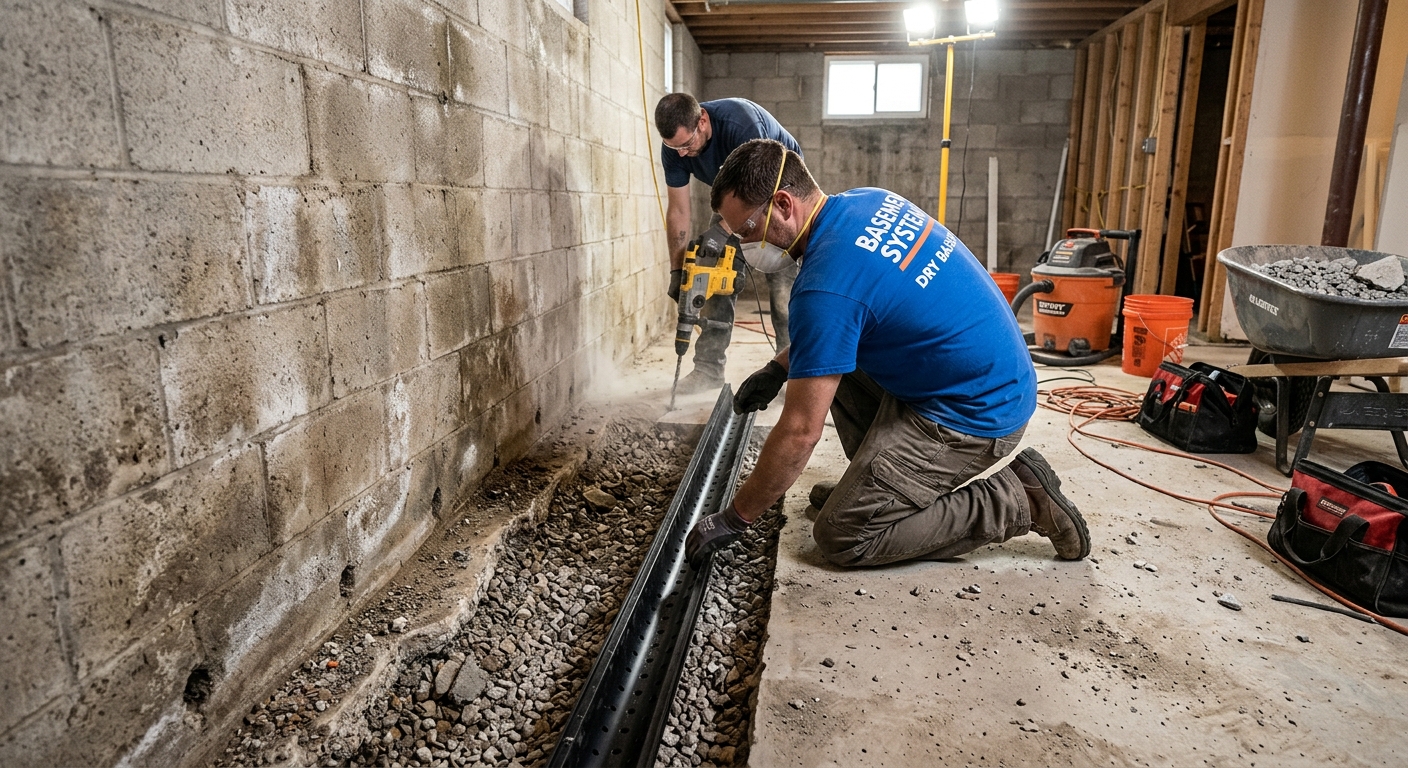
The fundamental difference is simple: exterior waterproofing (full excavation, new membrane, new drainage tile, and backfill) permanently addresses water at the source by relieving hydrostatic pressure before it reaches your foundation. It’s also significantly more disruptive—often involving deck/landscape removal, rock-breaking, and full yard restoration. Interior waterproofing (perimeter drain channel, sump pit, and sump pump) manages water after it enters. It generally costs less and is less invasive, but it does not stop water pressure from acting on the foundation wall itself; it only controls the water by collecting seepage and pumping it out.
In Rocky Mountain House, where seasonal water tables can remain elevated during spring melt and freeze–thaw cycles can widen existing cracks, the “right” approach depends on how and where water is entering. If you have a poured concrete wall with a clear cracking pattern, crack injection is often a strong first step because the concrete typically responds well when the correct resin is chosen and the discharge path is secure. If you’re dealing with block foundations or recurring seepage at multiple locations, interior perimeter drainage is frequently the practical backbone—especially where exterior excavation is difficult due to landscaping, access, or rocky substrates.
Sump pump backup matters here because spring flooding periods can coincide with short outages. A primary pump without backup can turn a damp basement into a cleanup job. For a practical cost example: if exterior excavation pushes you into the $9,000–$25,000 band, an interior system plus targeted crack injection may still be justified when the home’s drainage problem is mostly active seepage rather than severe bulk-water pressure. The key is pairing the method to the water entry path, not just chasing a leak spot.
| Method |
Best For |
Addresses Source? |
Disruption |
Lifespan |
Price Band |
| Full exterior excavation + membrane |
High water pressure, repeated seepage, failed exterior systems |
Yes (addresses hydrostatic pressure at the foundation) |
High |
Long-term with correct drainage and backfill |
$9,000–$25,000 |
| Interior French drain + sump system |
Ongoing seepage, perched water, difficult exterior access |
No (manages water after entry) |
Medium |
Very good with reliable discharge and pump maintenance |
$8,000–$22,000 |
| Crack injection — epoxy (structural) |
Non-leaking or stable cracks where structure is sound |
Partial (seals crack pathway, but relies on correct diagnosis) |
Low to medium |
Good for stable cracks when installed correctly |
$600–$2,500 |
| Crack injection — polyurethane (active leak) |
Active seepage where water is moving through cracks |
Partial (targets active leakage pathway) |
Low to medium |
Good when the crack behaviour matches the resin choice |
$800–$2,700 |
| Interior drain channel only (no sump) |
Drier basements, localized seepage with gravity discharge |
No |
Medium to low |
Moderate to good if discharge conditions stay stable |
$5,500–$15,000 |
| Re-grading + downspout extensions |
Surface runoff issues and minor perimeter dampness |
Yes for surface water control |
Low |
Moderate (depends on maintenance) |
$1,000–$3,500 |
How to choose a waterproofing contractor in Rocky Mountain House
Choosing the right contractor is the difference between a dry basement and a repeat problem. Start by verifying Alberta coverage and credentials. Ask for the company’s liability insurance certificate—then check that the coverage is current and that it includes work related to excavation and interior demolition. Next, verify WSIB/WCB coverage by requesting a clearance letter (or equivalent proof) showing the firm is properly registered and insured for its workers.
Then, get 2–3 itemised written quotes. You want a breakdown that separates labour, excavation/haulage, membrane/drainage materials, pump equipment, discharge piping, electrical work, disposal, and restoration—not just one lump number. Carefully read the scope: what’s excluded (e.g., tree removal, engineering fees, major landscaping restoration)? Is permit pulling included where required, and who applies? Also confirm whether they include disposal of excavated soils and old materials or if that’s billed separately.
Warranty matters. Look for a clear workmanship warranty length and product/manufacturer warranty details (including whether it’s transferable if you sell the home). For payment schedule, don’t pay more than about 10–15% upfront; hold back a portion until the job is fully completed and discharge is confirmed. Finally, insist on a start date and completion timeline in writing—especially important in Rocky Mountain House where seasonal scheduling can shift with weather windows.
- Confirm Alberta registration details and ask for proof in writing.
- Request liability insurance and verify effective dates and coverage limits.
- Provide WSIB/WCB clearance letter for the contractor’s workers.
- Ask whether permits are required for your scope and who handles the application.
- Get an itemised quote with labour and material lines, not just a lump sum.
- Confirm excavation scope (footage depth, rock/haulage allowance) for exterior work.
- Verify sump discharge routing (where it goes and how it’s protected).
- Ask if a battery backup is included or optional for spring melt conditions.
- Clarify warranty: workmanship term, product term, and exclusions.
- Confirm cleanup standards and who restores landscaping/finishes.
- Review how they test or verify the fix (drain flow checks, camera inspection, monitoring plan).
- Ensure payment terms protect you: limit upfront and keep a holdback.
Red flags I commonly see with lower-quality waterproofing bids in Rocky Mountain House include: vague scopes that don’t name drainage discharge details, no mention of backup power for sump systems in wet/spring periods, quotes that treat hairline dampness without diagnosing perched-water/freezing movement, “guarantees” that exclude workmanship or products, and contractors who won’t provide proof of insurance/WSIB/WCB before work begins.
Frequently asked questions — waterproofing in Rocky Mountain House
How do I know if a foundation crack is serious?
If you’re seeing cracks in Rocky Mountain House, the seriousness depends on crack behaviour—not just width. Step cracks, horizontal cracks, or stair-step patterns along mortar joints are more concerning because they can align with movement under freeze–thaw pressure or higher seasonal water loads. Also watch for “growing” evidence: crack edges that change after spring melt, fresh seepage tracks, or dampness that worsens during heavy snowmelt can indicate active water movement rather than a stable old crack. In a home where many boards and interior finishes are already showing moisture, older housing stock is common (44.5% built before 1981, Statistics Canada, 2021 Census), and original drainage failures can make small cracks behave worse over time. If you suspect structural movement, Alberta practice is to get an engineer assessment before sealing over—especially for horizontal or major step cracks.
How much does foundation crack repair cost in Rocky Mountain House?
For crack repair in Rocky Mountain House, pricing is usually driven by crack type, number of ports/length, and whether there’s active leakage at the time of repair. For typical injection jobs, homeowners often see totals in the $600–$2,500 range. If multiple long cracks are involved or there’s extensive prep due to efflorescence and moisture, the final cost can push toward the upper end, and sometimes higher when combined with perimeter drainage work. The biggest factor is matching the resin to the crack behaviour: epoxy is commonly used for structurally stable cracks, while polyurethane is used when the crack is actively leaking and water is moving through. A proper diagnosis during a dry and wet-season assessment is what helps keep costs from ballooning.
Do I need a sump pump in Rocky Mountain House?
You may need a sump pump if your basement experiences recurring seepage during spring melt, if your perimeter drain system can’t rely on gravity discharge, or if the home sits in a spot where a perched water table forms near grade. In the Banff–Jasper–Rocky Mountain House corridor, elevated seasonal water tables and freeze–thaw can increase seepage and shorten the time between “dry” periods. If you’re getting dampness at multiple locations or you’ve had failed weeping tile, a sump system is often the reliable way to keep water managed. Many homeowners also add battery backup to reduce the risk during Alberta power disruptions around wet periods. A sump installation with primary + battery backup commonly falls in the $1,600–$3,500 range, depending on pit size, discharge routing, and electrical requirements.
How does Rocky Mountain House's soil affect my foundation?
Soil affects how water sits around your foundation and how much pressure the walls experience. In Rocky Mountain House, conditions often range from coarse sands and gravels to finer glacial tills and clays. Coarse soils can drain better, but you can still get a perched water table in low-lying areas where water is trapped 75–100 cm below grade during wet periods. Clay and fine tills are more prone to moisture-driven expansion and contraction through freeze–thaw cycles, which can open existing cracks and allow meltwater to track into basements. If your lot grading directs runoff toward the foundation or if exterior drainage is marginal, those soil effects become stronger. That’s why older homes (many built before 1981, Statistics Canada, 2021 Census) often see recurring issues when original weeping tile and drainage pathways have failed.
Do I need a permit for foundation work in Alberta?
In Alberta, whether you need a permit depends on the exact work. Foundation excavation, structural crack repair—especially if cracks indicate possible movement—and changes to lot drainage commonly require permits or approvals. In Rocky Mountain House, sump pump installations that connect to municipal storm or sanitary sewer lines generally require municipal approval. On the other hand, minor work like downspout extensions or localized window well drainage sometimes does not require a permit, but you should still confirm based on your discharge route and how the contractor plans to tie things in. Best practice: ask your contractor to state in writing whether permits are required, who applies for them, and what inspections (if any) are expected.
How long does waterproofing last?
Good waterproofing can last many years, but “how long” depends on whether the system addressed the source of water versus only managing it after entry. Exterior waterproofing systems typically provide longer-term results because they relieve hydrostatic pressure at the wall, especially when drainage tile, backfill, and discharge routing are done correctly. Interior systems can also perform well for the long haul when the perimeter drain is properly installed, the sump runs are reliable, and the discharge doesn’t create a backup issue. In Rocky Mountain House, freeze–thaw cycles and seasonal water-table elevation can stress any system, and older homes (44.5% built before 1981, Statistics Canada, 2021 Census) may start with failing weeping tile and already-stressed foundation elements. That’s why warranties, correct resin selection for crack injection, and pump backup planning matter—so you’re not redoing the work every few spring seasons.