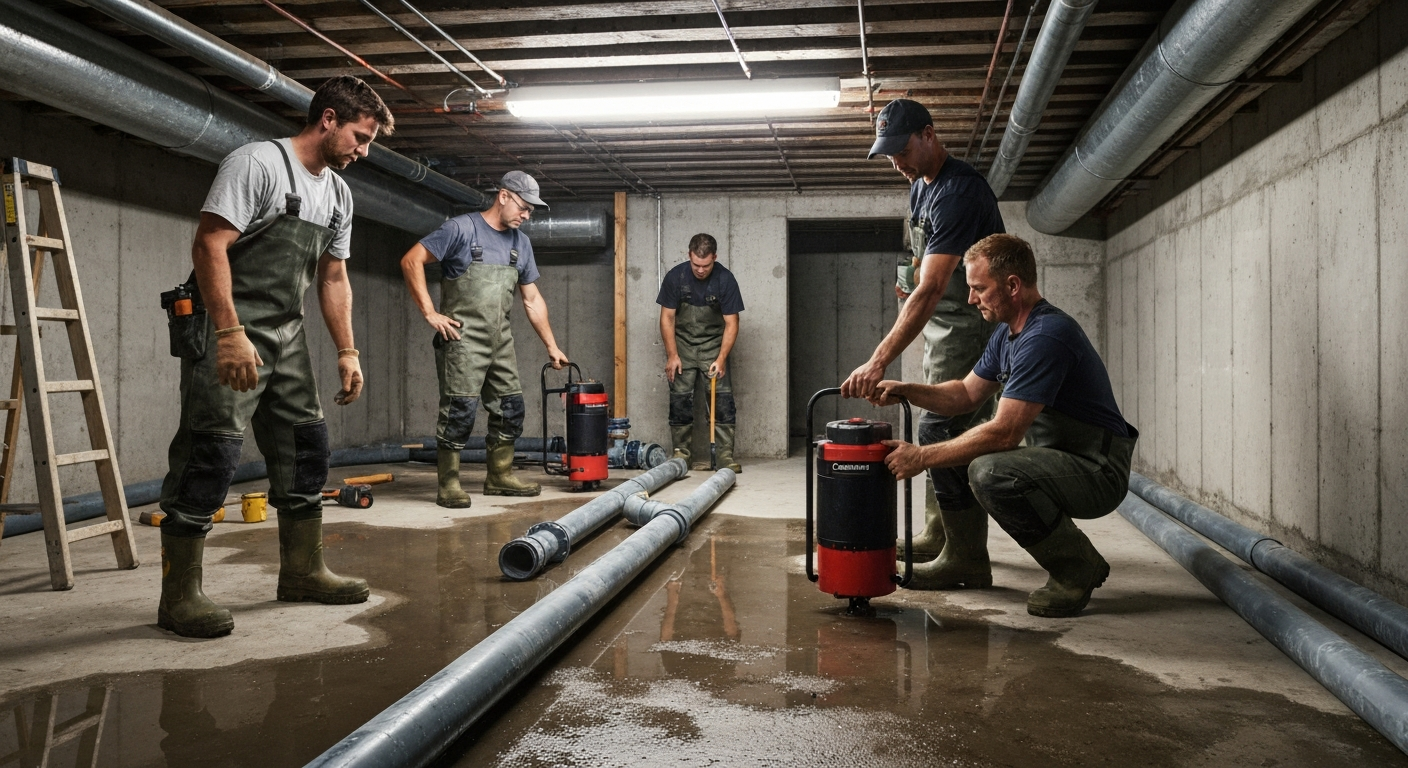
Basement waterproofing options and costs in Mayerthorpe
Mayerthorpe homeowners often start with a simple question: “Can this be fixed without digging everything up?” With 1,259 people in town (Statistics Canada, 2021 Census) and many homes being older—61.8% of dwellings were built before 1981 (Statistics Canada, 2021 Census)—the most common basement issues tend to be tied to aging drainage and freeze–thaw damage. In the Edmonton-area market, contractors see frequent failures of original weeping tile, clogged stone, and foundation joints that have widened over decades, especially after years of winter cycling.
Alberta’s freeze–thaw cycles matter for cost because small defects grow into active leaks: interior water can appear as wall dampness, floor-edge seepage, or recurring “cold room” moisture that returns each spring. At the same time, local soils and drainage behaviour drive how invasive a solution must be. In clay-heavy or silty pockets, excavation and drainage installation often cost more because staging, dewatering, and backfill compaction are more demanding; in slightly sandier lots, exterior work may be faster, but sump discharge still needs correct design. In Mayerthorpe, service demand is especially steady around older resale properties close to main access routes where landscaping removal and re-installation (shrubs, patios, or small driveways) increases labour.
Use the options below as a baseline for comparing quotes, then match the method to what’s actually causing water entry—before you decide between interior and exterior work.
| Method |
What It Addresses |
Disruption Level |
Durability |
Price Range |
| Exterior excavation + new membrane + drainage tile |
Hydrostatic pressure at the foundation wall; captures and drains groundwater away |
High (excavation, backfill, landscaping restoration) |
Long-term, source-control solution when done to spec |
$12,000–$25,000 |
| Interior perimeter drain channel + sump pit |
Water that has already entered; reduces wall seepage and floor-edge wetness |
Medium (interior excavation at perimeter, limited demolition) |
Very durable with correct discharge and pump maintenance |
$8,000–$18,000 |
| Foundation crack injection (epoxy or polyurethane) |
Fills and seals cracks to stop dampness (epoxy) or active leaks (polyurethane) |
Low to medium (minor interior wall prep/drilling) |
Good when crack type and pressure conditions match the product |
$600–$2,500 |
| Sump pump installation (primary + battery backup) |
Reliable discharge during heavy melt and power interruptions |
Low to medium (electrical work, sump pit and line routing) |
High when paired with backup and proper weeping tile connection |
$1,800–$3,800 |
| Window well drain installation |
Direct water entry at exterior window wells |
Low to medium (small exterior excavation and grading) |
Moderate to long-term if drainage daylighting is maintained |
$900–$2,200 |
| Lot re-grading / downspout extension |
Moves surface water away from the foundation to reduce ongoing wetting |
Low to medium (site grading, minor landscaping disruption) |
Moderate; best as a complement to drainage systems |
$900–$3,500 |
Prices are estimates only and vary by project scope, site access and material selection.
What affects the price of waterproofing in Mayerthorpe
It’s common to see quote differences of 30–50% for “the same basement leak” in the Edmonton region because waterproofing pricing is driven less by the word “waterproof” and more by how much excavation, drainage design, and repair scope is required to fix the site conditions. A contractor might propose interior perimeter drainage for symptom control, while another targets the source with exterior excavation and new drainage tile. Both can be correct—depending on soil saturation, foundation type, and whether hydrostatic pressure is actively pushing water inward.
In the Edmonton economic region, three local drivers separate regional costs from a national average: soil type, water table behaviour, and freeze–thaw. Clay-heavy and silty soils hold water and drain slowly, so lateral pressure increases on foundation walls when saturated. Freeze–thaw then widens joints and cracks each winter, increasing the need for crack repair and durable membranes or injection. In areas with higher perched water tables, sump pumps run longer and discharge infrastructure must be sized appropriately, which can push interior projects toward the higher end of the $8,000–$18,000 band. On properties with older housing stock—like many homes built before 1981 (Statistics Canada, 2021 Census)—failing weeping tile and degraded wall sealants are frequent, raising both labour and material time.
Concrete examples in Mayerthorpe: a poured-concrete basement with a single hairline crack and a clear seep pattern may only need epoxy crack injection plus improved downspouts, keeping scope near the $600–$2,500 band. By contrast, a block foundation with repeated wall dampness, floor edge seepage, and evidence of long-term moisture typically requires an interior drain channel and sump, making $8,000–$18,000 more realistic—especially if the existing discharge path is undersized or the discharge can’t daylight properly.
| Price Factor |
Why It Matters |
Cost Impact |
| Interior vs. exterior approach — interior is less disruptive but addresses symptoms |
Exterior targets source control; interior manages water after entry |
Often a $4,000–$12,000 swing depending on excavation and drainage needs |
| Foundation type — poured concrete vs. block vs. stone vs. ICF |
Crack behaviour and sealing method differ by wall construction |
Poured walls may suit injection; block may need more comprehensive drainage |
| Soil type — clay expands more than sand, adding pressure |
Clay retains water, increasing hydrostatic pressure on freeze–thaw cycles |
More protection and drainage design can move exterior projects toward the higher end |
| Crack type and length — hairline vs. structural horizontal cracks |
Structural cracks may indicate movement; treatment scope increases |
Can turn a repair into engineered remediation plus monitoring |
| Sump pump backup system — battery or water-powered backup needed |
Power interruptions during spring melt can lead to rapid re-wetting |
Typically adds cost within the $1,800–$3,800 sump scope range |
| Access — landscaping, decks, or driveways must be removed for exterior |
Demolition and restoration time is labour-intensive |
May increase excavation/disposal and re-installation costs |
| Weeping tile age — original tile (60+ years) may be completely failed |
Failed tile means water doesn’t route away even with membranes |
Replacement increases excavation and material quantity |
| Mould or efflorescence remediation required before sealing |
Moisture staining and salts affect adhesion and long-term performance |
Extra cleaning, drying time, and product steps before sealing |
Permits & regulations in Alberta
In Alberta, foundation excavation, structural crack repair, and changes to lot drainage typically require a building permit. If the work involves re-routing or connecting a sump discharge line to municipal storm or sanitary systems, that usually requires municipal approval as well. The key point for Mayerthorpe homeowners is to treat “waterproofing” and “drainage plumbing” as separate scopes in terms of permitting.
Work that typically does require a permit often includes: excavating around the foundation for exterior waterproofing, repairs that could be considered structural (for example, major horizontal cracks in block walls or signs of movement), and modifications to drainage patterns that affect how surface and subsurface water leaves the property. For structural crack repair, a structural engineer’s assessment is often needed to confirm whether injection alone is sufficient or whether underpinning/other measures are required.
Step-by-step, verify a contractor in Mayerthorpe like this:
- Ask for the contractor’s Alberta credentials (and the appropriate licensing/registration details for their business line) before signing anything.
- Request a current certificate of liability insurance—ensure it’s dated, includes the jobsite address, and lists the required coverages for your type of work.
- Confirm WSIB/WCB coverage (or the applicable coverage status) and ask for documentation.
- If structural repairs are proposed, confirm they have engineering support in writing (or that they will coordinate with an engineer).
- Verify who will pull permits and who is responsible for inspections, schedule, and compliance documentation.
- Look for a clearance letter or underwriting documentation when available for added confidence.
Don’t proceed until you’ve confirmed permitting responsibility and proof of coverage.
Interior vs exterior waterproofing — what does Mayerthorpe need?
Exterior waterproofing and interior waterproofing solve the problem in different ways. Exterior work—full excavation, new membrane, new drainage tile, and proper backfill—targets the source of water entry by relieving hydrostatic pressure against the foundation wall. It’s the most permanent approach when the site has clay-rich soils, slow drainage, or a history of failed weeping tile. The trade-off is higher cost and greater disruption: landscaping removal, disposal, backfill compaction, and restoration are often required.
Interior waterproofing—typically a perimeter drain channel, sump pit, and sump pump—manages water after it enters the basement. It doesn’t stop hydrostatic pressure from reaching the wall; instead, it captures seepage at the floor perimeter and reduces wall dampness and floor-edge wetness. In Mayerthorpe’s Edmonton-area freeze–thaw environment, interior systems are still very effective at preventing recurring moisture, especially when combined with reliable discharge and, where appropriate, crack injection.
Which approach fits Mayerthorpe most often? If you have a poured-concrete foundation with a moisture path tied to a few cracks, crack injection can complement either exterior or interior drainage. If you have block foundations with repeated dampness and evidence the weeping tile is failing, interior drainage is frequently the practical complement—particularly when excavation access is limited. For Alberta homes, sump pump backup systems are worth serious consideration because spring melt and freeze–thaw can overload primary pumps, and power interruptions can leave basements wet quickly. In terms of price justification: choosing interior perimeter drainage may land in the $8,000–$18,000 band, while full exterior excavation commonly sits in the $12,000–$25,000 range. Paying the higher exterior cost can be justified when your site is clay-heavy, drainage is poor, or you’re seeing repeated moisture that suggests active hydrostatic pressure—not just localized seepage.
| Method |
Best For |
Addresses Source? |
Disruption |
Lifespan |
Price Band |
| Full exterior excavation + membrane |
Clay-prone sites, persistent seepage, and recurring spring moisture |
Yes (source control) |
High |
Long-term when drainage tile and backfill are properly detailed |
$12,000–$25,000 |
| Interior French drain + sump system |
Basements with floor-edge seepage, damp walls, and limited exterior access |
No (captures water after entry) |
Medium |
Very durable with correct pump sizing and discharge routing |
$8,000–$18,000 |
| Crack injection — epoxy (structural) |
Hairline cracks in stable walls where water is not actively flowing under pressure |
Partially (seals the crack path) |
Low to medium |
Good with correct crack prep and appropriate conditions |
$600–$1,800 |
| Crack injection — polyurethane (active leak) |
Active leaks, dampness that returns quickly, and cracks with ongoing movement |
Partially (seals under wet conditions) |
Low to medium |
Good when matched to active-flow crack conditions |
$800–$2,500 |
| Interior drain channel only (no sump) |
Light seepage where gravity drainage and discharge are reliable |
No (captures water after entry) |
Medium |
Moderate; performance can drop if discharge pathway is inadequate |
$6,500–$12,000 |
| Re-grading + downspout extensions |
Surface-water problems and minor dampness near window wells or corners |
Yes (for surface water) |
Low to medium |
Moderate; best as a supplement to subsurface drainage |
$900–$3,500 |
How to choose a waterproofing contractor in Mayerthorpe
Choosing the right waterproofing contractor in Mayerthorpe starts with verifying the basics and then digging into the scope details. First, request proof of Alberta coverage and responsibilities: (1) licensing/registration information for the type of work they perform, (2) current liability insurance, and (3) WSIB/WCB status. The practical check: ask for your contractor’s certificate of insurance and confirm it matches the job location and coverage type; then ask for WSIB/WCB documentation and ensure it’s current. If a structural component is proposed (for example, major horizontal cracking), confirm they coordinate with engineering support rather than promising an injection-only fix.
Next, get 2–3 itemised written quotes. You want a labour and materials breakdown: excavation scope, drain material, membrane type, sump pump model (including backup), discharge line details, disposal and restoration. A good quote will also clearly state what’s excluded (for example, removing non-structural landscaping, restoring sod, or addressing pre-existing mould beyond surface cleanup). Ask whether permit pulling is included and whether they’re responsible for inspection scheduling.
Warranty matters: confirm the workmanship warranty length, the manufacturer warranty on membrane/pump components, and whether any warranty is transferable if you sell the home. For payment schedules, never pay more than 10–15% upfront—hold back a portion until key milestones are complete (and ideally until final grading/restoration). Finally, get a start date and completion estimate in writing so you’re not left guessing during freeze–thaw windows.
- Check licensing/registration details and the business name on all documents.
- Verify liability insurance dates and that the policy covers the work being proposed.
- Confirm WSIB/WCB coverage and request a clearance/coverage letter when available.
- Ask for the proposed pump model(s) and whether backup is included (not “maybe”).
- Require a written drainage plan: where the water goes, discharge method, and routing.
- Get product specs: membrane system, drain tile type, and sealant/injection type.
- Request an itemised quote (labour + materials) rather than a lump sum.
- Confirm permit pulling responsibility and list whether inspections are included.
- Clarify what disposal is included (excavated soil, broken concrete, demolition).
- Ask how they handle dewatering during exterior excavation.
- Ensure they describe drying time and cure times before sealing/injection.
- Read the warranty terms: workmanship length, exclusions, and transferability.
Common red flags I see in Mayerthorpe: (1) vague scopes like “we’ll waterproof the basement” without drainage discharge details, (2) quoting exterior excavation without addressing soil saturation and compaction/backfill quality, (3) skipping backup discussion where the existing system is undersized, (4) promising “structural crack injection” without assessing whether cracks are stable or require engineering, and (5) asking for large upfront payments without milestones or a written schedule.
Frequently asked questions — waterproofing in Mayerthorpe
How do I choose a waterproofing contractor in Mayerthorpe?
Start by verifying coverage and responsibility. In Alberta, you should ask for documentation for liability insurance and WSIB/WCB, and confirm the contractor can pull permits when required for excavation, drainage changes, or structural crack work. Then request 2–3 itemised quotes with a clear drainage plan: where the water comes from, where it goes, and how it’s discharged. For Mayerthorpe homes built before 1981 (Statistics Canada, 2021 Census), it’s especially important that the scope addresses aged weeping tile or clogged drainage routes, not just surface sealing. Finally, compare warranty terms: workmanship warranty length, manufacturer coverage on membrane/pumps, and whether warranties are transferable. If a quote is dramatically cheaper than others (or silently omits backup sump components), ask why.
What is a battery backup sump pump and do I need one in Mayerthorpe?
A battery backup sump pump is an additional backup power system that keeps the pump running during power interruptions. In Mayerthorpe and the broader Edmonton area, spring melt and freeze–thaw can drive heavy inflow, and even short outages can allow water to rise before normal power returns. A battery backup is most useful when you already have an active sump, when the basement sees recurring floor-edge seepage, or when the existing drainage path can’t handle a prolonged outage without overflowing. If you’re budgeting, sump pump installations with primary and battery backup typically fall within the $1,800–$3,800 band. If your contractor tries to “remove the backup option” without explaining your risk level and discharge capacity, that’s a gap worth correcting in writing.
How much does basement waterproofing cost in Mayerthorpe?
Basement waterproofing cost in Mayerthorpe depends on whether you’re controlling the source externally or managing water after it enters internally. Exterior excavation and drainage tile plus membrane work commonly runs $12,000–$25,000 because excavation, dewatering, and landscape restoration are included. Interior perimeter drain and sump systems are often in the $8,000–$18,000 range and can be more cost-effective when exterior access is limited. Crack repairs alone may be lower—foundation crack repair is commonly $600–$2,500—but only if the cracks match the right injection product and the wall is stable. The final price changes with soil and drainage behaviour (clay holds water longer) and with how much discharge piping and remediation is required. Always compare itemised scopes rather than headline totals.
Interior vs exterior waterproofing — which is better?
Neither option is universally “better”—they solve different parts of the moisture problem. Exterior waterproofing is best when you need source control: full excavation, membrane, and new drainage tile relieve hydrostatic pressure so water is captured before it reaches the wall. Interior waterproofing is best when you want to manage water after entry: a perimeter drain channel and sump reduce wall dampness and floor-edge seepage without requiring full excavation. In Mayerthorpe’s Edmonton-area freeze–thaw conditions, interior systems perform well when paired with correct pump sizing and reliable discharge. For poured-concrete walls, crack injection can complement either approach; for block foundations with recurring seepage, interior drainage often becomes the practical complement, especially if excavation is difficult. If you’re choosing based on cost alone, compare the typical bands: interior projects may be closer to $8,000–$18,000, while exterior can be $12,000–$25,000 when source control is required.
Why is my basement leaking in Mayerthorpe?
Most basement leaks in Mayerthorpe come from a combination of site drainage and winter conditions. In clay-heavy or silty soils, water can stay near the foundation for longer periods, and as temperatures cycle below and above freezing, expanded moisture and movement can widen cracks and joints. Many homes in the area are older (61.8% built before 1981), so original weeping tile or perimeter drainage may be partially failed or clogged, meaning water doesn’t route away effectively. Common signs include wall dampness that reappears each spring, floor-edge wetness near corners, or localized seepage around older window wells. If you have mould or efflorescence, it can indicate persistent moisture rather than a one-time event. A proper assessment—observing seep paths, checking discharge routing, and identifying foundation type—helps determine whether the fix should be exterior source control, interior drainage, or crack repair plus drainage improvements.
How do I know if a foundation crack is serious?
In Mayerthorpe, not every crack is a “structural emergency,” but seriousness depends on crack type, location, and whether it’s active. Hairline cracks in poured concrete that don’t show signs of movement are often treatable with appropriate injection after surface prep. However, structural concerns are more likely with major horizontal cracks in block walls, step cracking that progresses, or cracks with differential movement indicators (for example, doors/windows that have suddenly stopped fitting square). Freeze–thaw can widen smaller defects over time, so cracks that are dry in summer but leak during spring melt suggest pressure-driven seepage. Ask a contractor to document crack length, width, and whether water is actively passing through. If they propose structural-level work, they should coordinate engineering assessment and ensure the scope matches permit requirements. Getting the right diagnosis is what determines whether you’re looking at a $600–$2,500 crack repair scope or a more comprehensive drainage plan.