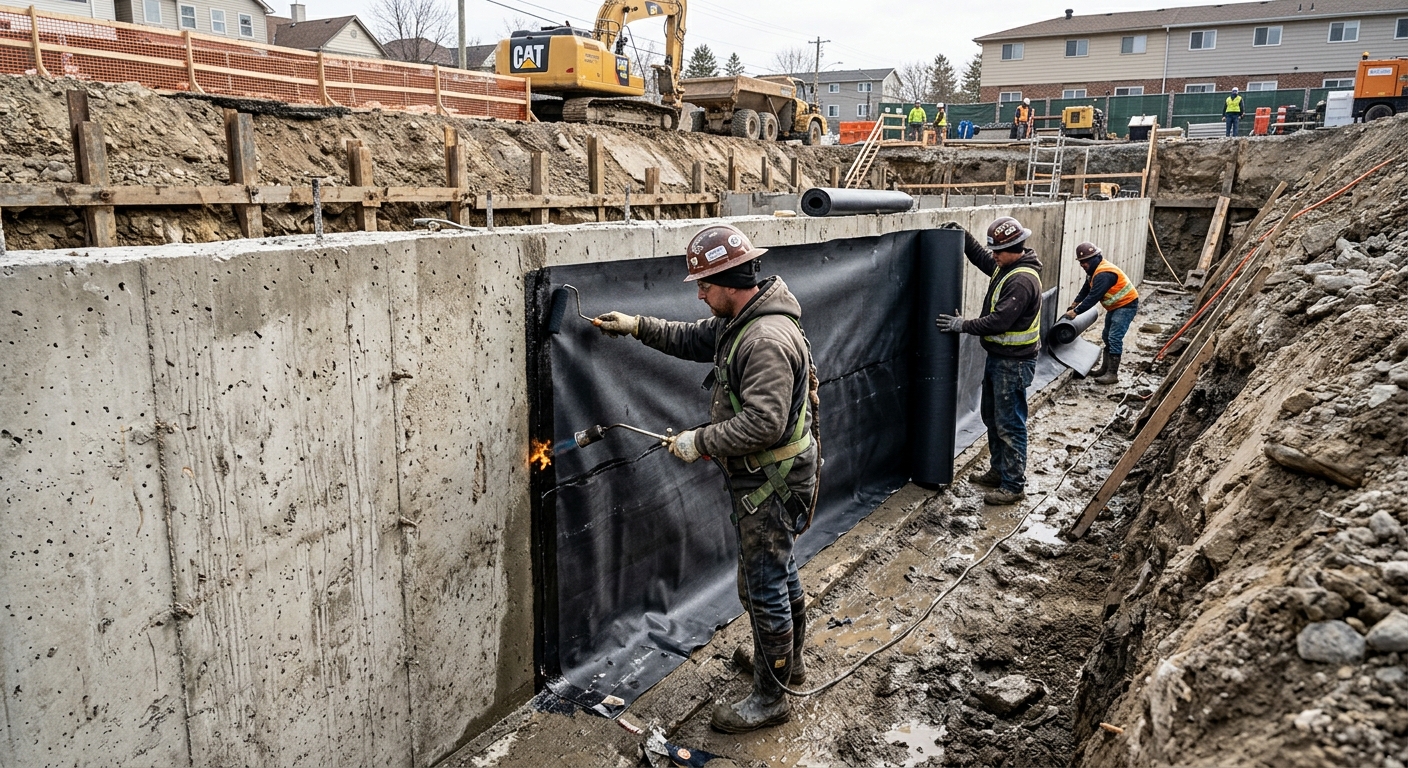
Basement waterproofing options and costs in Beaumont
Basement waterproofing in Beaumont, Alberta is usually about managing water pressure from clay-rich soils and freeze–thaw expansion, not just “drying out” a damp corner. With 20,888 people in the community and 6,060 homeowner households (Statistics Canada, 2021 Census), many residents are choosing to protect resale value by addressing chronic seepage before it damages finishings. Beaumont’s housing mix matters: 11.9% of homes were built before 1981 (Statistics Canada, 2021 Census), and older foundations are more likely to have failing original waterproofing details (weeping tile, tar/membrane systems, and drainage slopes) that can’t keep up once they clog or corrode.
In the Edmonton region, pricing is strongly influenced by how much excavation is needed, how saturated soils are during spring melt, and how long a crew can safely work around trees, fences, driveways, and infill lot grading. Freeze–thaw cycles in Alberta can widen dormant cracks each winter, increasing labour for prep and crack cleaning. That’s why two homes with the same visible dampness can land in different price bands: one may need a quick sump upgrade, while another needs full perimeter excavation and a new drainage system to stop hydrostatic pressure from returning.
In Beaumont, trade demand is especially common in older established pockets near the commuter routes toward Edmonton, where many basements see wall dampness, floor edge seepage, and periodic sump discharge. Below is a practical way to compare typical methods and what homeowners usually spend, then you can match the option to your symptoms in the comparison table.
| Method |
What It Addresses |
Disruption Level |
Durability |
Price Range |
| Exterior excavation + new membrane + drainage tile |
Stops water at the foundation exterior; new drainage relieves hydrostatic pressure |
High (excavation, landscaping disruption) |
Long-term (typically 25+ years with proper install) |
$12,000–$25,000 |
| Interior perimeter drain channel + sump pit |
Captures seepage after it enters; manages water safely to a sump |
Medium (interior demolition at perimeter) |
Good-to-long-term (often 15–25 years depending on discharge) |
$8,000–$18,000 |
| Foundation crack injection (epoxy or polyurethane) |
Seals cracks; epoxy for stable cracks, polyurethane for active leaks |
Low-to-medium (access, drilling/cleaning) |
Variable (strong when crack movement is addressed) |
$600–$2,500 |
| Sump pump installation (primary + battery backup) |
Prevents overflow during heavy spring melt and power interruptions |
Low-to-medium (pit + minor piping) |
Good with proper backup and discharge maintenance |
$1,800–$3,800 |
| Window well drain installation |
Controls water around window wells that can funnel toward the foundation |
Medium (excavation at wells) |
Good (site drainage dependent) |
$1,200–$3,200 |
| Lot re-grading / downspout extension |
Moves surface water away so it doesn’t saturate soils around the wall |
Low-to-medium (equipment and restoration) |
Medium (needs maintenance over time) |
$900–$2,400 |
Prices are estimates only and vary by project scope, site access and material selection.
What affects the price of waterproofing in Beaumont
In Beaumont and across the Edmonton region, waterproofing quotes for “the same” problem can vary by 30–50% because contractors price for site conditions and scope, not just the visible symptom. Two basements can both have damp concrete, yet one may be experiencing blocked weeping tile and high lateral pressure, while the other has surface water running toward a window well with minimal wall involvement. Labour rates, excavation effort, and how much material replacement/disposal is required are also big drivers in a market where crews are busiest in the shoulder seasons.
The three most important factors that separate local costs from the national average are soil type, water table behaviour, and freeze–thaw cycles. Clay-heavy and silty soils common around Edmonton hold water longer, so backfill stays saturated and exerts pressure against foundation walls. During Alberta freeze–thaw cycles, small cracks and joints widen each winter, meaning more drilling, more prep, and sometimes a shift from “seal and monitor” to “seal plus manage movement.” In high-water situations, sump pump run times increase and discharge pathways must be engineered carefully—often lifting a project from the lower end toward the higher end of interior or exterior ranges (for example, interior perimeter drainage commonly lands in the $8,000–$18,000 band, while exterior excavation tends to run $12,000–$25,000).
Concrete examples from Beaumont: (1) A home on saturated clay with long-term floor edge seepage often needs an interior perimeter drain plus sump discharge improvements, raising costs due to higher excavation in finished basements. (2) A resale in an older neighbourhood with pre-1981 construction details may have weeping tile that has failed for decades; reopening strategy changes and costs rise because the wall must be treated as an ongoing entry point. (3) If downspouts are discharging near the foundation or grading has sunk, re-grading can reduce the workload—sometimes keeping the job in the lower end of the interior/outlet-focused approach.
| Price Factor |
Why It Matters |
Cost Impact |
| Interior vs. exterior approach — interior is less disruptive but addresses symptoms |
Exterior stops water at the source; interior captures it after entry |
Interior can be 30–60% less costly, but only if the drainage strategy matches the water source |
| Foundation type — poured concrete vs. block vs. stone vs. ICF |
Crack patterns, joint types, and sealing performance differ by system |
Poured concrete often supports more reliable crack sealing; block and stone may require interior drainage add-ons |
| Soil type — clay expands more than sand, adding pressure |
Clay holds water and expands when saturated, increasing lateral pressure |
Higher saturation can push exterior work toward the upper range and increase sump capacity requirements |
| Crack type and length — hairline vs. structural horizontal cracks |
Movement determines whether injection will last and whether engineering is needed |
Structural or extensive cracking can expand scope beyond typical crack injection |
| Sump pump backup system — battery or water-powered backup needed |
Power interruptions during spring melt can overwhelm a single pump |
Backup adds cost, but reduces risk of overflow and rework |
| Access — landscaping, decks, or driveways must be removed for exterior |
Excavation logistics directly affect labour and restoration |
Heavy access constraints can raise exterior budgets substantially |
| Weeping tile age — original tile (60+ years) may be completely failed |
Old tile can be clogged or collapsed, forcing full replacement strategy |
Replacement increases excavation time and materials; often moves projects toward exterior upper pricing |
| Mould or efflorescence remediation required before sealing |
Sealing over contaminated surfaces can trap moisture and worsen odours/staining |
Surface remediation adds labour and materials before waterproofing can proceed |
Permits & regulations in Alberta
In Alberta, certain waterproofing-adjacent work may require a building permit, especially when it involves foundation excavation, structural crack repair, or changes that affect how water drains on your property. Typically, the work that often requires a permit includes: excavation of around the foundation perimeter, repairs that could involve structural elements (for example, significant foundation crack repairs in block walls or major horizontal crack locations), and modifications to lot drainage that change how storm water is managed. If your plan includes reconnecting or routing sump discharge toward storm or sanitary infrastructure, municipal approval is commonly required before a contractor connects anything to sewer systems.
For suspected structural cracking—such as horizontal cracks in concrete block walls, stair-step cracking that indicates movement, or cracks that have changed—an assessment by a structural engineer is often required to confirm whether underpinning or other structural remediation is necessary. Make sure the contractor can support that scope with proper documentation.
To verify a contractor in Beaumont step-by-step: (1) Ask for their Alberta business/company registration and confirm they are licensed where applicable for the type of work being performed. (2) Request a certificate of insurance showing general liability (and include the job address as an insured location if available). (3) Request WSIB/WCB coverage clearance for the company and confirm the policy is active and current. (4) For any structural assessment, ask whether they coordinate engineering support and can provide the engineer’s report references where needed. Finally, don’t sign until you’ve received a written scope that matches what you discussed.
Interior vs exterior waterproofing — what does Beaumont need?
The fundamental difference is whether you address water at its source or manage it after it enters the basement. Exterior waterproofing means full excavation, new membrane, new drainage tile, and backfill. It is the most permanent method because it relieves hydrostatic pressure before water reaches the wall, but it costs more and requires landscape disruption. Interior waterproofing—commonly a perimeter drain channel with a sump pit and sump pump—manages water after entry by capturing seepage and discharging it safely away.
For Beaumont homes, the “right” choice often depends on soil saturation and whether the foundation wall is likely being pressured by a persistent groundwater or perched water condition. Clay-rich soils around the Edmonton area tend to stay wet longer, which can make exterior systems worth it when seepage is widespread or when the original weeping tile system has clearly failed. In basements with localized dampness or single-source entry (like a window well or a section of wall affected by grading), interior strategies are frequently the better value because they reduce disruption while still controlling water.
Foundation type also influences the plan. Poured concrete walls generally respond well to targeted crack injection (especially when cracks are stable), but block foundations often need interior drainage as a practical complement because joints and mortar can allow moisture pathways even after surface sealing. And because Alberta spring melt and freeze–thaw can stress pumps, adding a sump pump backup system is a smart risk-control step rather than an optional extra.
Cost justification example: if exterior excavation is estimated at $12,000–$25,000 because full perimeter drainage tile replacement is required, but your issue is confined to floor edge seepage around one corner, an interior perimeter drain and sump solution may realistically fit in $8,000–$18,000. The difference is justified when exterior work would be more about restoring yard access and demolition than about fixing the true water pathway.
| Method |
Best For |
Addresses Source? |
Disruption |
Lifespan |
Price Band |
| Full exterior excavation + membrane |
Widespread seepage, failed weeping tile, high lateral pressure |
Yes (source control) |
High (yard, grading, backfill restoration) |
25+ years |
$12,000–$25,000 |
| Interior French drain + sump system |
Chronic seepage, finished basements where exterior excavation is limited |
No (controls water after entry) |
Medium (perimeter interior work) |
15–25 years |
$8,000–$18,000 |
| Crack injection — epoxy (structural) |
Stable cracks without active leak during test |
Partially (seals the entry path in the crack) |
Low-to-medium |
10–20 years (depends on movement control) |
$600–$2,500 |
| Crack injection — polyurethane (active leak) |
Active leaks and water weeping through cracks |
Partially (seals active pathways) |
Low-to-medium |
10–20 years (often strong when paired with drainage) |
$800–$2,900 |
| Interior drain channel only (no sump) |
Light dampness where gravity discharge is feasible |
No |
Low-to-medium |
5–15 years (site-dependent) |
$2,500–$7,000 |
| Re-grading + downspout extensions |
Surface water issues, minor seepage near perimeter |
Yes (reduces surface source) |
Low-to-medium |
5–10 years (maintenance dependent) |
$900–$2,400 |
How to choose a waterproofing contractor in Beaumont
Choosing the right contractor in Beaumont starts with proof: Alberta licensing where applicable, liability insurance, and WSIB/WCB coverage for the company and workers. Ask for documents before you compare prices. Then request 2–3 itemised written quotes that show labour and materials separately (not a single lump sum) so you can tell whether the scope includes prep, excavation, drainage tile, disposal, and interior restoration.
Read the scope carefully and confirm what is excluded. For example: is permit pulling included where required, and who submits the paperwork? Is excavation spoil disposal included, or is it an add-on? Is the contractor replacing damaged weeping tile sections or only “clearing” them? Does the price include backfill compaction, base prep, and waterproof coating or membrane, or only the waterproofing material? A contractor should also specify products, not just methods.
Warranty matters too: look for a workmanship warranty length and what it covers (for instance, labour to re-open and rework drains if the system fails). Ask for the product/manufacturer warranty details and whether it’s transferable to you as a homeowner. Payment scheduling is another reliability signal: never agree to pay more than 10–15% upfront, and hold back a portion until after final completion and key performance testing (for example, sump discharge and verification of drainage routing).
Finally, get the timeline in writing: a start date, a completion target, and what happens if weather delays work during freeze–thaw season. Waterproofing quality is tightly connected to preparation and proper curing windows.
- Confirm Alberta credentials and whether any specialized permits are required for your specific scope
- Ask for a current certificate of liability insurance (and ensure it covers the job site address if possible)
- Verify WSIB/WCB coverage with clear clearance info for the contractor and crew
- Get 2–3 itemised quotes with labour + material breakdowns (no vague “allowances”)
- Ensure the scope lists excavation depth, drainage tile type, and where discharge goes
- Confirm whether disposal of excavated soil is included in the quoted price
- Ask what prep is included before sealing (pressure wash, crack cleaning, surface drying)
- Request details on backfill compaction and drainage bedding for exterior work
- Ask about sump pump model, float switch settings, and discharge pipe routing
- If cracks are involved, confirm the testing approach (active leak vs stable crack) and injection material type
- Review warranty terms in writing: workmanship duration, exclusions, and transferability
- Set a payment schedule with a holdback and avoid large upfront deposits
Red flags in Beaumont: (1) no written scope, (2) “one-size-fits-all” promises like guaranteed dryness without assessing soil/water entry, (3) offering a waterproofing solution without specifying the crack injection type (epoxy vs polyurethane) when active leakage is present, (4) skipping sump backup discussion despite Alberta spring melt and outages, and (5) requesting full payment upfront or refusing to provide insurance/WSIB/WCB documentation.
Frequently asked questions — waterproofing in Beaumont
Interior vs exterior waterproofing — which is better?
In Beaumont, exterior waterproofing is usually the best “source control” option when water pressure is coming from saturated soils against the foundation. Full excavation with a new membrane and drainage tile typically runs in the $12,000–$25,000 band, but it’s built to relieve hydrostatic pressure before water reaches the wall. Interior waterproofing is often the better choice when the leak is more localized, when there are limits on excavation, or when you’re managing seepage after entry with a perimeter drain and sump system. That option commonly fits within $8,000–$18,000. If your cracks are stable and localized, crack injection can help too, but it should be paired with drainage strategy to prevent re-wetting.
Why is my basement leaking in Beaumont?
Basement leaks in Beaumont are usually triggered by a combination of soil saturation and how water moves toward the foundation. Clay-heavy and silty soils around the Edmonton area hold water longer, and freeze–thaw cycles can expand existing cracks and joints each winter, turning minor seepage into ongoing dampness. If your weeping tile is clogged or failed (common in older homes), water can back up and migrate through weak points like mortar lines, wall cracks, or floor edges. Surface water problems also matter: downspouts that discharge near the foundation or grading that has sunk can keep the backfill saturated. The most effective fixes are the ones matched to the entry point—wall seepage often needs drainage and capture, while window well issues may start with grading and targeted drainage upgrades.
How do I know if a foundation crack is serious?
A crack is more concerning when it shows signs of movement or structural involvement. In Alberta basements, watch for horizontal cracks in block walls, widening cracks over multiple seasons, or stair-step cracks that keep shifting. Also consider the context: if cracking is paired with active water seepage, efflorescence, or water staining that returns after spring melt, the crack may be functioning as an entry pathway. Hairline, dry cracks that don’t grow over time can be candidates for crack sealing, but you still want the contractor to confirm whether it’s stable. A practical approach is to document crack width over time and do dye/water tests (performed safely by pros) so the contractor can choose epoxy for stable cracks or polyurethane for active leaks rather than guessing.
How much does foundation crack repair cost in Beaumont?
In Beaumont, foundation crack repair cost typically depends on whether you’re sealing a stable crack or stopping an active leak, plus the total length and the need for surface prep. For many homeowners, crack injection commonly falls within $600–$2,500, with the final number moving based on drilling/porting labour and whether additional remediation is needed first (like removing mineral deposits or addressing minor spalling). If the contractor determines the crack is active and recommends polyurethane injection, pricing can trend toward the upper part of the range. If the crack is associated with structural movement, the conversation may expand to engineering assessment and potentially underpinning—those projects are not “small repairs” anymore. That’s why getting an itemised scope and crack material selection up front matters.
Do I need a sump pump in Beaumont?
You may need a sump pump when your basement has seepage that collects below the perimeter drain level, when there’s a pattern of water returning during spring melt, or when a drainage system requires reliable discharge. In Alberta’s freeze–thaw conditions, water can also re-freeze and stress piping and joints, so having a controlled discharge route reduces overflow risk. If your interior drainage design includes a sump pit, sump pump installation often falls in the $1,800–$3,800 band. Many homeowners add battery backup because power interruptions can occur during heavy weather or grid events. If your issue is only minor surface dampness that dries quickly, you might not need a sump—re-grading and correcting downspout discharge could solve it. The key is matching the pump to the water entry and the discharge strategy.
How does Beaumont's soil affect my foundation?
Soil plays a major role in how basements behave in Beaumont. Much of the Edmonton-area region is clay-rich or silty, which tends to hold water and drain slowly. When the backfill stays saturated, it can exert lateral pressure on foundation walls and push moisture through cracks and joints. During Alberta freeze–thaw cycles, that saturated soil can expand when it freezes, worsening existing imperfections and increasing seepage during thaw periods. Homes built before 1981 may be more vulnerable because older weeping tile and drainage details were not always designed for today’s conditions or later changes in grading and landscaping. If you’re seeing dampness that returns after snowmelt or prolonged rain, soil saturation is often a root cause, and the correct solution usually includes both capture (drains/sump) and relief (surface drainage improvements and, when warranted, exterior drainage tile replacement).